
The William Henry Letters
Abby Morton Diaz
THE CLASSIC COLLECTION · 1911
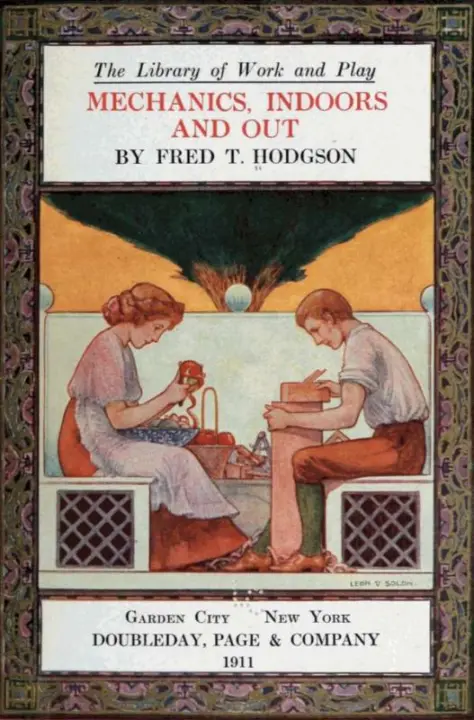
"The Library of Work and Play: Mechanics, Indoors and Out" by Fred T. Hodgson is a practical guidebook written in the early 20th century. The book focuses on the principles of mechanics and hands-on projects suitable for children, emphasizing the learning of practical skills through engaging activities and construction. It likely aims to inspire a sense of curiosity about mechanics and offers invaluable guidance for aspiring young builders. The opening of the book introduces us to the Gregg family, particularly focusing on siblings Fred, Jessie, and George, who are eager to make improvements on their newly acquired property by the Passaic River. The excitement begins with Jessie's wish for their father to secure the land, leading to discussions about building a cement pathway, a boat house, and eventually a gasoline launch. As their father involves them in the planning and execution of these projects, the family engages in various practical tasks, employing rudimentary mechanical principles such as leverage and teamwork to overcome obstacles and construct their dreams. Overall, the beginning sets the stage for a delightful exploration of mechanics through meaningful projects.
Introduction adapted from the source catalogue; source summaries may be automatically generated.
Free to read · English · 85,003 words · No account needed
MAKE TIME FOR A GOOD BOOK
On by default. Untick to stop anonymous reading totals. Each page counts after 10 seconds in view. How this works.
Anonymous counting is on unless you have switched it off.
4. The shape, consequently, at once denotes whether a flag is that of a club, a flag officer, or a member.
5. The majority of flag officers' signals are coloured: Blue for commodore, red for vice-commodore, and white for rear-commodore.
6. The international code of signals enables yachts to communicate with each other, and is also used for dressing ship.
The ensign should be flown from the peak of the main-sail on a sailing yacht, when under way, and from a stern flag pole when moored.
On a yawl, it should be hoisted at the mizzen truck.
On a steamer, launch, or dinghy, it should be flown from a stern flag pole, when under way or at anchor.
Club Burgee.--The burgee should measure in length about one-half inch for each foot of height of truck from the water; width to be two-thirds of the length. Private signals may be smaller.
The burgee should be flown from the mast-head or truck of a cutter, sloop, or cat-rigged yacht, the main truck of a yawl, the fore truck of a schooner and steamer, and from the bow pole of a launch or dinghy.
Flag officers' and private signals should be flown from the truck of a cutter, sloop, or cat-rigged yacht, the main truck of a schooner, yawl, or steamer, and from the bow pole of a launch or dinghy.
The following flags are not considered as colours:
Night Pennant (blue).--Is hoisted at the main truck from sundown to 8 A. M.; also occasionally used as a tell-tale when racing or sailing.
Owner's Absent Flag (blue rectangular).--Is flown from the main starboard spreader when yacht is at anchor only. It denotes owner is not on board, but should never be flown when under way.
Owner's Meal Flag (white rectangular).--Is flown from the main starboard spreader, and denotes the owner is at meals--boarding a yacht when this flag is flying is considered bad form.
Crew Meal Flag (red triangular).--Is flown from the foreport spreader on schooners and main-port spreader on single-masted yachts. This denotes that the crew is at meals.
The Ensign.--Displayed on a vessel indicates distress and want of
assistance.
Flag "B," of the International Code of Signals, is used for a protest flag, and is conspicuously displayed in the rigging of a yacht protesting during a race.
A yacht, on withdrawing from any race, should at once lower its racing colours, and allow yachts still competing the right of way.
This code was studied by the boys until both of them thoroughly understood its full meaning, and George became so enthusiastic over it that he exclaimed: "Fred, I am going to be an admiral of the navy!"
Your reading position is saved on this browser. Take it to another device with a library code. Reading pages adapt to text, rather than matching a printed edition.
BEHIND THE BOOK
This eBook is for the use of anyone anywhere in the United States and most other parts of the world at no cost and with almost no restrictions whatsoever. You may copy it, give it away or re-use it under the terms of the Project Gutenberg License included with this eBook or online at www.gutenberg.org. If you are not located in the United States, you will have to check the laws of the country where you are located before using this eBook. Read the source licence.
The original source file, including credits and licence, is retained by this library. Request an original-format copy at no charge. Please include the book title and Project Gutenberg identifier #45083.
KEEP YOUR CURIOSITY GOING
Abby Morton Diaz
Helen Hunt Jackson
Mary Frances Blaisdell
Stuart Dodgson Collingwood

Kate Douglas Smith Wiggin
Hesba Stretton