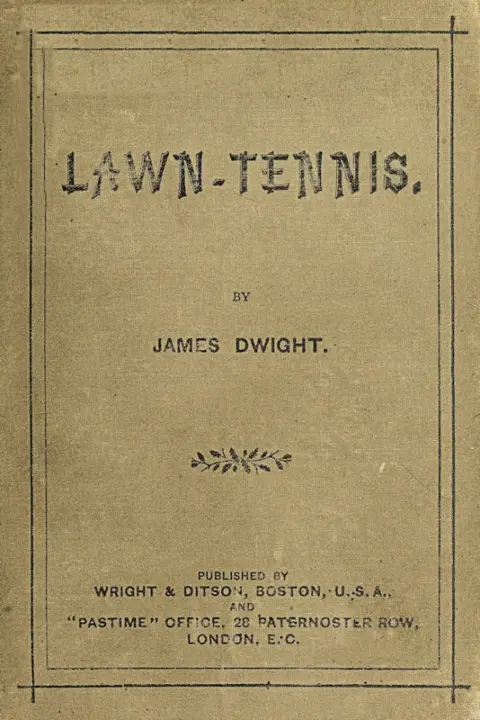
Lawn-tennis
James Dwight
THE CLASSIC COLLECTION · 1888
"The Laws of Euchre" by Herbert Corey Leeds and James Dwight is a scientific publication on the rules of the card game Euchre, written in the late 19th century. The book serves to standardize the myriad of rules that different players and groups have adopted over time. Its primary focus is on providing a comprehensive set of laws to ensure that the game is played fairly and consistently among experienced players. The book details the specific rules that govern gameplay, scoring, cutting, dealing, and various gameplay scenarios in Euchre. It includes precise descriptions of rules such as the rubber, scoring methods, misdeals, revokes, and guidelines for playing alone, among other game mechanics. Additionally, the authors provide general remarks and strategic advice tailored for players at different positions at the table, illustrating the nuances of strategic play and etiquette. By compiling these laws and recommendations, Leeds and Dwight aim to enhance the enjoyment and competitive nature of Euchre for both novice and seasoned players.
Introduction adapted from the source catalogue; source summaries may be automatically generated.
Free to read · English · 9,016 words · No account needed
MAKE TIME FOR A GOOD BOOK
On by default. Untick to stop anonymous reading totals. Each page counts after 10 seconds in view. How this works.
Anonymous counting is on unless you have switched it off.
If your partner adopts the turn-up without your assistance, and you hold queen, seven; ten, eight, etc., in trumps, ruff as early as possible with the big one, and lead the small one.
If you take the first trick in suit, and your partner throws away, do not lead the suit he has shown, even if you have the ace of it.
If your partner turn down black, make it red if you can, especially if he has turned down the bower.
When playing second to a small card, do not ruff with right alone if it is the first trick. Ruff with left alone, especially with your partner's make or adoption.
If your partner refuses to adopt the turn-up, and the third hand declares to play alone, lead a card of the same suit as the turn-down.
With one small trump, ruff as soon as you can.
Do not finesse in lay cards.
It requires a stronger hand to order or make the trump in this position than in the eldest hand, since you cannot depend upon your partner's lead, and he has displayed weakness by passing.
However, if you have a good hand at the turn-up, and are very strong at next, it is better to order, since the stronger you are at next, the greater the improbability that your partner will be able to make it next.
It is wise to see your way absolutely clear to three tricks before
ordering the right.
There are certain hands, however, which by their strength compel you to order,--the right not being turned; and here are most of them.
Order with four trumps.
two bowers and another.
two bowers and outside ace.
three trumps and two aces.
three trumps and one suit, headed by ace.
right, ace, and another.
left, ace, king, and outside ace.
left, ace, king, and one suit.
left, ace, king, dependent upon the score.
left, king and another, and outside ace.
left, queen and another, and outside ace.
Order with ace, king and another, and outside ace.
If you ruff, it is usually well to beat the turn-up.
Take up three trumps.
right and ace.
right and king
right and queen.
right and another, and one suit.
right, another, and outside ace.
left, ace, and outside ace.
left, another, outside ace; and king, queen of the third suit.
ace, king, and one suit headed by ace; dependent upon score.
two trumps and two aces.
With the score at four-all or four-love in his favor, the dealer may
play a lighter hand than any mentioned above, especially if it is his
best.
Your reading position is saved on this browser. Take it to another device with a library code. Reading pages adapt to text, rather than matching a printed edition.
James Dwight
BEHIND THE BOOK
This eBook is for the use of anyone anywhere in the United States and most other parts of the world at no cost and with almost no restrictions whatsoever. You may copy it, give it away or re-use it under the terms of the Project Gutenberg License included with this eBook or online at www.gutenberg.org. If you are not located in the United States, you will have to check the laws of the country where you are located before using this eBook. Read the source licence.
The original source file, including credits and licence, is retained by this library. Request an original-format copy at no charge. Please include the book title and Project Gutenberg identifier #20506.
KEEP YOUR CURIOSITY GOING

Charles G. (Charles Griffith) Ross
Hannah Webster Foster

Emily Lawless
Edwin Hamlin Carr

Charles De Lano Hine
Andrew Ure