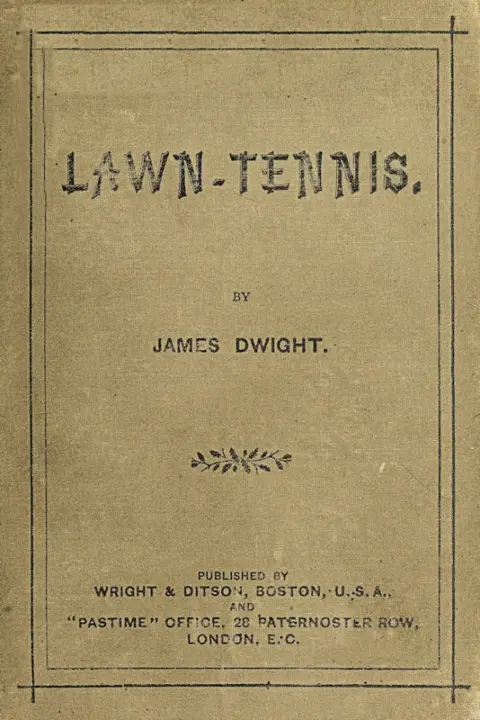
Lawn-tennis
James Dwight
THE CLASSIC COLLECTION · 1888
"The Laws of Euchre" by Herbert Corey Leeds and James Dwight is a scientific publication on the rules of the card game Euchre, written in the late 19th century. The book serves to standardize the myriad of rules that different players and groups have adopted over time. Its primary focus is on providing a comprehensive set of laws to ensure that the game is played fairly and consistently among experienced players. The book details the specific rules that govern gameplay, scoring, cutting, dealing, and various gameplay scenarios in Euchre. It includes precise descriptions of rules such as the rubber, scoring methods, misdeals, revokes, and guidelines for playing alone, among other game mechanics. Additionally, the authors provide general remarks and strategic advice tailored for players at different positions at the table, illustrating the nuances of strategic play and etiquette. By compiling these laws and recommendations, Leeds and Dwight aim to enhance the enjoyment and competitive nature of Euchre for both novice and seasoned players.
Introduction adapted from the source catalogue; source summaries may be automatically generated.
Free to read · English · 9,016 words · No account needed
MAKE TIME FOR A GOOD BOOK
On by default. Untick to stop anonymous reading totals. Each page counts after 10 seconds in view. How this works.
Anonymous counting is on unless you have switched it off.
72. Any player (on paying for them) before, but not after, the pack is cut for the deal, may call for fresh cards. He must call for two new packs, of which the dealer has the choice.
73. A card or cards torn or marked must be replaced by agreement, or new cards called for at the expense of the table.
74. The trump card having been turned, the eldest hand may pass, order up, or play alone; in either of the last two cases the third hand may take it from him and play alone.
75. Should the eldest hand pass, the second hand may pass, assist, or play alone; in either of the last two cases the dealer may take it from him and play alone.
76. Should the second hand pass, the third hand can pass, order up, or play alone; and after him the dealer must pass, take up the trump, or play alone.
77. Should all four players pass, the trump is turned down, and the first hand can name a suit, or pass; and so on in turn around the table. Should all pass again, the deal is at an end, and the next player deals.
78. Should the player entitled to make a trump name a suit, he cannot change; and should he name the suit turned down, he is considered to have passed.
79. Should the player, after naming the suit turned down, or passing, mention the suit he intended to make trumps, his partner also must pass.
80. Should a player pass, and then attempt to assist, or order up the trump, his partner also must pass. The adversaries, however, may elect that it shall be played.
81. Should a player make a declaration, and his partner not hear it and pass, the declaration is not invalidated.
82. No player can take away another's right by passing, ordering up, or assisting, out of turn; but should the dealer turn down the trump card, or on the second round throw his cards on the table, such action is binding on his partner.
83. If any one, prior to his partner's playing, should call attention to the trick either by saying that it is or is not his, or by naming his card or by drawing it without being asked to do so, or call on his partner to take or not to take the trick, the adversaries may require that opponent's partner to play his highest or lowest of the suit led, or to win or lose the trick.
Your reading position is saved on this browser. Take it to another device with a library code. Reading pages adapt to text, rather than matching a printed edition.
James Dwight
BEHIND THE BOOK
This eBook is for the use of anyone anywhere in the United States and most other parts of the world at no cost and with almost no restrictions whatsoever. You may copy it, give it away or re-use it under the terms of the Project Gutenberg License included with this eBook or online at www.gutenberg.org. If you are not located in the United States, you will have to check the laws of the country where you are located before using this eBook. Read the source licence.
The original source file, including credits and licence, is retained by this library. Request an original-format copy at no charge. Please include the book title and Project Gutenberg identifier #20506.
KEEP YOUR CURIOSITY GOING

Charles G. (Charles Griffith) Ross
Hannah Webster Foster

Emily Lawless
Edwin Hamlin Carr

Charles De Lano Hine
Andrew Ure