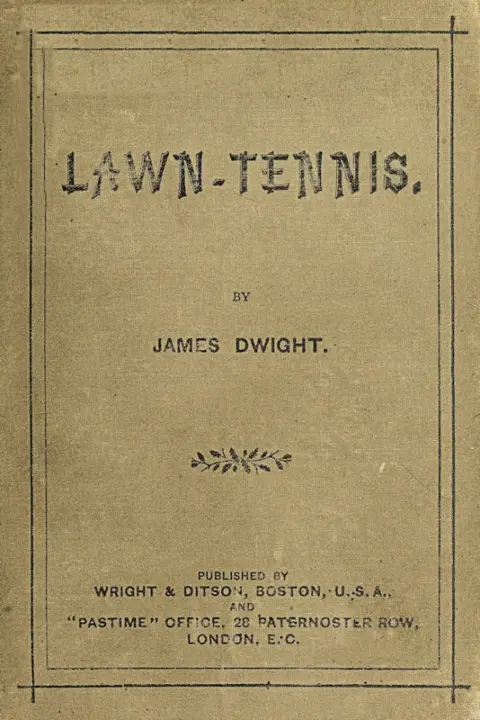
Lawn-tennis
James Dwight
THE CLASSIC COLLECTION · 1888
"The Laws of Euchre" by Herbert Corey Leeds and James Dwight is a scientific publication on the rules of the card game Euchre, written in the late 19th century. The book serves to standardize the myriad of rules that different players and groups have adopted over time. Its primary focus is on providing a comprehensive set of laws to ensure that the game is played fairly and consistently among experienced players. The book details the specific rules that govern gameplay, scoring, cutting, dealing, and various gameplay scenarios in Euchre. It includes precise descriptions of rules such as the rubber, scoring methods, misdeals, revokes, and guidelines for playing alone, among other game mechanics. Additionally, the authors provide general remarks and strategic advice tailored for players at different positions at the table, illustrating the nuances of strategic play and etiquette. By compiling these laws and recommendations, Leeds and Dwight aim to enhance the enjoyment and competitive nature of Euchre for both novice and seasoned players.
Introduction adapted from the source catalogue; source summaries may be automatically generated.
Free to read · English · 9,016 words · No account needed
MAKE TIME FOR A GOOD BOOK
On by default. Untick to stop anonymous reading totals. Each page counts after 10 seconds in view. How this works.
Anonymous counting is on unless you have switched it off.
The play of the cards is governed by the card sense of the individual.
The refinement of the game consists in playing to the score, which is quite peculiar to Euchre, since it is so constantly changing. The same hand should suggest different ideas at different scores.
A player should school himself to notice the score before he picks up his hand. No attempt has been made to go beyond the adoption of the trump, passing, assisting, and the original lead or play, at the risk of being confusing.
A beginner should follow these hints pretty closely. A good Euchre player can make his own exceptions; but they should be made with careful consideration, and not abused.
When the right is not turned, order with three medium trumps or better, and some strength in suit, provided you have nothing to go to; for example, ace, queen, ten of the turn-up, and two cards of another suit.
Do not order (unless with great strength) if you can make it next; for example, queen of clubs turned up, you hold right, ten, and nine of clubs, and king and ten of spades; or left, ace and seven of clubs, seven of spades, and seven of diamonds. In both of these cases pass, and make it next.
Make it next when you can, and do not cross the suit, unless very strong, especially when a bower is turned down; for example, the dealer has turned down the king of spades, with ace, king, and seven of hearts, knave of spades, and ten of clubs: make it next, and lead the left.
When making the trump with ace and two others (without the king), lead ace in next, and small one when crossing the suit.
If the right is not turned, lead trumps through the assisting hand. The exceptions to this are,--With left and small one; ace and small one; with score four to three in your favor, and you play with certain reasons to stop a march; and occasionally when short of a suit.
With a large tenace in trumps as right, ace, or right, king, and no outside cards of any special value, play an off-suit, whether dealer takes up with or without assistance.
With one or two trumps and two aces, lead trumps, whether through
assistance or not.
If the dealer adopts the trump, avoid, if you can, leading from suits of king, seven; queen, seven, etc. If possible, lead an ace, or from a short suit of king or queen, or from a suit of equals, as king, queen, or queen, knave, or knave, ten.
Your reading position is saved on this browser. Take it to another device with a library code. Reading pages adapt to text, rather than matching a printed edition.
James Dwight
BEHIND THE BOOK
This eBook is for the use of anyone anywhere in the United States and most other parts of the world at no cost and with almost no restrictions whatsoever. You may copy it, give it away or re-use it under the terms of the Project Gutenberg License included with this eBook or online at www.gutenberg.org. If you are not located in the United States, you will have to check the laws of the country where you are located before using this eBook. Read the source licence.
The original source file, including credits and licence, is retained by this library. Request an original-format copy at no charge. Please include the book title and Project Gutenberg identifier #20506.
KEEP YOUR CURIOSITY GOING

Charles G. (Charles Griffith) Ross
Hannah Webster Foster

Emily Lawless
Edwin Hamlin Carr

Charles De Lano Hine
Andrew Ure