
Last letters from the living dead man
David Patterson (Spirit) Hatch
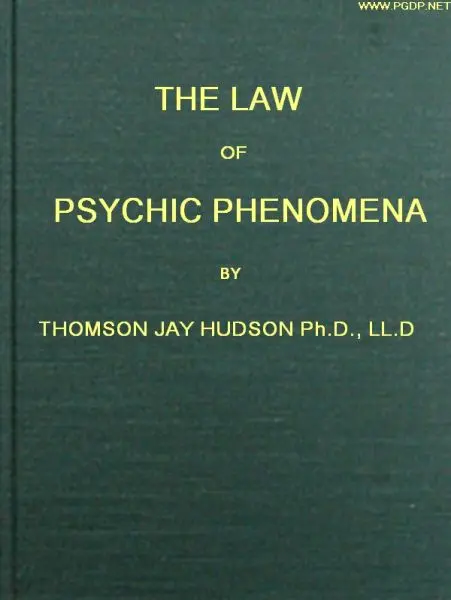
THE CLASSIC COLLECTION · 1896
"The Law of Psychic Phenomena" by Thomson Jay Hudson is a scientific publication written in the late 19th century. The book seeks to establish a comprehensive working hypothesis to analyze and classify various psychic phenomena, including hypnotism, spiritism, and mental therapeutics. Hudson aims to bridge the gaps in psychological science by proposing that many seemingly disparate psychic manifestations are connected through a general principle that can be understood and studied systematically. The opening of the work lays the groundwork for this ambitious project by articulating the necessity for a unifying hypothesis in psychology, akin to those in other scientific domains like physics and chemistry. Hudson argues that without such a framework, psychological phenomena remain chaotic and misunderstood. He quickly introduces the concept of duality in human mental processes, positing the existence of an "objective mind" that interacts with the physical world through the senses, and a "subjective mind" that operates outside of these constraints, particularly when in states of hypnosis. This duality is central to understanding the book’s deeper exploration of how the human mind navigates and comprehends psychic phenomena.
Introduction adapted from the source catalogue; source summaries may be automatically generated.
Free to read · English · 138,370 words · No account needed
MAKE TIME FOR A GOOD BOOK
On by default. Untick to stop anonymous reading totals. Each page counts after 10 seconds in view. How this works.
Anonymous counting is on unless you have switched it off.
No one without an objective education can, by the development of the subjective faculties alone, become a great poet, or a great artist, or a great orator, or a great statesman. But he may be a great mathematician or a great musician, independently of objective education or training, by the development of the subjective faculties alone. Many facts are on record which demonstrate this proposition. Hundreds of instances might be cited showing to what a prodigious extent the mathematical and musical faculties can be developed in persons, not only without objective training, but, in some instances, without a brain capable of receiving any considerable objective education.
Mathematical prodigies of the character mentioned are numerous; one of the most remarkable was the famous Zerah Colburn. The following account of his early career, published when he was yet under eight years of age, is taken from the "Annual Register" of 1812, an English publication, and will serve to illustrate the proposition:
"The attention of the philosophical world has been lately attracted by the most singular phenomenon in the history of human mind that perhaps ever existed. It is the case of a child, under eight years of age, who, without any previous knowledge of the common rules of arithmetic, or even of the use and power of the Arabic numerals, and without having given any attention to the subject, possesses, as if by intuition, the singular faculty of solving a great variety of arithmetical questions by the mere operation of the mind, and without the usual assistance of any visible symbol or contrivance.
"The name of the child is Zerah Colburn, who was born at Cabut (a town lying at the head of the Onion River, in Vermont, in the United States of America), on the 1st of September, 1804. About two years ago,--August, 1810,--although at that time not six years of age, he first began to show these wonderful powers of calculation which have since so much attracted the attention and excited the astonishment of every person who has witnessed his extraordinary abilities. The discovery was made by accident. His father, who had not given him any other instruction than such as was to be obtained at a small school established in that unfrequented and remote part of the country, and which did not include either writing or ciphering, was much surprised one day to hear him repeating the products of several numbers. Struck with amazement at the circumstance, he proposed a variety of arithmetical questions to him, all of which the child solved with remarkable facility and correctness. The news of the infant prodigy was soon circulated through the neighborhood, and many persons came from distant parts to witness so singular a circumstance. The father, encouraged by the unanimous opinion of all who came to see him, was induced to undertake with this child the tour of the United States. They were everywhere received with the most flattering expressions, and in several towns which they visited, various plans were suggested to educate and bring up the child free from all expense to his family. Yielding, however, to the pressing solicitations of his friends, and urged by the most respectable and powerful recommendations, as well as by a view to his son's more complete education, the father has brought the child to this country, where they arrived on the 12th of May last; and the inhabitants of this metropolis have for the last three months had an opportunity of seeing and examining this wonderful phenomenon, and verifying the reports that have been circulated respecting him. Many persons of the first eminence for their knowledge in mathematics, and well known for their philosophical inquiries, have made a point of seeing and conversing with him, and they have all been struck with astonishment at his extraordinary powers. It is correctly true, as stated of him, that he will not only determine with the greatest facility and despatch the exact number of minutes or seconds in any given period of time, but will also solve any other question of a similar kind. He will tell the exact product arising from the multiplication of any number consisting of two, three, or four figures by any other number consisting of the like number of figures; or any number consisting of six or seven places of figures being proposed, he will determine with equal expedition and ease all the factors of which it is composed. This singular faculty consequently extends not only to the raising of powers, but to the extraction of the square and cube roots of the number proposed, and likewise to the means of determining whether it is a prime number (or a number incapable of division by any other number); for which case there does not exist at present any general rule amongst mathematicians. All these and a variety of other questions connected therewith are answered by this child with such promptness and accuracy (and in the midst of his juvenile pursuits) as to astonish every person who has visited him.
Your reading position is saved on this browser. Take it to another device with a library code. Reading pages adapt to text, rather than matching a printed edition.
BEHIND THE BOOK
This eBook is for the use of anyone anywhere in the United States and most other parts of the world at no cost and with almost no restrictions whatsoever. You may copy it, give it away or re-use it under the terms of the Project Gutenberg License included with this eBook or online at www.gutenberg.org. If you are not located in the United States, you will have to check the laws of the country where you are located before using this eBook. Read the source licence.
The original source file, including credits and licence, is retained by this library. Request an original-format copy at no charge. Please include the book title and Project Gutenberg identifier #54665.
KEEP YOUR CURIOSITY GOING
David Patterson (Spirit) Hatch
Coulson Kernahan

Ralph Waldo Emerson
Frances Wright

Edwin Abbott Abbott

Joseph Droz