
Last letters from the living dead man
David Patterson (Spirit) Hatch
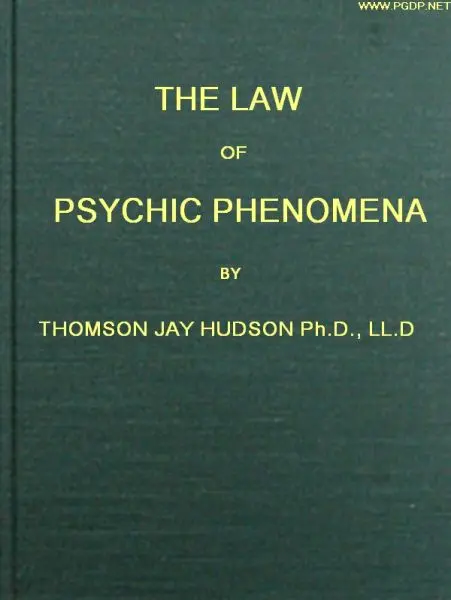
THE CLASSIC COLLECTION · 1896
"The Law of Psychic Phenomena" by Thomson Jay Hudson is a scientific publication written in the late 19th century. The book seeks to establish a comprehensive working hypothesis to analyze and classify various psychic phenomena, including hypnotism, spiritism, and mental therapeutics. Hudson aims to bridge the gaps in psychological science by proposing that many seemingly disparate psychic manifestations are connected through a general principle that can be understood and studied systematically. The opening of the work lays the groundwork for this ambitious project by articulating the necessity for a unifying hypothesis in psychology, akin to those in other scientific domains like physics and chemistry. Hudson argues that without such a framework, psychological phenomena remain chaotic and misunderstood. He quickly introduces the concept of duality in human mental processes, positing the existence of an "objective mind" that interacts with the physical world through the senses, and a "subjective mind" that operates outside of these constraints, particularly when in states of hypnosis. This duality is central to understanding the book’s deeper exploration of how the human mind navigates and comprehends psychic phenomena.
Introduction adapted from the source catalogue; source summaries may be automatically generated.
Free to read · English · 138,370 words · No account needed
MAKE TIME FOR A GOOD BOOK
On by default. Untick to stop anonymous reading totals. Each page counts after 10 seconds in view. How this works.
Anonymous counting is on unless you have switched it off.
Platform Experiments misleading.--Their Utter Inutility as a Test.--So-called "Tests" described and explained.--Sexual Outrages impossible.--Auto-suggestion protects the Virtuous.--A Willing Subject necessary.--Demonstrative Experiments.--Modern Authorities cited against themselves.--Professor Gregory's Views.--The Elevated Moral Tone of Subjects when mesmerized.--Successful Suggestion of Suicide impossible.--The Three Normal Functions of the Subjective Mind.--Self-Preservation.--Propagation.--Preservation of Offspring.--Instinctive Auto-suggestion.--Indifference on Near Approach of Death.--A Universal Law.--Illustrative Incidents.--Suggestive Criminal Abortion impossible.--Premonitions explained.--The Dæmon of Socrates.--Clairaudience.--The Instinct of Death.--Hypnotism in Jurisprudence.--Testimony Valueless.--Vital Secrets impossible to obtain.--Doctors must not monopolize the Forces of Nature.--The Folly of Adverse Legislation.
Before leaving the subject of hypnotism, I deem it proper to say a few words on one of its branches which is just now attracting the attention alike of students of the science and the public at large. The idea is being very generally promulgated among the people that the ability of one man to mesmerize or hypnotize another implies the possession of a very dangerous power, and one which, in the hands of an unscrupulous man, may be used for criminal purposes. It is perhaps not strange that such an idea should prevail among those who have not studied the science except by observation of platform experiments, which are designed rather to amuse than to instruct. There is something so mysterious in the whole subject, viewed from the standpoint of an audience assembled to witness experiments of this character, that it would be strange indeed if the average man were not impressed with an indefinable dread of the power of the hypnotist. He sees him, by means of certain mysterious manipulations, throw his subject into a profound sleep, and awaken him by a snap of the fingers. He sees the subject impressed with all manner of incongruous ideas,--made to believe that he is Diogenes, or a dog, at the will of the operator. He is made to ride an imaginary horse-race, astride a deal table, or to go in swimming on the bare floor. He is made to see angels or devils; to wander in the Elysian fields of paradise, or to scorch in the sulphurous fires of hell; to feel pain or pleasure, joy or sorrow,--all at the caprice of the man in whose power he has placed himself. All this, and much more, can be seen at public exhibitions of hypnotism, and under conditions that leave no doubt in the mind of the observer, of the genuineness of the phenomena. He sees his friends, for whose integrity he can vouch, go upon the platform and become subject to the same mysterious power. Still doubting, he may go upon the stage himself, only to find that he is amenable to the same subtle influence, controllable by some power that is to him agreeable, yet mysterious, indefinable, incomprehensible. At first he perfectly comprehends all his objective surroundings, remembers afterwards all that took place, and very likely fancies that he obeyed the suggestions of the hypnotist merely to please him and to avoid doing anything to mar the harmony of the occasion. Later on he learns that his supposed complacency was really an irresistible impulse to obey the will of the hypnotist. As the experiments proceed he experiences the sensation of double consciousness. He is told that in his hand he holds a delicious fruit,--a strawberry, perhaps. He is still possessed of sufficient objective consciousness to know that there is really no strawberry in his hand, and yet he sees it plainly, feels it, smells it, tastes it, and experiences all the satisfaction incident to having actually eaten the fruit. He is able to converse rationally on the subject, and to express his amazement at the vividness and apparent reality of the subjective sensation. After a few repetitions of the experiments he loses all consciousness of his objective environment, yields unquestioning obedience to the suggestions of the hypnotist, and retains no recollection, after he is awakened, of what occurred when he was in the somnambulic condition. His friends inform him of the many wonderful things which occurred, of his ready obedience to all suggestions,--how he made a speech far transcending his natural abilities, under the influence of a suggestion that he was Daniel Webster; how he flapped his wings and crowed when told that he was a cock; and so on through the répertoire of platform experiments. He is now strongly impressed with the idea that he was controlled by a power that he could under no circumstances resist. But, wishing to pursue his investigations further, he resolves to test the question whether this power can be employed for criminal purposes. A few friends are called together, a hypnotist is employed, and a few well-trained subjects are invited to give a private exhibition for the benefit of "science." In order to give the proposed psychological experiment an undoubted scientific value, a few doctors of physic are invited to be present,--not because they know anything about psychology or of hypnotism, but because it is well known that they have heard something about the latter science, particularly that it has been found to be a great therapeutic agent, and they are just now deeply interested in proving that hypnotism, in the hands of any one outside of the medical profession, must necessarily be employed for the perpetration of crime.
Your reading position is saved on this browser. Take it to another device with a library code. Reading pages adapt to text, rather than matching a printed edition.
BEHIND THE BOOK
This eBook is for the use of anyone anywhere in the United States and most other parts of the world at no cost and with almost no restrictions whatsoever. You may copy it, give it away or re-use it under the terms of the Project Gutenberg License included with this eBook or online at www.gutenberg.org. If you are not located in the United States, you will have to check the laws of the country where you are located before using this eBook. Read the source licence.
The original source file, including credits and licence, is retained by this library. Request an original-format copy at no charge. Please include the book title and Project Gutenberg identifier #54665.
KEEP YOUR CURIOSITY GOING
David Patterson (Spirit) Hatch
Coulson Kernahan

Ralph Waldo Emerson
Frances Wright

Edwin Abbott Abbott

Joseph Droz