
Last letters from the living dead man
David Patterson (Spirit) Hatch
THE CLASSIC COLLECTION · 1896
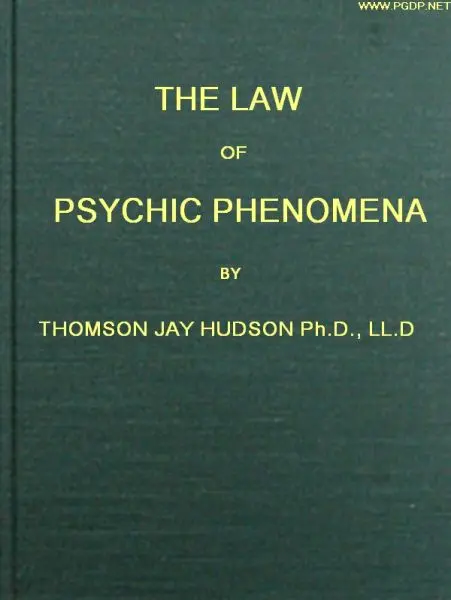
"The Law of Psychic Phenomena" by Thomson Jay Hudson is a scientific publication written in the late 19th century. The book seeks to establish a comprehensive working hypothesis to analyze and classify various psychic phenomena, including hypnotism, spiritism, and mental therapeutics. Hudson aims to bridge the gaps in psychological science by proposing that many seemingly disparate psychic manifestations are connected through a general principle that can be understood and studied systematically. The opening of the work lays the groundwork for this ambitious project by articulating the necessity for a unifying hypothesis in psychology, akin to those in other scientific domains like physics and chemistry. Hudson argues that without such a framework, psychological phenomena remain chaotic and misunderstood. He quickly introduces the concept of duality in human mental processes, positing the existence of an "objective mind" that interacts with the physical world through the senses, and a "subjective mind" that operates outside of these constraints, particularly when in states of hypnosis. This duality is central to understanding the book’s deeper exploration of how the human mind navigates and comprehends psychic phenomena.
Introduction adapted from the source catalogue; source summaries may be automatically generated.
Free to read · English · 138,370 words · No account needed
MAKE TIME FOR A GOOD BOOK
On by default. Untick to stop anonymous reading totals. Each page counts after 10 seconds in view. How this works.
Anonymous counting is on unless you have switched it off.
I am aware that those who have hitherto regarded the soul as possessing all the intellectual powers, as well as all the moral attributes, will be shocked when they realize that the object of their admiration is hedged about with any limitations whatever. The first question they will ask is, "Why is it that God has given to man a soul possessing such transcendent powers in certain directions, and yet under the absolute control, in all its ideas and intellectual functions, of a finite, perishable intelligence?" The broad and comprehensive answer is, To constitute man a free moral agent. It needs no argument to show that if the soul were not so limited in its initiative power of reasoning, the finite, mortal man could not be held responsible for the moral status of his soul. God gave to objective man the powers of reason, inductive as well as deductive, for the purpose of enabling him successfully to struggle with his physical environment. He gave him the power to know the right from the wrong. He gave him supreme control of the initial processes of reasoning, and thus made him responsible for the moral status of his soul. The soul, in the mean time, so long as it inhabits the body, is charged with limited responsibilities. It is the life-principle of the body, and its normal functions pertain solely to the preservation of human life and the perpetuation of the human race. It possesses wonderful powers in other directions, under certain abnormal conditions of the body, it is true. But their exercise outside of those limits is always abnormal, and productive of untoward results. Those powers of which we catch occasional glimpses, and which so excite our admiration, are powers which pertain to its existence in a future world. They are powers which proclaim it as a part of God, as partaking of the nature and attributes of the Divine Mind. Its powers of perception of the fixed laws of nature demonstrate its kinship to Omniscience. It is independent of the feeble powers of inductive reasoning when it is freed from its earthly trammels; and there is not one power or attribute peculiar to the finite, objective mind that could be of any service to the soul in its eternal home. We boast of our powers of inductive reason, forgetting how little we have learned, or ever can know, compared with what there is to learn. We forget that they are the outgrowth of our physical wants and necessities, and simply enable us to grope in the dark for the means of subsistence, and to render our physical existence tolerable. The powers of the objective mind, compared with those of the subjective mind, may be likened to a man born in a cave, in which the light of the sun never entered, and supplied only with a rushlight with which to grope his way and find the means of subsistence. The light, feeble as it is, is invaluable to him; for by its means he is enabled gradually to learn his bearings, to take note of his environment, to make occasional discoveries of the necessities of life, and finally to achieve some of the comforts of existence. The more he discovers, the more he appreciates the value of his rushlight and the more he boasts of its transcendent powers of illumination. He hears vague reports of an outside world where the comforts and luxuries of life are comparatively easy to obtain, and he resolves to grope his way out. He is told that the outside world is lighted by a great luminary which will render his rushlight of no value to him except as a reminder of the limitations of his cave-life. But he is sceptical, and points with pride to his accumulations and the discoveries he has made with the aid of his "God-given illuminant," and refuses to believe that there is a possible state of existence which would be tolerable without rushlights. At length a cataclysm of nature throws him upon the outside world in the full blaze of the light of a midday sun. He then finds that he is in a world of light; that he can perceive things as they are, and observe their bearings and relations to each other, and he finds that the rays of his rushlight are no longer visible. It is obvious that this is but a feeble illustration of the difference between the powers of inductive inquiry into the laws of nature, and the powers of perception possessed by the subjective entity. When the soul is freed from its physical trammels it ascends to its native realm of truth, and, untrammelled by false suggestions arising from the imperfect knowledge of the objective mind, it "sees God as he is;" that is, it apprehends all his laws, and imbibes truth from its Eternal Source.
Your reading position is saved on this browser. Take it to another device with a library code. Reading pages adapt to text, rather than matching a printed edition.
BEHIND THE BOOK
This eBook is for the use of anyone anywhere in the United States and most other parts of the world at no cost and with almost no restrictions whatsoever. You may copy it, give it away or re-use it under the terms of the Project Gutenberg License included with this eBook or online at www.gutenberg.org. If you are not located in the United States, you will have to check the laws of the country where you are located before using this eBook. Read the source licence.
The original source file, including credits and licence, is retained by this library. Request an original-format copy at no charge. Please include the book title and Project Gutenberg identifier #54665.
KEEP YOUR CURIOSITY GOING
David Patterson (Spirit) Hatch
Coulson Kernahan

Ralph Waldo Emerson
Frances Wright

Edwin Abbott Abbott

Joseph Droz