
Last letters from the living dead man
David Patterson (Spirit) Hatch
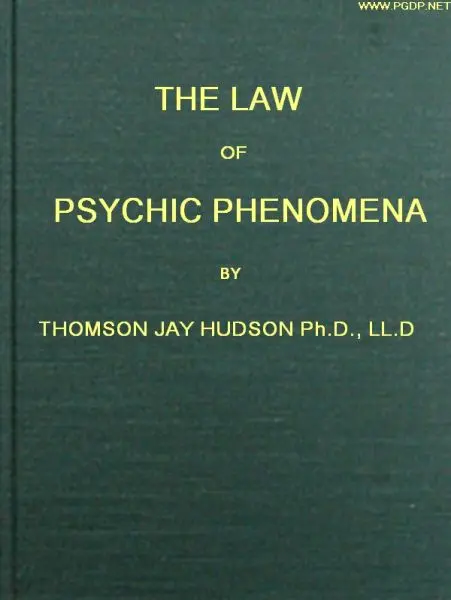
THE CLASSIC COLLECTION · 1896
"The Law of Psychic Phenomena" by Thomson Jay Hudson is a scientific publication written in the late 19th century. The book seeks to establish a comprehensive working hypothesis to analyze and classify various psychic phenomena, including hypnotism, spiritism, and mental therapeutics. Hudson aims to bridge the gaps in psychological science by proposing that many seemingly disparate psychic manifestations are connected through a general principle that can be understood and studied systematically. The opening of the work lays the groundwork for this ambitious project by articulating the necessity for a unifying hypothesis in psychology, akin to those in other scientific domains like physics and chemistry. Hudson argues that without such a framework, psychological phenomena remain chaotic and misunderstood. He quickly introduces the concept of duality in human mental processes, positing the existence of an "objective mind" that interacts with the physical world through the senses, and a "subjective mind" that operates outside of these constraints, particularly when in states of hypnosis. This duality is central to understanding the book’s deeper exploration of how the human mind navigates and comprehends psychic phenomena.
Introduction adapted from the source catalogue; source summaries may be automatically generated.
Free to read · English · 138,370 words · No account needed
MAKE TIME FOR A GOOD BOOK
On by default. Untick to stop anonymous reading totals. Each page counts after 10 seconds in view. How this works.
Anonymous counting is on unless you have switched it off.
Under the general head of trance may be grouped all that class of cases in which the objective faculties are, for the time being, held in practically complete abeyance, and the subjective mind becomes correspondingly active. Various names have been applied to this condition, such as somnambulism, hypnosis, mesmeric trance, ecstasy, catalepsy, obsession, etc., many of the names implying a theory of causation rather than distinctive features of condition. The condition varies in accordance with the idiosyncrasies of the individual as much as from the causes which induce it. The leading characteristics are, however, the same in all cases. These are, first, the partial or complete abeyance of the objective mind; second, the activity of the subjective mind; and, third, the perfect amenability of the latter to control by the power of suggestion. Many remarkable mental phenomena are developed in these states, but this discussion will be confined to the supposed power of persons in the condition of trance to hold intercourse with the spiritual world.
This power has been held to exist from time immemorial; the ancient and modern mystical literature is filled with the most interesting, not to say startling, accounts of interviews held by these persons with the inhabitants of the spirit-land. Vast systems of religion have been founded upon the supposed revelations of persons in a trance, and untold millions of the human race base their hopes of a life in a future world upon the dreams of ecstatics. The whole vast fabric of Oriental philosophy and religion is based upon the revelations of persons in a trance. The Swedenborgian philosophy in the Western world is founded upon the dreams of a person who, in a condition of a trance, believed himself to be able to hold familiar converse with the inhabitants of heaven and of hell. Some of these systems of spiritual philosophy are of such vast and complicated structure that the mind is wrapped in wonder and admiration of their magnitude and perfection. The Oriental philosophy, in particular, is so symmetrical, so pervaded by grand and noble conceptions, so permeated with lofty precepts of morality, humanity, and religion, that we are wont to lose sight of the fact that the whole structure is built up by a process of deductive reasoning from premises that have no better foundation than the dreams of ecstatics. But we are told that it has stood the test of thousands of years of thought and investigation, and that no fact in physical science can be adduced to disprove its fundamental principles. Doubtless this is true. The adepts have steered clear of propositions in physical science which could be disproved by the learning of the schoolboy. In this they have avoided those errors of the Bible of the Christians, which, though unimportant in themselves, having no bearing upon the real philosophy of the Christian religion, have proved a stumbling-block to superficial minds. But does it follow that because a proposition regarding the condition of affairs in the spirit-world cannot be controverted by the science of the physical world, the proposition must necessarily be true? Clearly not. Again, does it follow that because a system of philosophy, the alleged facts of which are necessarily undemonstrable, has stood the test of thousands of years of investigation, it is necessarily correct? By no means. Time has effected for the Oriental philosophy that which has not been effected for the Western spiritual philosophy, simply for the want of time; it has perfected it as a system. The lapse of time has enabled the system to be evolved by the gradual but constant accretions of human thought, from generation to generation, until it has grown, from the first vague hope of the human soul for a life beyond the grave, to its present stupendous proportions. The processes of its growth can readily be seen and understood by a glance at the evolution of our own spiritistic philosophy within the memory of men now living. It is true that modern spiritism found a philosophy ready made to its hand in the writings of Emanuel Swedenborg. His descriptions of the spirit-world were in the main confirmed by the earlier mediums who were acquainted with his writings. His was essentially a material heaven. "As on earth, so in heaven," was his highest conception of the beauties and glories of the land of "spirits of just men made perfect." But he believed in hell, and he found one. He was inimical to certain Christian sects, and he found that all who belonged to those sects were condemned to everlasting punishment. When modern spiritism became a belief, it found its most enthusiastic followers among those who were outside of the pale of the Church, those who were in revolt against the asceticism of the Puritan belief and practices, those who refused to believe that a God of love and mercy would condemn any portion of his creatures to everlasting fire. They found in the Rochester knockings the first evidence which appealed to their senses of a life beyond the tomb; and they consulted their mediums with perfect confidence in their ability correctly to portray the condition of the denizens of the land of spirits. They learned from those oracles that their preconceived notions of divine justice were eminently correct, that there was no such place as hell, and that all alike shared in the boon of immortality; and, by a series of progressive steps, through seven or eight concentric spheres, all at last reached the highest state of divine felicity. They found that Swedenborg was right in the main, but was a little incorrect in his information concerning hell. It would be tedious, as well as superfluous, to enumerate the steps by which the philosophy of modern spiritism has advanced from the crude notions of the earlier writers to its present status. Every intelligent reader will recognize the wide difference between the rhapsodic hodge-podge of Andrew Jackson Davis and the calm philosophy of Judge Edmonds, and will not fail to note how completely the latter is now superseded by modern writers, who are gradually engrafting upon the indigenous stem the most luxurious branches of the Oriental tree. What their philosophy will be in coming years can be conjectured only by those who observe what evolution has done for the Oriental philosophy during the thousands of years of its existence.
Your reading position is saved on this browser. Take it to another device with a library code. Reading pages adapt to text, rather than matching a printed edition.
BEHIND THE BOOK
This eBook is for the use of anyone anywhere in the United States and most other parts of the world at no cost and with almost no restrictions whatsoever. You may copy it, give it away or re-use it under the terms of the Project Gutenberg License included with this eBook or online at www.gutenberg.org. If you are not located in the United States, you will have to check the laws of the country where you are located before using this eBook. Read the source licence.
The original source file, including credits and licence, is retained by this library. Request an original-format copy at no charge. Please include the book title and Project Gutenberg identifier #54665.
KEEP YOUR CURIOSITY GOING
David Patterson (Spirit) Hatch
Coulson Kernahan

Ralph Waldo Emerson
Frances Wright

Edwin Abbott Abbott

Joseph Droz