
Last letters from the living dead man
David Patterson (Spirit) Hatch
THE CLASSIC COLLECTION · 1896
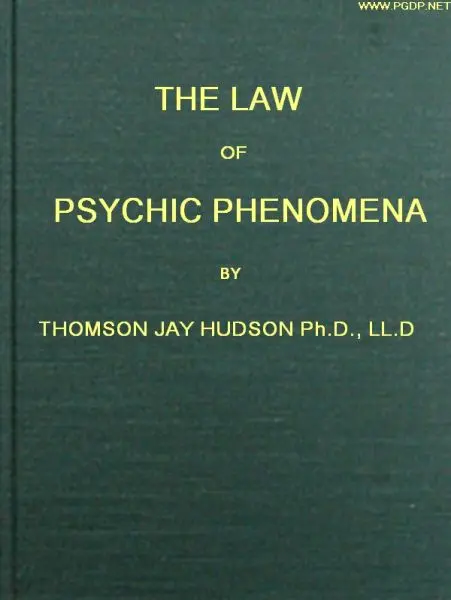
"The Law of Psychic Phenomena" by Thomson Jay Hudson is a scientific publication written in the late 19th century. The book seeks to establish a comprehensive working hypothesis to analyze and classify various psychic phenomena, including hypnotism, spiritism, and mental therapeutics. Hudson aims to bridge the gaps in psychological science by proposing that many seemingly disparate psychic manifestations are connected through a general principle that can be understood and studied systematically. The opening of the work lays the groundwork for this ambitious project by articulating the necessity for a unifying hypothesis in psychology, akin to those in other scientific domains like physics and chemistry. Hudson argues that without such a framework, psychological phenomena remain chaotic and misunderstood. He quickly introduces the concept of duality in human mental processes, positing the existence of an "objective mind" that interacts with the physical world through the senses, and a "subjective mind" that operates outside of these constraints, particularly when in states of hypnosis. This duality is central to understanding the book’s deeper exploration of how the human mind navigates and comprehends psychic phenomena.
Introduction adapted from the source catalogue; source summaries may be automatically generated.
Free to read · English · 138,370 words · No account needed
MAKE TIME FOR A GOOD BOOK
On by default. Untick to stop anonymous reading totals. Each page counts after 10 seconds in view. How this works.
Anonymous counting is on unless you have switched it off.
Again, we find that the intelligence is controllable by the power of suggestion. This is shown in the readiness with which "spirits" can be made to respond to calls made upon them, whether they have any real existence or not. It is well known that any one can as readily obtain a communication from an imaginary person as from a real one, from a living person as from the dead, providing the medium does not happen to know the facts. The writer has had frequent and very affectionate communications from an imaginary dead sister, and has occasionally had a very touching communication from himself, the medium believing the name to represent a dead brother. The fact that he never had either brother or sister made the communication all the more convincing.
This perfect amenability to control by suggestion is evinced in another most remarkable way. It is well known to every person who has been in the habit of attending spiritual séances how necessary it is that "harmonious conditions" should prevail. The very presence of an avowed sceptic will often prevent any manifestations. It frequently happens that some one present remarks, in a despairing tone, that he does not expect any manifestations, "because it always happens that when I am present no communications can be had." When such a remark is made, the chances are ten to one that the "spirits" will refuse to respond. Why this happens, spiritists have laboriously attempted to explain, but never satisfactorily, except to themselves. The fact that a spirit, possessing sufficient power to move a table, raise a piano to the ceiling, or levitate the medium, should be paralyzed in presence of one who does not believe in spirits, is simply inexplicable, except upon the one hypothesis, namely, that the power evoked is that of the subjective mind of the medium, which is amenable to control by the mysterious power of suggestion. It is inconceivable that the spirit of Napoleon Bonaparte, who, when living, swayed the destinies of nations, used kings and popes as his puppets, and led his hosts to successful battle against the combined armies of Europe, should, when dead, shrink, abashed and powerless, in presence of some one man who happens not to believe in spiritism. But it can be readily understood how a séance should prove a failure when we assume that the power that moves the table or writes the communications is exercised by the subjective intelligence of the medium, and that the presence of an avowed sceptic operates as an ever-present and all-potent suggestion that the promised manifestations are impossible in his presence. It is in strict accordance with the universal law of suggestion that such should be the result. It is this constant amenability to control by suggestion which always hampers mediums when they are giving test séances in the presence of sceptical investigators; and I undertake to say that no medium ever was, or ever can be, powerful enough to produce his phenomena under test conditions in presence of a hostile and aggressively sceptical investigating committee. It is no fault of the medium that this is the case, and it is no test whatever of the genuineness of his phenomena. But it is presumptive, if not conclusive, evidence that the source of his phenomena resides within himself, and hence is amenable to the universal law which governs the action of all subjective intelligence and power. Neither is it any reflection upon the sincerity of the investigator that he fails to witness the phenomena that have been promised. His ignorance of the law which governs the subject-matter, together with his desire to be frank and honest enough with the medium to put him in possession of a knowledge of his sentiments and prejudices, leads him unwittingly to place an insuperable barrier in the way of success. It unfortunately happens that many professional mediums, despairing of success in producing the genuine phenomena, and more than ordinarily anxious to earn the reward of success, will, under such circumstances, resort to fraud and legerdemain. The temptation to do so is great when he reflects upon how much is at stake, the immediate monetary reward promised being the least consideration. His professional pride, his love of approbation, his hope of future fame and emolument in case he succeeds in convincing a sceptical scientific investigator,--all operate to constitute a temptation too great to be always successfully withstood. Besides, he knows that, under favorable conditions, he can produce the genuine phenomena, that he has produced them again and again, and he quiets his conscience by reflecting that it can do no harm to resort to legerdemain to simulate that which he knows to have a genuine existence.
Your reading position is saved on this browser. Take it to another device with a library code. Reading pages adapt to text, rather than matching a printed edition.
BEHIND THE BOOK
This eBook is for the use of anyone anywhere in the United States and most other parts of the world at no cost and with almost no restrictions whatsoever. You may copy it, give it away or re-use it under the terms of the Project Gutenberg License included with this eBook or online at www.gutenberg.org. If you are not located in the United States, you will have to check the laws of the country where you are located before using this eBook. Read the source licence.
The original source file, including credits and licence, is retained by this library. Request an original-format copy at no charge. Please include the book title and Project Gutenberg identifier #54665.
KEEP YOUR CURIOSITY GOING
David Patterson (Spirit) Hatch
Coulson Kernahan

Ralph Waldo Emerson
Frances Wright

Edwin Abbott Abbott

Joseph Droz