
Last letters from the living dead man
David Patterson (Spirit) Hatch
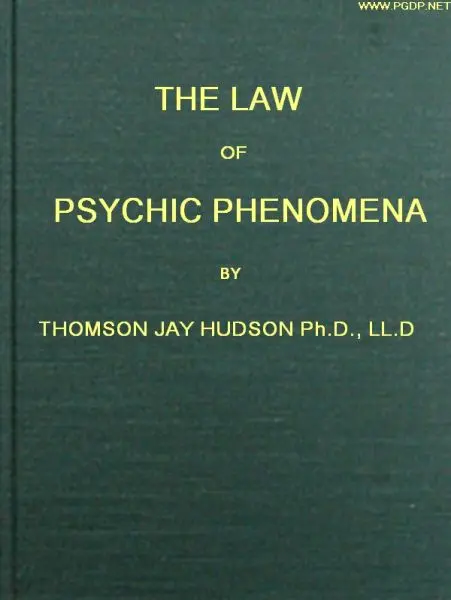
THE CLASSIC COLLECTION · 1896
"The Law of Psychic Phenomena" by Thomson Jay Hudson is a scientific publication written in the late 19th century. The book seeks to establish a comprehensive working hypothesis to analyze and classify various psychic phenomena, including hypnotism, spiritism, and mental therapeutics. Hudson aims to bridge the gaps in psychological science by proposing that many seemingly disparate psychic manifestations are connected through a general principle that can be understood and studied systematically. The opening of the work lays the groundwork for this ambitious project by articulating the necessity for a unifying hypothesis in psychology, akin to those in other scientific domains like physics and chemistry. Hudson argues that without such a framework, psychological phenomena remain chaotic and misunderstood. He quickly introduces the concept of duality in human mental processes, positing the existence of an "objective mind" that interacts with the physical world through the senses, and a "subjective mind" that operates outside of these constraints, particularly when in states of hypnosis. This duality is central to understanding the book’s deeper exploration of how the human mind navigates and comprehends psychic phenomena.
Introduction adapted from the source catalogue; source summaries may be automatically generated.
Free to read · English · 138,370 words · No account needed
MAKE TIME FOR A GOOD BOOK
On by default. Untick to stop anonymous reading totals. Each page counts after 10 seconds in view. How this works.
Anonymous counting is on unless you have switched it off.
Taking it for granted, then, that there is a fluidic emanation, or effluence, proceeding from the mesmerist and impinging upon the patient, it follows that there is a positive dynamic force exerted upon the patient, either for good or evil, by the employment of mesmeric methods. That its effects are salutary when properly used for therapeutic purposes is proved by the concurrent testimony of all who have intelligently made the experiment, from the days of Paracelsus down to the present time.
From this it would appear that mesmerism must be the most powerful, in its immediate effects, of any of the known methods of mental healing. It combines oral suggestion with mental suggestion, and employs in addition that mysterious psycho-physical force, or effluence, popularly known as animal magnetism.
Before leaving this branch of the subject, a few remarks will be in order regarding the relative value of the different systems of mental healing now in vogue. It has frequently been charged that healing by hypnotism and mesmerism is not lasting in its effects,--that no permanent cure is ever made by these methods. It must be admitted that there is some ground for these statements, although so sweeping a charge is by no means justifiable. It is true that in many instances patients who have been cured by hypnotism and mesmerism have suffered a relapse, and in some cases the relapse has been worse than was the original sickness. This of itself constitutes no valid objection to the means of cure; for it must be admitted that under no system of treatment is a patient free from the danger of a relapse or of a recurrence of the disease at some future time. There is, however, this to be said in regard to hypnotic or mesmeric treatment which does not apply with the same force to healing by medicines. The success of mental methods of treatment depending, as it does, upon the mental condition of the patient and upon the mental impressions made upon him, it follows that if the mental impressions are not permanent, the cure may not be permanent. Hence it often happens that a patient, elated by the success of hypnotic treatment in his case, relates the circumstances to his friends, especially to his sceptical associates, only to meet with a storm of ridicule, or at least with expressions of incredulity or doubt. In such a mental environment his subjective mind inevitably takes hold of the adverse suggestions, and without being objectively conscious of it, he has lost faith, the citadel of his defence is broken down, and if his disease had a mental origin, he is open to another attack more severe and serious perhaps than the first. That Christ was fully alive to this danger is shown by the fact that when he healed a person in private, he rarely failed to place the solemn injunction upon him, "See thou tell no man." No recorded words that the Master ever uttered display a more profound knowledge of the underlying principles of mental healing than these. Modern healers are not so modest, nor do they seem to understand the prime necessity for seeing to it that their patients are kept in a proper frame of mind in reference to their disease and the means employed to cure them. The general principle of auto-suggestion is recognized by all scientific hypnotists of the present day; but they fail to recognize its extreme importance as a therapeutic agent. Properly understood and applied, auto-suggestion supplies a means of enabling every one to heal himself, or at least to hold himself in the proper mental attitude to make permanent the good effects of hypnotic treatment by others. Many of the pains and ills to which the average man is subject can be cured by this means, and it should be the first care of every hypnotist to instruct his patients in this branch of the science. In this respect the Christian scientists are far in advance of the hypnotists and mesmerists. They teach their patients how to help themselves. They organize them into classes, deliver lectures, and give minute instructions how to treat themselves, as well as how to treat others. Without knowing it, they in effect teach their patients the methods of auto-suggestion. Without having the remotest conception of the real principles which underlie their so-called "science," they have somehow stumbled upon the machinery of mental therapeutics. To do them full justice, it must be said that they employ the machinery to good purpose. They do much good and little harm, and the little harm they do, generally arises from over confidence in the universal efficacy of their methods.
Your reading position is saved on this browser. Take it to another device with a library code. Reading pages adapt to text, rather than matching a printed edition.
BEHIND THE BOOK
This eBook is for the use of anyone anywhere in the United States and most other parts of the world at no cost and with almost no restrictions whatsoever. You may copy it, give it away or re-use it under the terms of the Project Gutenberg License included with this eBook or online at www.gutenberg.org. If you are not located in the United States, you will have to check the laws of the country where you are located before using this eBook. Read the source licence.
The original source file, including credits and licence, is retained by this library. Request an original-format copy at no charge. Please include the book title and Project Gutenberg identifier #54665.
KEEP YOUR CURIOSITY GOING
David Patterson (Spirit) Hatch
Coulson Kernahan

Ralph Waldo Emerson
Frances Wright

Edwin Abbott Abbott

Joseph Droz