
Last letters from the living dead man
David Patterson (Spirit) Hatch
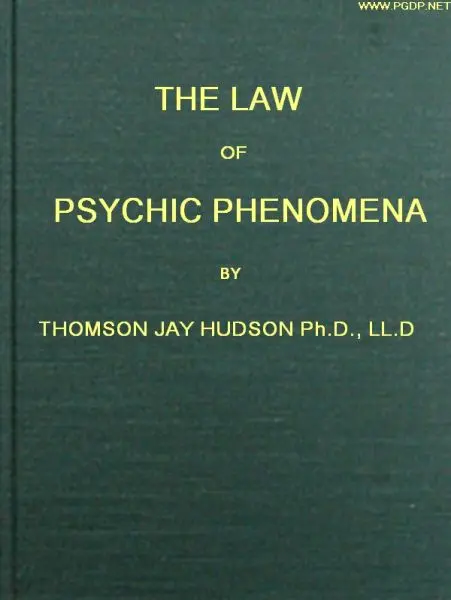
THE CLASSIC COLLECTION · 1896
"The Law of Psychic Phenomena" by Thomson Jay Hudson is a scientific publication written in the late 19th century. The book seeks to establish a comprehensive working hypothesis to analyze and classify various psychic phenomena, including hypnotism, spiritism, and mental therapeutics. Hudson aims to bridge the gaps in psychological science by proposing that many seemingly disparate psychic manifestations are connected through a general principle that can be understood and studied systematically. The opening of the work lays the groundwork for this ambitious project by articulating the necessity for a unifying hypothesis in psychology, akin to those in other scientific domains like physics and chemistry. Hudson argues that without such a framework, psychological phenomena remain chaotic and misunderstood. He quickly introduces the concept of duality in human mental processes, positing the existence of an "objective mind" that interacts with the physical world through the senses, and a "subjective mind" that operates outside of these constraints, particularly when in states of hypnosis. This duality is central to understanding the book’s deeper exploration of how the human mind navigates and comprehends psychic phenomena.
Introduction adapted from the source catalogue; source summaries may be automatically generated.
Free to read · English · 138,370 words · No account needed
MAKE TIME FOR A GOOD BOOK
On by default. Untick to stop anonymous reading totals. Each page counts after 10 seconds in view. How this works.
Anonymous counting is on unless you have switched it off.
This, however, is a digression. The main point which it is desired to enforce is, first, that the strongest instinct in mankind is that of self-preservation; and second, that this instinct, this strong desire to preserve the life of the body, constitutes a subjective, or an instinctive, auto-suggestion of such supreme potency that no suggestion from another, nor any objective auto-suggestion, could possibly overcome it. The inevitable conclusion is that suicide is certainly not a crime which can be successfully instigated by means of hypnotism.
Criminal abortion is another of the crimes which, the people are told, can be performed by means of hypnotic suggestion. The inherent absurdity of this statement is almost as great as that suicide can be successfully instigated by such means. It is here that another strong instinct prevails against a suggestion of that character, namely, the desire inherent in the soul of the mother to preserve her offspring. It is possibly true that conception could be prevented by hypnotic suggestion, and it may be true that barrenness is sometimes caused by unconscious auto-suggestion; but a very different state of affairs exists after the foetus is once formed. The instinctive desire to preserve the life that exists, constitutes an instinctive auto-suggestion which no suggestion from another, nor even the objective auto-suggestion of the mother, could prevail against.
It may be safely set down, therefore, as a fundamental truth of hypnotic science that the auto-suggestion most difficult to overcome is that which originates in the normal action of the subjective mind,--otherwise, instinctive auto-suggestion.
The same line of reasoning applies, though with somewhat diminished force, to the commission of other crimes. We will suppose the most favorable condition possible for procuring the commission of a capital crime; namely, a criminal hypnotist in control of a criminal subject. The disposition of the subject might not stand in the way; there might be no auto-suggestion against the commission of crime in the habits and principles of the life of the subject; and yet the instinct of self-preservation would have its weight and influence in suggesting to him that the commission of a murder would imperil his own life. Such a consideration would operate as potently in the hypnotic condition as it would in the normal state. It would be an instinctive auto-suggestion, just the same as in the case of suicide, although it would operate indirectly in one case, and directly in the other. The deductive reasoning of the subjective mind, as we have seen in preceding chapters, is perfect; and in the case supposed, the subject would instantaneously reason from the proposed crime to its consequences to himself. The same law would operate in preventing the commission of crimes of less magnitude, with a resistance decreased in proportion to the nature of the offence. But it would, in all cases, be a factor of great importance in the prevention of crime; for the subjective mind is ever alert where the safety and well-being of the individual are concerned. This law is universal, and has often been manifested in the most striking manner. Premonitions of impending danger, so often felt and recorded, are manifestations of the constant solicitude of the subjective entity for the welfare of the individual. It is comparatively rare that these subjective impressions are brought above the threshold of consciousness; but this is largely due to the habits of thought of mankind at the present day. Generally such impressions are disregarded, and in this sceptical and materialistic age are often relegated to the domain of superstition. When they are felt and acted upon, they are generally attributed to a supernatural source. The dæmon of Socrates is a strong case in point. He believed himself to have been constantly attended by a familiar spirit, whose voice he could hear, and whose admonitions were always wise. That he did hear voices there can, in the light of modern science, be little doubt. It is noteworthy, however, that the voice was generally one of warning, and that its strongest manifestations were made when his personal safety or his personal well-being was involved. The explanation, in pursuance of the hypothesis under discussion in this book, is not difficult. He was endowed with that rare faculty which, in one way or another, belongs to all men of true genius, and which enabled him to draw from the storehouse of subjective knowledge. In his case the threshold of consciousness was so easily displaced that his subjective mind was able at will to communicate with his objective mind in words audible to his senses. This phenomenon is known to spiritists as clairaudience. As before remarked, this voice was generally one of warning, and was the direct manifestation of that strongest instinct of the human soul,--the instinct of self-preservation.
Your reading position is saved on this browser. Take it to another device with a library code. Reading pages adapt to text, rather than matching a printed edition.
BEHIND THE BOOK
This eBook is for the use of anyone anywhere in the United States and most other parts of the world at no cost and with almost no restrictions whatsoever. You may copy it, give it away or re-use it under the terms of the Project Gutenberg License included with this eBook or online at www.gutenberg.org. If you are not located in the United States, you will have to check the laws of the country where you are located before using this eBook. Read the source licence.
The original source file, including credits and licence, is retained by this library. Request an original-format copy at no charge. Please include the book title and Project Gutenberg identifier #54665.
KEEP YOUR CURIOSITY GOING
David Patterson (Spirit) Hatch
Coulson Kernahan

Ralph Waldo Emerson
Frances Wright

Edwin Abbott Abbott

Joseph Droz