THE CLASSIC COLLECTION✦The Theory of Social RevolutionsCLASSIC FREE BOOKS
The Theory of Social Revolutions
Brooks Adams
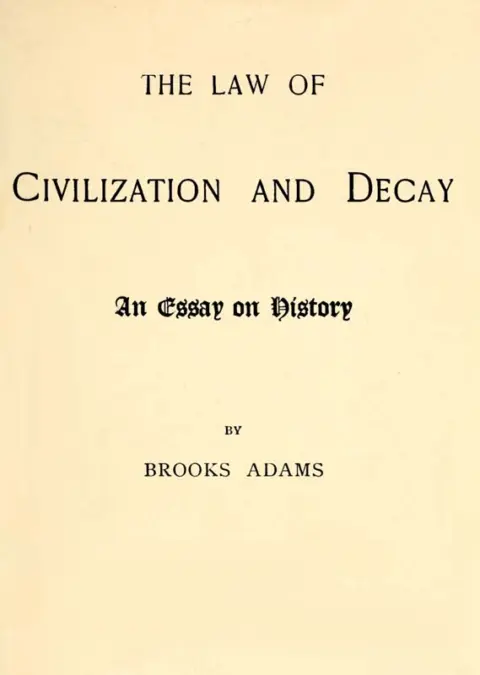
THE CLASSIC COLLECTION · 1896
"The Law of Civilization and Decay: An Essay on History" by Brooks Adams is a work of history privately published in 1895. Adams argues that civilizations follow a predictable cycle of rise and fall, driven by economic and social forces. As societies centralize and accelerate through industrialization, imaginative energy transforms into capital accumulation, causing profound shifts in human temperament and power. Through examples spanning from Rome to modern empires, Adams traces how commercial centers migrate and civilizations decay, suggesting that humanity's fate follows iron laws as inevitable as natural selection itself.
Introduction adapted from the source catalogue; source summaries may be automatically generated.
Free to read · English · 107,746 words · No account needed
MAKE TIME FOR A GOOD BOOK
On by default. Untick to stop anonymous reading totals. Each page counts after 10 seconds in view. How this works.
Anonymous counting is on unless you have switched it off.
Rome: early society of 1;
classes in 2;
law of debt in 2–4;
early army of 9;
not maritime 12;
slavery in 13;
economic revolution in 14;
a plutocracy 15;
annexes Egypt 17;
senators land-owners 21;
great domains of 21;
conquests of 23;
unable to compete with Asia 23;
foreign exchanges unfavourable to 23;
insolvent 28;
decline of 37;
ceases breeding soldiers 40;
later emperors of foreign adventurers 40;
governed by a monied oligarchy 41;
economic type autocratic in 42;
women of emancipated 43;
paid police of 45;
barbarian invasions 46, 47;
domestic relations in 369;
art of 372;
architecture of 381;
see Coinage, Slaving, Usurers, Usury.
Rothschilds: rise of 322;
establish house in London 323.
Russell, John, Earl of Bedford: conducts trial of
Abbot of Glaston 241.
Saint Bernard: birth of 108;
enters Citeaux 108;
founds Clairvaux 109;
recognizes Innocent II. 110;
preaches second crusade 112;
miracles of 113;
declines to lead crusade 114;
remarks on defeat of crusade 118.
Saint Cuthbert: plunder of shrine of 239.
Saint Denis: Abbey of 154.
Saint Riquier: sacrilege at 162.
Saint Sophia: architecture of 89, 377;
desecration of 145.
Saint Thomas à Becket: shrine of 65.
Saint Thomas Aquinas: veneration of for Eucharist 67.
Saladin: sends physician to Richard 94;
crowned Sultan 104;
kills Reginald de Chatillon 121;
Hattin 122;
campaign against Richard 130;
treats with Richard 131.
Saracens: architecture of 89, 90;
household decorations of 90;
philosophy of 93;
sciences of 94;
see Crusades, Nour-ed-Din, Saladin, Zenghi.
Schism: Greek 78.
Seymour, Protector: confiscations under 261;
executed 261.
Sicily: cheap labour in 16;
servile war in 16;
cheap grain of 17.
Silver: Roman standard 26;
discarded in Rome 31;
restored by Charlemagne 128;
ratio of to gold in Rome 30;
to gold in thirteenth century 169;
Potosi 204;
Spaniards plundered of 288;
brought to England by piracy 291;
ratio to gold in seventeenth century 300;
standard in England 300;
exported to India in eighteenth century 299–302;
in 1810 320;
discarded by England 330;
by Germany 347;
relation to Asiatic competition 360;
see Coinage, Currency, Denarius, Gold standard.
Slavery: for debt in Rome 5;
plebeians sink into 33;
Roman population exhausted by 36;
in West Indies 289, 290.
Slaving: part of Roman fiscal system 34;
by Roman emperors 39;
Venetian 126;
English 291;
see Hawkins.
Smith, Captain John: career of 295.
Solidus: see Aureus.
Somerset: Duke of, see Seymour.
Spain: empire of 286;
war with Flanders 287;
plundered by Drake 288;
attacked by Cromwell 301;
see Armada, West Indies.
Spanish America: revolution of 324.
Suez Canal: effect of 355.
Sylvester II.: thought a sorcerer 81;
proposes a crusade 83.
Syria: industrial 25;
see Architecture, Crusades, Eastern trade, Saracens.
Temple, see Knights of the.
Tenures: primitive Roman 1;
servile Roman 33;
English military 244;
the manor 244;
modern economic 245;
Indian peasant 356.
Thompson, Charles Andrew: petition of 332.
Tiberias: battle of, see Hattin.
Tortosa: fortress of 101;
surrender of 171.
Trade, see Eastern trade, Fairs of Champagne, Slaving.
Urban II.: preaches at Clermont 83.
Usurers: form Roman aristocracy 2;
checked by Licinian Laws 10;
absolute in Rome 46;
rise of in England 321;
absolute in Europe 353;
Indian 357;
see Bankers.
Usury: a patrician privilege 2;
stronghold of in Roman fiscal system 5;
ruins Roman provinces 35;
basis of Roman slaving 36;
see Usurers.
Vagrant Acts: English 248.
Your reading position is saved on this browser. Take it to another device with a library code. Reading pages adapt to text, rather than matching a printed edition.
BEHIND THE BOOK
This eBook is for the use of anyone anywhere in the United States and most other parts of the world at no cost and with almost no restrictions whatsoever. You may copy it, give it away or re-use it under the terms of the Project Gutenberg License included with this eBook or online at www.gutenberg.org. If you are not located in the United States, you will have to check the laws of the country where you are located before using this eBook. Read the source licence.
The original source file, including credits and licence, is retained by this library. Request an original-format copy at no charge. Please include the book title and Project Gutenberg identifier #44908.
KEEP YOUR CURIOSITY GOING

David Patterson (Spirit) Hatch
Cécile Tormay

Moritz Busch
Coulson Kernahan
John L. Ransom

Ralph Waldo Emerson