THE CLASSIC COLLECTION✦The Theory of Social RevolutionsCLASSIC FREE BOOKS
The Theory of Social Revolutions
Brooks Adams
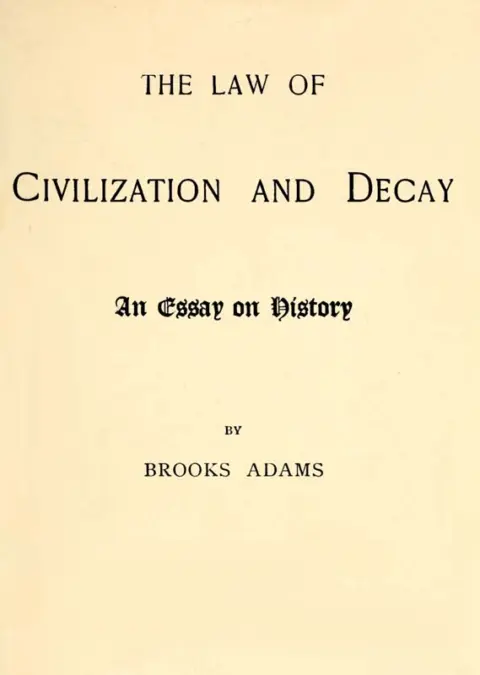
THE CLASSIC COLLECTION · 1896
"The Law of Civilization and Decay: An Essay on History" by Brooks Adams is a work of history privately published in 1895. Adams argues that civilizations follow a predictable cycle of rise and fall, driven by economic and social forces. As societies centralize and accelerate through industrialization, imaginative energy transforms into capital accumulation, causing profound shifts in human temperament and power. Through examples spanning from Rome to modern empires, Adams traces how commercial centers migrate and civilizations decay, suggesting that humanity's fate follows iron laws as inevitable as natural selection itself.
Introduction adapted from the source catalogue; source summaries may be automatically generated.
Free to read · English · 107,746 words · No account needed
MAKE TIME FOR A GOOD BOOK
On by default. Untick to stop anonymous reading totals. Each page counts after 10 seconds in view. How this works.
Anonymous counting is on unless you have switched it off.
Patricians: usurers 7;
not martial 7;
sanction Licinian Laws 10;
see Usury.
Pauperism: under Henry VII I. 249;
in 1848 345.
Peel, Sir Robert: represents Lombard Street 330;
separates from his father on money issue 330;
his Resumption Act 331;
effect of 331;
repeals Corn Laws 340;
parentage 342.
Pelagius, Cardinal: commands crusade 150.
Penny: the Roman, see Denarius;
of Charlemagne 129;
depreciation of Venetian 129;
depreciation of English in fourteenth century 195;
under Henry VIII. 206, 207.
Philip Augustus: regal of France vowed for recovery of 65;
belief in intercession 69;
commands crusade 129;
returns to Fiance 130;
divorced from Ingeburga 135;
excommunicated 135.
Philip the Fair: character of 171;
quarrel with Boniface 172;
defeated at Courtray 175;
seizes Boniface 177;
makes Clement V. pope 178;
arrests Templars 180;
tortures Templars 182;
death of 185.
Pilgrimage of Grace: see Rebellion.
Plassey: battle of 308;
effect of 313.
Plebeians: farmers 6;
form infantry 6;
sold for debt 7;
secede to Mons Sacer 9;
favoured by Licinian Laws 10;
overthrow patricians 10;
suffer from Asiatic competition 11;
suffer from slave labour 12;
insolvent 22;
become coloni 33;
disappear 44, 45.
Police, a paid: lack of, causes defeat of patricians 39;
an effect of money 45;
organized by Augustus 45;
makes capital autocratic at Rome 46;
impossible when the defence in war is superior to the attack 79;
lack of, causes weakness of the Kingdom of Jerusalem 99, 121, 122;
the weapon of an economic community 164;
an effect of wealth and the basis of centralization 165;
in England under Henry VIII. 245;
destroys martial type 245;
drives adventurers from England 254;
resistless in nineteenth century 353.
Pompey: defeat of 364.
Potosi: discovery 207.
Prices: fall of, under Trajan 33;
rise of in thirteenth century 167;
fall of in fifteenth century 203;
rise of in sixteenth century 207, 283;
rise of after Plassey 319;
culminate in 1809 324;
fall of in England after 1815 330;
depressed by gold standard 337;
fall of after Bank Act 339;
rise of after 1849 345;
fall of since 1873 349.
Producers: predominance of 321;
currency system of 328, 329;
weakness of modern 349;
Indian 360.
Puritans: reject royal supremacy 264;
resist ecclesiastical confiscation 270;
eviction of clergy 285;
emigration of 285;
foes of Spaniards 289.
Pyrrhus: admires Roman infantry 11;
defeat of 11.
Raleigh: family of 255;
captures Madre-de-Dios 257;
death of 257.
Raymond de Poitiers: at feud with de Courtney 107;
breach with Louis VII. 117;
death of 118.
Rebellion: of Pilgrimage of Grace 216;
suppression of 222;
Kett’s 250;
in West of England 250, 252.
Reformation: an economic movement 188;
in England 230;
under Edward VI. 259, 260;
see Church of England, Convents, Lollards.
Reginald de Chatillon 121.
Regulus: poverty of 15.
Relics: magical 64;
gifts to 65;
list of English 66;
worship of cause of crusades 81;
true cross 119;
plunder of at Constantinople 148;
despised 151;
relic worship costly 192–196;
desecrated in England 200.
Rent: rise of money value of in Rome 32;
effect of 33, 34;
substitution of for military service 245;
rises in sixteenth century 247;
effect of rise 248;
rise of in seventeenth century 283;
fall of after 1815 causes insolvency of landlords 332;
dependent on Corn Laws 340;
fall of after 1873 ruins gentry 348.
Ridley: doctrine concerning sacrament 261;
burned 282.
Robinson, John: congregation of 285.
Your reading position is saved on this browser. Take it to another device with a library code. Reading pages adapt to text, rather than matching a printed edition.
BEHIND THE BOOK
This eBook is for the use of anyone anywhere in the United States and most other parts of the world at no cost and with almost no restrictions whatsoever. You may copy it, give it away or re-use it under the terms of the Project Gutenberg License included with this eBook or online at www.gutenberg.org. If you are not located in the United States, you will have to check the laws of the country where you are located before using this eBook. Read the source licence.
The original source file, including credits and licence, is retained by this library. Request an original-format copy at no charge. Please include the book title and Project Gutenberg identifier #44908.
KEEP YOUR CURIOSITY GOING

David Patterson (Spirit) Hatch
Cécile Tormay

Moritz Busch
Coulson Kernahan
John L. Ransom

Ralph Waldo Emerson