THE CLASSIC COLLECTION✦The Theory of Social RevolutionsCLASSIC FREE BOOKS
The Theory of Social Revolutions
Brooks Adams
THE CLASSIC COLLECTION · 1896
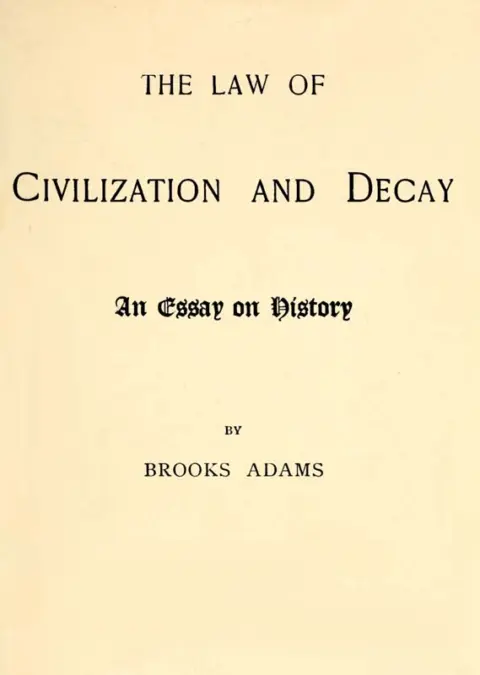
"The Law of Civilization and Decay: An Essay on History" by Brooks Adams is a work of history privately published in 1895. Adams argues that civilizations follow a predictable cycle of rise and fall, driven by economic and social forces. As societies centralize and accelerate through industrialization, imaginative energy transforms into capital accumulation, causing profound shifts in human temperament and power. Through examples spanning from Rome to modern empires, Adams traces how commercial centers migrate and civilizations decay, suggesting that humanity's fate follows iron laws as inevitable as natural selection itself.
Introduction adapted from the source catalogue; source summaries may be automatically generated.
Free to read · English · 107,746 words · No account needed
MAKE TIME FOR A GOOD BOOK
On by default. Untick to stop anonymous reading totals. Each page counts after 10 seconds in view. How this works.
Anonymous counting is on unless you have switched it off.
France: convents of in tenth century 72;
Cluny 73;
decentralization of in eleventh century 80;
money of 80;
barbarian invasions of 80;
seat of Gothic architecture 89;
ogive introduced into 95;
emotional in eleventh century 107;
disintegration of in tenth century 152;
kings of enjoy supernatural powers 153;
alliance of crown with clergy 154;
consolidation of under Philip Augustus 158;
centralization of under Saint Louis 165;
depreciation of coinage of 170;
estates of sustain Philip the Fair 174;
castles of 202.
Frumentariæ Leges, see Corn.
Gardiner, Stephen: on True Obedience 265;
rise of 276;
death of 277.
Germans: hunted by Romans for slaves 39;
used as recruits 40;
invade the Empire 46;
character of in fourth century 48;
adopt the gold standard 347.
Glastonbury: suppression of 240.
Godfrey de Bouillon: elected King of Jerusalem 85;
his kingdom 86;
his alliance with Venice 127.
Gold: ratio of to silver in Roman Empire 30;
fall of value of in sixth century 48;
ratio of to silver in thirteenth century 169.
Gold standard: in Rome 31;
under the Merovingians 80;
in England 330;
Overstone’s views on 337;
in Germany 347;
elsewhere 348;
effect of 347.
Gunther: chronicle of 137;
sails with Dandolo 138.
Hanse of London: organization of 158;
trades at fairs of Champagne 159;
Italian merchants frequent 159.
Hastings: Governor-General 310;
policy of 311.
Hattin: battle of 123.
Hawkins, John: a slaver 289.
Héloïse, hymn of 368.
Henry IV., Emperor: breach with Hildebrand 75;
penance at Canossa 77;
death of 77.
Henry VIII.: court of 212;
character of 220;
Lambert’s trial 226;
supreme head 228;
orthodox 229;
suppresses convents 233;
revises Formularies of Faith 266;
helpless without landlords 267.
Heraclius: disasters under 52.
Hildebrand: prior of Cluny 74;
propositions presented by in council of Rome 75;
excommunicates Henry IV. 76;
Canossa 77.
Holland: decay of 318.
Hospital, see Knights of.
Howard, Thomas, Duke of Norfolk: family of 214;
character of 215;
commands against Pilgrims of Grace 215;
tries to corrupt Darcy 217;
arrests Cromwell 224.
Hugh Capet: elected by clergy 153.
Hugh du Puiset, see Louis the Fat.
Hun, Richard: death of 198.
Imagination: basis of mediæval Church 60;
gives power to priesthood 63;
cause of relic worship 64;
vivid in age of decentralization 69;
most intense in tenth century 72;
evolves Cluny 73;
cause of Hildebrand’s power 78;
cause of crusades 82;
inspires Gothic architecture 89;
strong in Saint Bernard 108;
weakness of Louis VII. 117:
lacking in Venetians 126;
its power in France in thirteenth century 136;
strength of in Church up to 1200 148;
a weakness in war 151;
economic mind lacks 162;
cause of Templars’ martyrdom 183;
lacking in English reformers 191;
Anglican clergy without 259;
Tudor aristocracy without 268;
strong in early Christians 373;
in contempt in nineteenth century 380, 381.
India: failure of Romans to conquer 12;
hoards in 305;
conquered by England 307 et seq.;
spoliation of 309–311;
influx of treasure from 313;
flow of silver to 320;
value of bullion exported to in 1810 321;
in 1840 339;
centralization of 356;
mutiny in 356;
money-lenders of 357;
fate of warlike tribes in 358;
see Eastern trade.
Industrial revolution: begins 313;
caused by Indian treasure 314.
Innocent III.: incites crusade 132;
excommunicates Philip Augustus 135;
Dandolo 138;
absolves Dan dolo 147;
reproves Baldwin 147.
Inquisition: organized 191.
Jacques de Vitry: hates bourgeoisie 163.
Your reading position is saved on this browser. Take it to another device with a library code. Reading pages adapt to text, rather than matching a printed edition.
BEHIND THE BOOK
This eBook is for the use of anyone anywhere in the United States and most other parts of the world at no cost and with almost no restrictions whatsoever. You may copy it, give it away or re-use it under the terms of the Project Gutenberg License included with this eBook or online at www.gutenberg.org. If you are not located in the United States, you will have to check the laws of the country where you are located before using this eBook. Read the source licence.
The original source file, including credits and licence, is retained by this library. Request an original-format copy at no charge. Please include the book title and Project Gutenberg identifier #44908.
KEEP YOUR CURIOSITY GOING

David Patterson (Spirit) Hatch
Cécile Tormay

Moritz Busch
Coulson Kernahan
John L. Ransom

Ralph Waldo Emerson