THE CLASSIC COLLECTION✦The Theory of Social RevolutionsCLASSIC FREE BOOKS
The Theory of Social Revolutions
Brooks Adams
THE CLASSIC COLLECTION · 1896
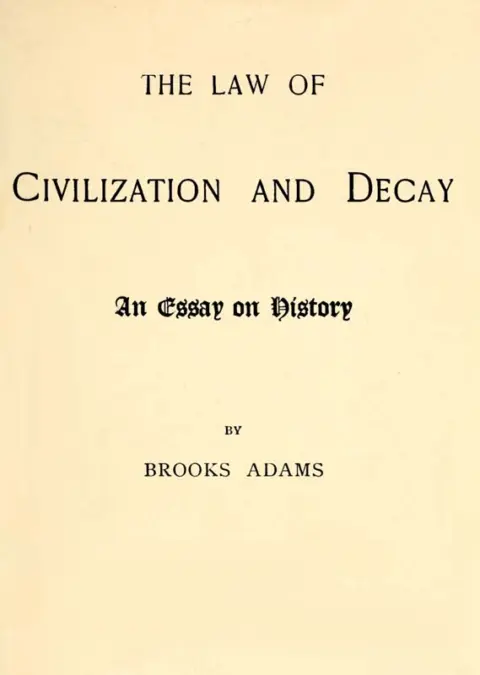
"The Law of Civilization and Decay: An Essay on History" by Brooks Adams is a work of history privately published in 1895. Adams argues that civilizations follow a predictable cycle of rise and fall, driven by economic and social forces. As societies centralize and accelerate through industrialization, imaginative energy transforms into capital accumulation, causing profound shifts in human temperament and power. Through examples spanning from Rome to modern empires, Adams traces how commercial centers migrate and civilizations decay, suggesting that humanity's fate follows iron laws as inevitable as natural selection itself.
Introduction adapted from the source catalogue; source summaries may be automatically generated.
Free to read · English · 107,746 words · No account needed
MAKE TIME FOR A GOOD BOOK
On by default. Untick to stop anonymous reading totals. Each page counts after 10 seconds in view. How this works.
Anonymous counting is on unless you have switched it off.
Credit: dawn of in thirteenth century 167;
rise of modern system of 303;
extension of after Plassey 319;
regulated by Bank Act of 1844 336;
prices dependent on 337;
weapon of the creditor class 349.
Cromwell, Oliver: raises Ironsides 252;
attacks Spanish America 301;
intercepts plate fleet 301.
Cromwell, Thomas: rise of 208;
arrest of 224;
vicar general 231;
proceeds against convents 233:
prosecutes Abbot of Glaston 240;
death of 242.
Cross: miracle worked by at Bosra 119;
see Relics.
Crusade: first 84;
takes Jerusalem 85;
second, preached by Saint Bernard 112;
suffers before Atalia 115;
defeat of 118;
crusading becomes commercial 124;
third, led by Cœur-de-Lion 129;
takes Acre 130;
of Constantinople, preached 132;
reaches Venice 134;
diverted by Dandolo 139;
attacks Zara 138;
sacks Constantinople 145;
of Damietta 150;
defeated in Egypt 151.
Currency: regulated by Charlemagne 129;
mediæval 168;
contraction of in thirteenth century 169;
debasement of English 194;
depreciation of in Middle Ages 204;
under Henry VIII. 207;
paper 303;
management of by producers 326;
by bankers 330;
see Coinage, Bank of England, Bankers.
Dalhousie, Lord: administration of 356.
Damietta, see Crusade.
Dandolo, Henry: character of 132;
treats with Franks 133;
takes command of crusade 137;
diverts crusade 139;
excommunicated 139;
assaults Constantinople 141;
shriven 147.
Darcy, Thomas, Loid: character of 216;
declines to betray Aske 217;
execution of 219;
dying speech to Cromwell 219.
Denarius: depreciation of at Rome 26;
repudiation of 26;
of Charlemagne 128;
of Venice 129;
see Penny.
Diocletian: a slave 27;
established capital at Nicomedia 27;
returns to silver coinage 30.
Divine right: defined 272;
see Church of England.
Divorce: see Domestic relations.
Domestic relations: ancient and modern 365 et seq.
Dovercourt: rood of 200.
Drake: rise of 255;
death of 256;
cruises of 288.
Dudley, John, Duke of Northumberland: rise of 251;
suppresses Kett’s rebellion 252;
supersedes Seymour 261;
quarrel with Knox 262.
East India Companies: organized 292;
English company commercial up to 1757 306;
administration of 309.
Eastern Empire, see Constantinople.
Eastern trade: in Rome 23, 24;
centres at Constantinople 28;
migrates to Italy 126;
early routes of 128;
character of in twelfth century 128;
brings bullion to Europe 129;
centres in Champagne 159;
centres at Antwerp 201;
at Amsterdam 287;
at London 291;
drains silver from Europe 299;
effect of Plassey on 310.
Edessa: position of 86;
capture of 103;
occupied by Baldwin 105.
Egypt: cheap labour of 19;
grain ships of 19;
architecture of 90;
conquered by Saladin 103;
slave trade with Venice of 126;
crusaders defeated in 151.
Elizabeth: greed of 257;
severe to clergy 269;
letter about Ely House 270.
England: Lollardy in 186;
Reformation in, an economic phenomenon 190;
debasement of currency in 194;
martyrdoms in 199;
condition of in Middle Ages 202;
new nobility of 212 et seq.;
convents suppressed in 233 et seq.;
population of in Middle Ages 243;
social revolution in, in sixteenth century 245, 246;
not originally maritime 254;
seamen of 255;
prosperity of in seventeenth century 292;
industrial revolution in 315;
distress in after 1815 332;
ruin of aristocracy of 341, 348;
money-lenders autocratic in 344;
see Bank, and Church of England, and Yeomen.
Exchanges: see Rome, Constantinople, Eastern trade, Fairs of
Champagne, Venice.
Fairs, see Champagne.
Fetish, see Relics.
Fisher: temperament of 277.
Flotte: chancellor of Philip the Fair 165.
Your reading position is saved on this browser. Take it to another device with a library code. Reading pages adapt to text, rather than matching a printed edition.
BEHIND THE BOOK
This eBook is for the use of anyone anywhere in the United States and most other parts of the world at no cost and with almost no restrictions whatsoever. You may copy it, give it away or re-use it under the terms of the Project Gutenberg License included with this eBook or online at www.gutenberg.org. If you are not located in the United States, you will have to check the laws of the country where you are located before using this eBook. Read the source licence.
The original source file, including credits and licence, is retained by this library. Request an original-format copy at no charge. Please include the book title and Project Gutenberg identifier #44908.
KEEP YOUR CURIOSITY GOING

David Patterson (Spirit) Hatch
Cécile Tormay

Moritz Busch
Coulson Kernahan
John L. Ransom

Ralph Waldo Emerson