
Neka, the boy conjuror
Edward Stratemeyer
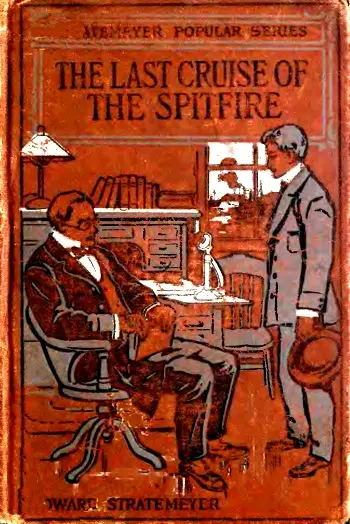
THE CLASSIC COLLECTION · 1894
"The Last Cruise of the Spitfire; or, Luke Foster's Strange Voyage" by Edward Stratemeyer is a novel written in the late 19th century. This story revolves around a young boy named Luke Foster, who feels oppressed under the caretaking of his harsh uncle, Felix Stillwell. After discovering that his uncle is not who he seems, and amidst his struggles with family dynamics and the beginnings of a thrilling maritime adventure, Luke embarks on a journey that combines elements of mystery, adventure, and self-discovery. The beginning of the book introduces readers to Luke's unhappy life in New York City, where he is virtually a servant in his uncle’s office. On the day of his seventeenth birthday, after being mistreated and denied a holiday, Luke finds himself embroiled in a series of events that lead him to discover a shocking letter revealing his true guardian is not his uncle. Shortly thereafter, he's accused of theft when a large sum of money goes missing from the office safe. In a dramatic turn of circumstances, he is captured and forced aboard a ship, the Spitfire, where he learns about the ship’s dubious crew and their sinister plans. The story sets the stage for Luke's transformation from a mistreated boy to a more self-reliant individual as he navigates through danger and uncertainty on the open sea.
Introduction adapted from the source catalogue; source summaries may be automatically generated.
Free to read · English · 46,668 words · No account needed
MAKE TIME FOR A GOOD BOOK
On by default. Untick to stop anonymous reading totals. Each page counts after 10 seconds in view. How this works.
Anonymous counting is on unless you have switched it off.
To be suddenly aroused out of a sound sleep, and immediately afterwards to find yourself struggling in deep, dark water is not an experience to be desired. The first plunge made me shiver from head to foot, and it was only by instinct that I kept my mouth shut and struck out to keep myself afloat.
I had not the slightest notion of what had happened, and in the darkness could see nothing. It was some time ere I could recover and call out to the cabin boy:
"What is it, Phil? Where are you?"
"Here I am," he cried, close beside me; and an instant later his hand
touched my body.
"What happened?" I repeated.
"I don't know," he replied. "Either something struck the boat, or else
we hit a rock."
"I don't think we are near enough to shore to strike a rock," I
rejoined.
"Well, what was it then?"
"I don't know, and what's more I'm not going to try to find out just at present. Where is the raft?"
"I guess the Hasty has gone to the bottom. I can't see her anywhere
around."
"Don't be foolish. She couldn't sink."
"That's so; I forgot. Well, where is she then?"
"We must find her. Can you keep on swimming?"
"For awhile. But don't leave me!" added the cabin boy in sudden alarm.
"I won't. We can swim together. Take it easy."
Side by side we struck out. My thoughts were busy. Suppose we were not able to find the raft? To swim any great distance would be impossible, and we could not float forever.
"It's hard work, and no mistake," said Phil, after a few moments of silence. "I can't go much further."
"Suppose we let ourselves drift with the current."
"That's a good plan, for I suppose the Hasty did the same thing."
So we allowed ourselves to drift for fully ten minutes. Fortunately both of us were good swimmers, and understood the art of floating. If not, it might have gone hard with us.
"What's that ahead?" cried the cabin boy, at length.
"Where?"
"There! To the right!"
I strained my eyes. Was it a light? Yes; not one but several, and all
moving rapidly away.
"It's a boat!" I cried. "Let us yell."
And yell we did; once, twice, and then a dozen times, in a tone that made me so hoarse I could hardly speak afterwards.
"It's no use," said Phil. "It's a steamer, and they won't pay any
attention."
"I shouldn't wonder but that it was the vessel that struck us?" I
exclaimed.
"Most likely. But if they would only pick us up I wouldn't care a
straw."
Your reading position is saved on this browser. Take it to another device with a library code. Reading pages adapt to text, rather than matching a printed edition.
Edward Stratemeyer

Edward Stratemeyer
Edward Stratemeyer

Edward Stratemeyer
BEHIND THE BOOK
This eBook is for the use of anyone anywhere in the United States and most other parts of the world at no cost and with almost no restrictions whatsoever. You may copy it, give it away or re-use it under the terms of the Project Gutenberg License included with this eBook or online at www.gutenberg.org. If you are not located in the United States, you will have to check the laws of the country where you are located before using this eBook. Read the source licence.
The original source file, including credits and licence, is retained by this library. Request an original-format copy at no charge. Please include the book title and Project Gutenberg identifier #34367.
KEEP YOUR CURIOSITY GOING
Wilfrid Scawen Blunt
Wilfrid Scawen Blunt

E. W. (Edgar Watson) Howe
Coulson Kernahan

Maurice Baring
Frances Wright