
Neka, the boy conjuror
Edward Stratemeyer
THE CLASSIC COLLECTION · 1894
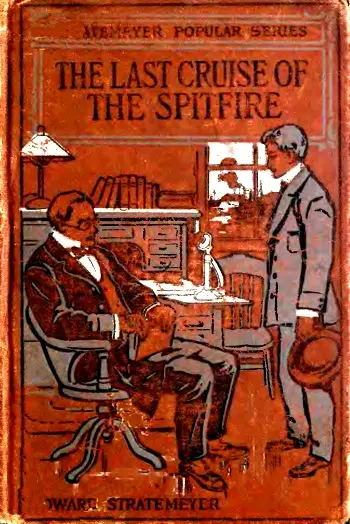
"The Last Cruise of the Spitfire; or, Luke Foster's Strange Voyage" by Edward Stratemeyer is a novel written in the late 19th century. This story revolves around a young boy named Luke Foster, who feels oppressed under the caretaking of his harsh uncle, Felix Stillwell. After discovering that his uncle is not who he seems, and amidst his struggles with family dynamics and the beginnings of a thrilling maritime adventure, Luke embarks on a journey that combines elements of mystery, adventure, and self-discovery. The beginning of the book introduces readers to Luke's unhappy life in New York City, where he is virtually a servant in his uncle’s office. On the day of his seventeenth birthday, after being mistreated and denied a holiday, Luke finds himself embroiled in a series of events that lead him to discover a shocking letter revealing his true guardian is not his uncle. Shortly thereafter, he's accused of theft when a large sum of money goes missing from the office safe. In a dramatic turn of circumstances, he is captured and forced aboard a ship, the Spitfire, where he learns about the ship’s dubious crew and their sinister plans. The story sets the stage for Luke's transformation from a mistreated boy to a more self-reliant individual as he navigates through danger and uncertainty on the open sea.
Introduction adapted from the source catalogue; source summaries may be automatically generated.
Free to read · English · 46,668 words · No account needed
MAKE TIME FOR A GOOD BOOK
On by default. Untick to stop anonymous reading totals. Each page counts after 10 seconds in view. How this works.
Anonymous counting is on unless you have switched it off.
"A good many things that you don't dream of. You are not treating me rightly, and you know it. You don't give me decent clothing to wear, and I have to work harder than any one in the office. I am sure my father never intended such a future for his son."
"I don't care what you father intended!" he snarled.
"But I do, and what is more, I intend, sooner or later, to try to have matters mended. My father always told me he wished me to keep on going to school and then to enter Princeton."
"Never mind, I am your guardian now, and I know what is best for you."
"How much money did my father leave me?" I asked, with considerable
curiosity.
"None of your business."
"Oh, but it is my business."
"It is not your business, and I want you to shut up!" he cried, in a rage. "He left little enough."
"Little enough," I cried. "My father was rich."
"He was at one time; but he lost the most of his fortune in stocks just before he died. You have hardly enough to keep you until you are twenty-one."
I must confess that my uncle's remarks were quite a shock to me. I had always supposed that I would some day be wealthy. I gave the matter a moment's thought, and then came to the conclusion that Mr. Stillwell was not telling the truth.
"How much money did my father leave?" I repeated. "I am entitled to
know."
"You will know when I get ready to tell you, not before."
"Perhaps you are mistaken," said I. "And another thing, Uncle Felix, how is it that you were appointed my guardian?"
At these words I fancied my uncle turned pale. He sprang towards me,
then stopped short.
"What do you mean by that question?" he demanded.
"I mean why were you made my guardian when my father and you were not on
good terms?"
"Pooh, that quarrel was of no consequence," was the lofty reply. "Your father could not find a better person in which to trust his son's care."
I had my own opinion on that point, but did not find it fit to say so. Then I put in what I thought was a master stroke.
"I thought Mr. Banker was to be my guardian."
At these words Mr. Stillwell turned even paler than before, and his hand trembled as he pointed his long finger at me in a threatening manner.
"You think too much!" he growled.
"Are you going to answer that question?"
"What put it into your head?"
"Never mind."
"Has John Banker been writing to you about it?"
Your reading position is saved on this browser. Take it to another device with a library code. Reading pages adapt to text, rather than matching a printed edition.
Edward Stratemeyer

Edward Stratemeyer
Edward Stratemeyer

Edward Stratemeyer
BEHIND THE BOOK
This eBook is for the use of anyone anywhere in the United States and most other parts of the world at no cost and with almost no restrictions whatsoever. You may copy it, give it away or re-use it under the terms of the Project Gutenberg License included with this eBook or online at www.gutenberg.org. If you are not located in the United States, you will have to check the laws of the country where you are located before using this eBook. Read the source licence.
The original source file, including credits and licence, is retained by this library. Request an original-format copy at no charge. Please include the book title and Project Gutenberg identifier #34367.
KEEP YOUR CURIOSITY GOING
Wilfrid Scawen Blunt
Wilfrid Scawen Blunt

E. W. (Edgar Watson) Howe
Coulson Kernahan

Maurice Baring
Frances Wright