
Neka, the boy conjuror
Edward Stratemeyer
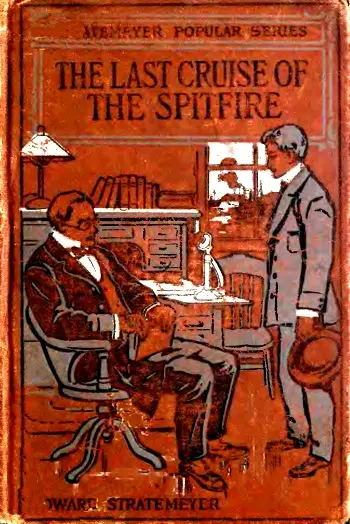
THE CLASSIC COLLECTION · 1894
"The Last Cruise of the Spitfire; or, Luke Foster's Strange Voyage" by Edward Stratemeyer is a novel written in the late 19th century. This story revolves around a young boy named Luke Foster, who feels oppressed under the caretaking of his harsh uncle, Felix Stillwell. After discovering that his uncle is not who he seems, and amidst his struggles with family dynamics and the beginnings of a thrilling maritime adventure, Luke embarks on a journey that combines elements of mystery, adventure, and self-discovery. The beginning of the book introduces readers to Luke's unhappy life in New York City, where he is virtually a servant in his uncle’s office. On the day of his seventeenth birthday, after being mistreated and denied a holiday, Luke finds himself embroiled in a series of events that lead him to discover a shocking letter revealing his true guardian is not his uncle. Shortly thereafter, he's accused of theft when a large sum of money goes missing from the office safe. In a dramatic turn of circumstances, he is captured and forced aboard a ship, the Spitfire, where he learns about the ship’s dubious crew and their sinister plans. The story sets the stage for Luke's transformation from a mistreated boy to a more self-reliant individual as he navigates through danger and uncertainty on the open sea.
Introduction adapted from the source catalogue; source summaries may be automatically generated.
Free to read · English · 46,668 words · No account needed
MAKE TIME FOR A GOOD BOOK
On by default. Untick to stop anonymous reading totals. Each page counts after 10 seconds in view. How this works.
Anonymous counting is on unless you have switched it off.
"I think I will take a walk out and post it," I said, for to write the letters had taken over an hour and a half, and I felt somewhat cramped from the work.
"All right. You will find me in the room when you return. Remember it is
number 67."
I walked out upon the busy street. It was brightly lighted, and in the evening looked very similar to Fourteenth Street in New York.
I found a mail-box on the corner, and dropped my letter in it.
I was just turning away from the box when I felt a hand on my arm and a
cheery voice called out:
"Well, dash my toplights, if it ain't Luke Foster! How under the polar star did you git here, boy?"
I turned swiftly and found that the man who had addressed me so cheerily was none other than Tony Dibble.
"Why, Dibble!" I returned, warmly, and clasped his hand.
"I thought you was on your way to Liverpool."
"I just got in Boston," I returned.
"And where's the Spitfire?"
"At the bottom of the Atlantic, Dibble."
"No!" He stared at me for a moment. "Then the old man----" he began in a
whisper.
"Hush! not so loud!" I interrupted. "Somebody may overhear you."
"That's so." He lowered his voice still more. "She was really done for,
then?"
"Yes, burned up."
"Too bad! She was an old tub, nothin' better. But I kinder loved her, havin' sailed in her so long. The villains! They ought to be strung up to the yard-arm, every one of 'em!"
"How did you get here?" I asked, curiously.
"Just came up from New Bedford. That there lawyer, Ranson, said I had better come up here and wait till I heard from him. He was going to git a boat and go after the Spitfire."
"He did get a boat, and rescued Phil Jones and I from a raft, after the
Spitfire was burned."
"Good for him! And where is the captain now?"
"Locked up."
"What!" roared Tony Dibble, in amazement. "Do you mean to tell me they
caught him red-handed?"
"Hardly, but they caught him, and the others, too."
"Good!"
"Mr. Ranson is now stopping at the Ridgerow House, and I am stopping
with him."
"Yes, he told me the name of the hotel. I was on the way down there now to see if he had got back."
"Perhaps you can help him as a witness against Captain Hannock," I went
on.
"I reckon I can. I ain't a lovin' the captain much, I can tell you."
"I suppose not."
Your reading position is saved on this browser. Take it to another device with a library code. Reading pages adapt to text, rather than matching a printed edition.
Edward Stratemeyer

Edward Stratemeyer
Edward Stratemeyer

Edward Stratemeyer
BEHIND THE BOOK
This eBook is for the use of anyone anywhere in the United States and most other parts of the world at no cost and with almost no restrictions whatsoever. You may copy it, give it away or re-use it under the terms of the Project Gutenberg License included with this eBook or online at www.gutenberg.org. If you are not located in the United States, you will have to check the laws of the country where you are located before using this eBook. Read the source licence.
The original source file, including credits and licence, is retained by this library. Request an original-format copy at no charge. Please include the book title and Project Gutenberg identifier #34367.
KEEP YOUR CURIOSITY GOING
Wilfrid Scawen Blunt
Wilfrid Scawen Blunt

E. W. (Edgar Watson) Howe
Coulson Kernahan

Maurice Baring
Frances Wright