Peter Jameson: A Modern Romance
Gilbert Frankau
THE CLASSIC COLLECTION · 1918
"The Judgement of Valhalla" by Gilbert Frankau is a collection of war poetry written in the early 20th century, during the time of World War I. The book explores the themes of honor, disgrace, and the moral complexities surrounding life and death in battle. Through vivid imagery and emotional intensity, Frankau delves into the psyche of soldiers, addressing both the glory of combat and the shame of cowardice. The collection presents a series of poems that hauntingly depict the brutal realities of war and the judgments that follow in the afterlife. Characters such as a deserter confront their fate in Valhalla, the hall of the slain, only to discover that cowardice is punished. Through verses like "The Song of the Red-Edged Steel" and "The Eye and the Truth," Frankau emphasizes the brutal choices faced by soldiers—between courage and shame, life and death—highlighting the struggle against the chaos of warfare. This poignant exploration leaves readers with a stark understanding of the psychological toll of battle and the elusive nature of valor.
Introduction adapted from the source catalogue; source summaries may be automatically generated.
Free to read · English · 8,731 words · No account needed
MAKE TIME FOR A GOOD BOOK
On by default. Untick to stop anonymous reading totals. Each page counts after 10 seconds in view. How this works.
Anonymous counting is on unless you have switched it off.
Arms have I sung full oft, both steel and white ones; Guns have I sung till I can sing no more; Men have I sung, both common and polite ones: Yet never sang one heroine before. Come, then, my ghost-girls, dark, fair, plump, and slight ones, Come in the finest, flimsiest frocks ye wore.... Alas, not one of you quite fills the bill-- A life-size model for my Lady Jill.
Pardon, then, Magda, Gladys, Nancy, Florence, Doris, Patricia, Mollie, Celandine, Nor hold your erstwhile suitor in abhorrence Because, from one, he takes eyes subtly green; From other, hands a Sargent or a Lawrence Had envied for his canvas; here, the sheen Of gold hair, auburn-shot, in whose abundance, What time Jill dreamed, young Cupids watched the sun dance;
There a smooth throat, an arched, attractive ankle, Soft cheek, curved back in bloom to close-set ear, Red mouth full-lipped, a voice whose love-tones rankle Still in this heart of mine,--a voice so dear That ... But no more! In fear this rhyming prank’ll Offend some damozel whom I revere, I state: Jill’s just an ordinary blonde, Fair, frail, flirtatious, rather fast than fond.
You know the type--aristo-plutocratic, Out of blue blood by hard North Country cash; A self-assertive sire; a dam, lymphatic (Since rarely strawberry leaves and sovereigns clash); Their sole son, daring in the diplomatic (Thumping his Underwood while kingdoms crash); Their daughter ... Is there a man alive can swear Exactly what she did or did not dare?
For Jill was one of those astounding females, Born in a chaster, pre-Edwardian day; When lone Lucindas dared not dine nor tea males For dread lest scandal dub them “coryphée”; When none drank deep of D’Abernonian dream-ales, But quietly our Empire went its way, Nor realised that subalterns on horses Monopolized the brain-power of its Forces:
One who was yet a span from flapperhood, Still puzzling o’er the simplest of equations; What time in robe of saffron Phoebus stood, And all our Lanes were gay with green carnations, And private hansoms sought the Johnian Wood, And the shrill cycle-bell’s first tintillations Resounded from the dawning to the dark In a Rolls-Royceless, Peter Panless Park:
One who attained the pig-tail’s ribboned dowry, And helped to pass a Kipling tambourine, When first from lands of wattle, maple, Maori, Men came at summons of a dying Queen: One who, at Auteuil, Dresden, and Rathgowrie, Acquired that polish reft of which, I ween, It is not possible for our Dianas To emulate a modern grande dame’s manners:
Your reading position is saved on this browser. Take it to another device with a library code. Reading pages adapt to text, rather than matching a printed edition.
Gilbert Frankau
Gilbert Frankau
Gilbert Frankau
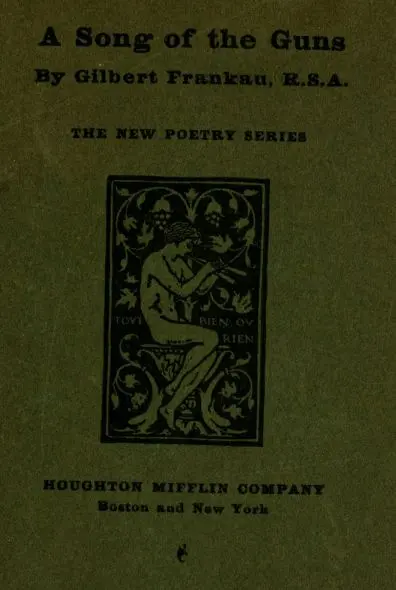
Gilbert Frankau
BEHIND THE BOOK
This eBook is for the use of anyone anywhere in the United States and most other parts of the world at no cost and with almost no restrictions whatsoever. You may copy it, give it away or re-use it under the terms of the Project Gutenberg License included with this eBook or online at www.gutenberg.org. If you are not located in the United States, you will have to check the laws of the country where you are located before using this eBook. Read the source licence.
The original source file, including credits and licence, is retained by this library. Request an original-format copy at no charge. Please include the book title and Project Gutenberg identifier #53756.
KEEP YOUR CURIOSITY GOING
Cécile Tormay

Moritz Busch
John L. Ransom
Frances Wright
Cécile Tormay

Mabel Potter Daggett