THE CLASSIC COLLECTION✦An outlaw’s diary: the CommuneCLASSIC FREE BOOKS
An outlaw’s diary: the Commune
Cécile Tormay
THE CLASSIC COLLECTION · 1885
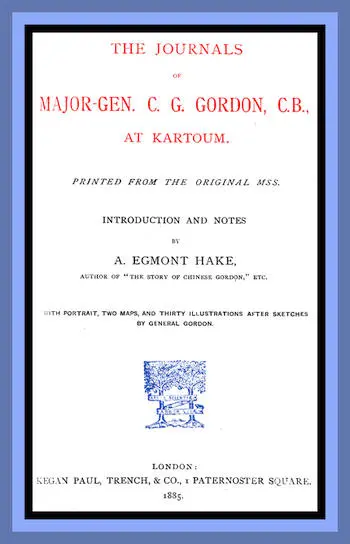
"The Journals of Major-Gen. C. G. Gordon, C.B., at Kartoum" by Charles George Gordon is a historical account written in the late 19th century. This work details the journals of General Gordon during his time in Kartoum, shedding light on the challenging conditions in Sudan and his efforts to navigate the complex political and military landscape of the region. At the start of the book, the author presents Gordon's initial observations and experiences following his appointment as Governor-General of the Sudan. The opening chapters describe his reflections on the dire circumstances faced by the local population, the oppressive regime in place, and his commitment to assisting the Soudanese people while opposing the slave trade. Gordon expresses a blend of hope and concern as he documents the precarious situation around Kartoum, emphasizing both his sense of duty and the moral complexities of his mission amidst rising tensions and rebellion from groups like the Mahdi. The tone suggests a deep introspection as he grapples with the responsibilities thrust upon him and the challenges of implementing meaningful reform.
Introduction adapted from the source catalogue; source summaries may be automatically generated.
Free to read · English · 174,578 words · No account needed
MAKE TIME FOR A GOOD BOOK
On by default. Untick to stop anonymous reading totals. Each page counts after 10 seconds in view. How this works.
Anonymous counting is on unless you have switched it off.
[337] The existence of these two despatches was not known to Sir E. Baring till they appeared in the ‘Egyptian Gazette’ of the 27th November. Chérif Pasha had previously informed him that nothing had been heard of General Hicks since the 27th September, the date on which he started from Duem. Chérif Pasha subsequently admitted that he was mistaken in making that statement.
[338] The undermentioned European officers are believed to have perished, viz.—Lieut.-General Hicks, Colonel Farquhar, Majors Warner, Massey, Evans, Alfred Freiherr von Seckendorff, Captains Arthur Herlth, and Alexander Matyuga, Lieut. Morris Brody, late Sergeant-Major R.H.A., Surgeon-General Georges Bey, and Surgeon-Major Rosenberg. And with them, Al-ed-Deen Pasha, Governor-General of the Soudan, and many Egyptian officers of high rank. Mr. O’Donovan and Mr. Vizetelly, newspaper correspondents who accompanied the expedition, have not since been heard of.
[339] The Paris Temps of 23rd November, 1883, states that the Mahdi’s forces are organised and commanded by a Frenchman named Soulié, who has lived for many years in Egypt. He went there after having served in the French Army; and, after the bombardment of Alexandria, went to Kartoum, whence he proceeded to join the False Prophet, soon making his way into the latter’s graces, and obtaining his confidence.
[340] Galabat, Kalabat and Metemma are the same place.
[341] This territory is called Bogos by the Abyssinians, and Senheit by the Egyptians. Its capital is Keren.
[342] Evidently Colonel Stewart’s journal.
[343] Colonel Stewart’s Journal.
[344] Suggests that, in place of the railway from Wady Halfa, the Cataracts be passed as suggested by General Gordon.
[345] The word Mahdi signifies guide.
[346] Lupton Bey’s assumed name.
[347] The term Seyyed (Lord) is given only to the reputed descendants
(or family) of Mahommed.
[348] Shakka is often pronounced Shagga.
[349] The word here used is the one from which Khalif is derived.
[350] This word primarily means the pole or axis of the Universe, &c.
[351] The saint who is supposed to be immortal, and to have appeared first as Elijah and afterwards as St. George.
[352] The Mohammedans divide the Jinns (or demons) into believers in
Mohammed and unbelievers.
[353] The Angel of Death.
[354] This Hegira is an evident imitation of the Flight of Mahomed.
[355] Verses; usually applied to verses of the Koran.
[356] Inasmuch as Abraham, the Friend of God, was a pilgrim who left his land and his father’s house by Divine command to escape the idolators.
[357] This paragraph is thus repeated in the original.
[358] For one of these, see Roth’s letter.
—Obvious print and punctuation errors were corrected.
Your reading position is saved on this browser. Take it to another device with a library code. Reading pages adapt to text, rather than matching a printed edition.
BEHIND THE BOOK
This eBook is for the use of anyone anywhere in the United States and most other parts of the world at no cost and with almost no restrictions whatsoever. You may copy it, give it away or re-use it under the terms of the Project Gutenberg License included with this eBook or online at www.gutenberg.org. If you are not located in the United States, you will have to check the laws of the country where you are located before using this eBook. Read the source licence.
The original source file, including credits and licence, is retained by this library. Request an original-format copy at no charge. Please include the book title and Project Gutenberg identifier #49224.
KEEP YOUR CURIOSITY GOING
Cécile Tormay

Moritz Busch
John L. Ransom
Frances Wright
Cécile Tormay

Mabel Potter Daggett