THE CLASSIC COLLECTION✦An outlaw’s diary: the CommuneCLASSIC FREE BOOKS
An outlaw’s diary: the Commune
Cécile Tormay
THE CLASSIC COLLECTION · 1885
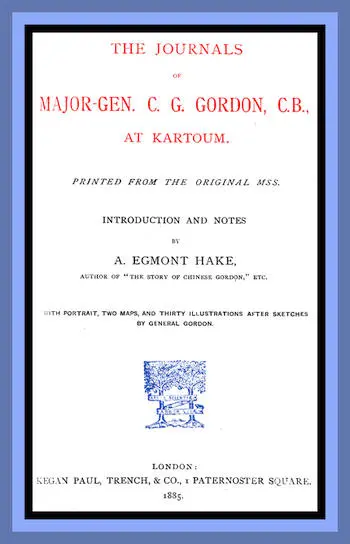
"The Journals of Major-Gen. C. G. Gordon, C.B., at Kartoum" by Charles George Gordon is a historical account written in the late 19th century. This work details the journals of General Gordon during his time in Kartoum, shedding light on the challenging conditions in Sudan and his efforts to navigate the complex political and military landscape of the region. At the start of the book, the author presents Gordon's initial observations and experiences following his appointment as Governor-General of the Sudan. The opening chapters describe his reflections on the dire circumstances faced by the local population, the oppressive regime in place, and his commitment to assisting the Soudanese people while opposing the slave trade. Gordon expresses a blend of hope and concern as he documents the precarious situation around Kartoum, emphasizing both his sense of duty and the moral complexities of his mission amidst rising tensions and rebellion from groups like the Mahdi. The tone suggests a deep introspection as he grapples with the responsibilities thrust upon him and the challenges of implementing meaningful reform.
Introduction adapted from the source catalogue; source summaries may be automatically generated.
Free to read · English · 174,578 words · No account needed
MAKE TIME FOR A GOOD BOOK
On by default. Untick to stop anonymous reading totals. Each page counts after 10 seconds in view. How this works.
Anonymous counting is on unless you have switched it off.
[280] This opinion hardly agrees with that of a military correspondent of the Times, who, writing from Kartoum, on the 24th July, 1883, states that to preserve tranquillity at ordinary times, 9,000 troops, exclusive of the garrison of Kartoum, would be necessary, even supposing the provinces of Kordofan and Darfur to be abandoned, as has been recommended by several high authorities. He suggests that the 9,000 troops should be distributed as follows—viz., 4,000 between Kartoum and Jebel Ain, on both sides of the White Nile, 1,000 at Fashoda to keep the Denka tribes and Shilluks in order, and 4,000 on the Blue Nile, between Kartoum and Karkoj.
[281] South of Kordofan. This district is principally inhabited by negro tribes, with a king of their own, nominally subject to Kordofan.
[282] About 150 miles north-west of Kaka on the White Nile.
[283] A tribe above Korti, on the left bank of the Nile.
[284] An Italian of great force of character. He joined Colonel Gordon’s Staff in the summer of 1874, and subsequently became Governor of the Bahr-el-Ghazāl province.
[285] A district on the Abyssinian frontier near the sources of the
Atbara.
[286] Sometimes called Suk-abu-Sin.
[287] Above Sennaar on the Blue Nile.
[288] A negro tribe, numbering nearly a million souls, inhabiting the banks of the White Nile for 200 miles northwards from the mouth of the Ghazal river.
[289] A powerful Arab tribe, living in the country between the Atbara
and Kartoum.
[290] Capital of Kordofan.
[291] A large town in the south of Darfur.
[292] A district south of Kordofan.
[293] A district called by the Abysrians Bogos, on the road between
Kassala and Massowah.
[294] A pretty town, with a good supply of water, and surrounded by
excellent gardens.
[295] One ardeb = 5⅗ bushels.
[296] A kind of maize.
[297] The information concerning the events of the rebellion up to the arrival of Lieut.-Colonel Stewart at Kartoum, is derived almost entirely from native sources, and it is consequently impossible to put much reliance on the statements as to the extent of the losses in the various engagements. It is even difficult to ascertain the correct dates of the principal events. Some accounts state that the assaults on El Obeyed took place on the 4th, 5th and 6th September.
[298] South of the country of the Baggara Arabs, and west of Bahr
el-Ghazel.
[299] Bara is due north of Obeyed.
[300] The Fakirs are learned pious men. The Dervishes are their
satellites.
[301] The junction between the 1st Battalion and Abdel Kader’s force was to have taken place on the 15th January, but, for some reason or other, it did not take place till Abdel Kader’s arrival at Kawa on the 1st February.
[302] An Arab tribe inhabiting the country between Sennaar and Fazokl.
Your reading position is saved on this browser. Take it to another device with a library code. Reading pages adapt to text, rather than matching a printed edition.
BEHIND THE BOOK
This eBook is for the use of anyone anywhere in the United States and most other parts of the world at no cost and with almost no restrictions whatsoever. You may copy it, give it away or re-use it under the terms of the Project Gutenberg License included with this eBook or online at www.gutenberg.org. If you are not located in the United States, you will have to check the laws of the country where you are located before using this eBook. Read the source licence.
The original source file, including credits and licence, is retained by this library. Request an original-format copy at no charge. Please include the book title and Project Gutenberg identifier #49224.
KEEP YOUR CURIOSITY GOING
Cécile Tormay

Moritz Busch
John L. Ransom
Frances Wright
Cécile Tormay

Mabel Potter Daggett