THE CLASSIC COLLECTION✦An outlaw’s diary: the CommuneCLASSIC FREE BOOKS
An outlaw’s diary: the Commune
Cécile Tormay
THE CLASSIC COLLECTION · 1885
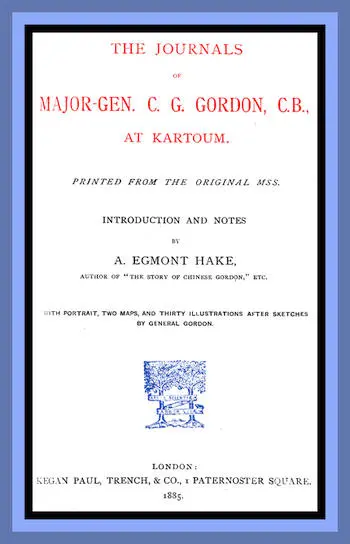
"The Journals of Major-Gen. C. G. Gordon, C.B., at Kartoum" by Charles George Gordon is a historical account written in the late 19th century. This work details the journals of General Gordon during his time in Kartoum, shedding light on the challenging conditions in Sudan and his efforts to navigate the complex political and military landscape of the region. At the start of the book, the author presents Gordon's initial observations and experiences following his appointment as Governor-General of the Sudan. The opening chapters describe his reflections on the dire circumstances faced by the local population, the oppressive regime in place, and his commitment to assisting the Soudanese people while opposing the slave trade. Gordon expresses a blend of hope and concern as he documents the precarious situation around Kartoum, emphasizing both his sense of duty and the moral complexities of his mission amidst rising tensions and rebellion from groups like the Mahdi. The tone suggests a deep introspection as he grapples with the responsibilities thrust upon him and the challenges of implementing meaningful reform.
Introduction adapted from the source catalogue; source summaries may be automatically generated.
Free to read · English · 174,578 words · No account needed
MAKE TIME FOR A GOOD BOOK
On by default. Untick to stop anonymous reading totals. Each page counts after 10 seconds in view. How this works.
Anonymous counting is on unless you have switched it off.
[257] “It is rather amusing to see the personality of this Arab
battery:” p. 42.—ED.
[258] General Gordon here declines to fight the Khedive’s ministerial
battles.—ED.
[259] i.e. General Gordon.—ED.
[260] Title of the Book, ‘The Dissipation of Gloom from all
(Mohammedan) Peoples.’
[261] The Moslems say that the Koran was sent down, every word of it, by the Angel Gabriel to Mahomed.
[262] This verse is considered to be the completion of God’s final Revelation through Mahomed.
[263] The Hadiths—the authorised traditional sayings of Mahomed and those brought down by Gabriel.
[264] In Arabic writing quotation marks are not used, but, at the end of the quotation, they append the words, “End of his words.”
[265] Saadat—“Felicity”—is used as title of honour, and cannot, of course, be properly used for one who is a Kāfir and under Divine wrath.
[266] “Peace be on him” (on whom be peace), the usual formula of salutation to a true believer if alive, and used of prophets when their names are mentioned.
[267] Prince of the Faith—literally, axis or pole.
[268] The argument here rests upon the duty of avoiding force in dealing with brother Moslems, and of using persuasion only.
[269] The argument here is that true believers are sometimes killed, though in the right, as the Israelites were by Nebuchadnezzar.
[270] “Yellow-haired Greeks”—the ancient phrase here applied as “Children of the Yellow (race),” the yellow-haired Russians being meant.
[271] The intention of the writer seems to be to convey reproach of the Government authorities in Cairo, who were responsible for the fate of the army and his own desperate condition. But he seems unwilling to utter a word inconsistent with Moslem resignation or the loyalty of a soldier, though the detachment to which he belonged had been exposed to destruction.
[272] The latest accounts from the Soudan state that Ibn en Najoomi has quarrelled with Mahomed el Khair on account of his peculations.
[273] Query—Does this refer to a veil such as dervishes wear, which was sent to a renegade by the Mahdi?
[274] Reference is here made to the earthquake mentioned in a former letter, as being prepared by Gordon.
[275] Evidently a wrong enclosure had been put in by General Gordon.
[276] Slatin’s new name.
[277] This document came down with the fourth Journal. It was compiled in the Intelligence Branch, Quartermaster-General’s Department of the War Office.
[278] Powerful nomad tribes inhabiting the country west of the White Nile, and south east of Kordofan and Darfur.
[279] A body corresponding to the Divines in Christendom, who are appealed to by the Sultan respecting the right application of precepts of the Moslem faith, and their decision is known as a fetua.
Your reading position is saved on this browser. Take it to another device with a library code. Reading pages adapt to text, rather than matching a printed edition.
BEHIND THE BOOK
This eBook is for the use of anyone anywhere in the United States and most other parts of the world at no cost and with almost no restrictions whatsoever. You may copy it, give it away or re-use it under the terms of the Project Gutenberg License included with this eBook or online at www.gutenberg.org. If you are not located in the United States, you will have to check the laws of the country where you are located before using this eBook. Read the source licence.
The original source file, including credits and licence, is retained by this library. Request an original-format copy at no charge. Please include the book title and Project Gutenberg identifier #49224.
KEEP YOUR CURIOSITY GOING
Cécile Tormay

Moritz Busch
John L. Ransom
Frances Wright
Cécile Tormay

Mabel Potter Daggett