THE CLASSIC COLLECTION✦My diaries, being a personal narrative of events 1888-1914, Part 2 (1900-1914)CLASSIC FREE BOOKS
My diaries, being a personal narrative of events 1888-1914, Part 2 (1900-1914)
Wilfrid Scawen Blunt
THE CLASSIC COLLECTION · 1898
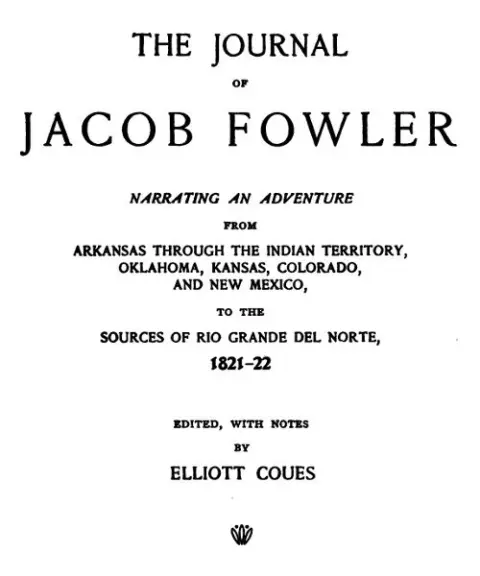
"The Journal of Jacob Fowler" by Jacob Fowler is a historical account documenting a remarkable journey through the American West during the early 19th century. The narrative covers Fowler's expedition from Fort Smith through various territories, including Arkansas, Oklahoma, Kansas, Colorado, and New Mexico, in 1821-22. The text provides a firsthand account of the challenges faced and observations made by the author and his companions as they navigate uncharted territories and encounter both natural obstacles and indigenous peoples. The opening of the journal introduces readers to the initial stages of this adventurous journey, beginning on September 6, 1821. Jacob Fowler describes crossing rivers, traversing rich lands, and encountering both wildlife and challenging terrain, often while battling harsh weather conditions. As the party progresses, they set up camps, forage for food, and contend with the perils of travel, such as losing pack animals and maintaining supplies. The narrative is characterized by Fowler's detailed descriptions and personal reflections, immersing readers in the hardships and triumphs of early American exploration.
Introduction adapted from the source catalogue; source summaries may be automatically generated.
Free to read · English · 48,766 words · No account needed
MAKE TIME FOR A GOOD BOOK
On by default. Untick to stop anonymous reading totals. Each page counts after 10 seconds in view. How this works.
Anonymous counting is on unless you have switched it off.
[87] Besides the distance above given for making the pass to-day. Camp on Sangre de Cristo creek, which flows past Fort Garland into Trinchera creek, in the San Luis valley. That branch of the D. and R. G. R. R. which goes through the Veta pass follows down the creek on which Fowler is camped.
[88] Trinchera creek. Fowler seems to have left Sangre de Cristo creek at a point about 4 m. E. of Fort Garland.
[89] A portion of the San Luis valley, through which the Rio Grande flows for a great distance. See Pike, ed. of 1895, p. 492.
[90] Rio Culebra, next tributary of the Rio Grande from the E. See Pike,
ed. of 1895, p. 494.
[91] The San Luis hills, on each side of the Rio Grande near the Rio
Culebra.
[92] Rio Costilla, next tributary of the Rio Grande from the E. See Pike, ed. of 1895, p. 494. On reaching lat. 37° N. Fowler passes from Colorado into New Mexico. The principal landmark is Ute peak, isolated in the plain, a little south of the boundary and of Rio Costilla, on the E. bank of the Rio Grande, alt. about 10,000 feet.
[93] Apparently Colorado creek, another tributary of the Rio Grande from
the E.
[94] San Cristobal—or the next village below, Los Montes. The “deet guters” of the text are the arroyos which Fowler intended to call deep gutters.
[95] See Lewis and Clark, ed. of 1893, p. 215, for a similar name of ardent spirits, apparently the same word as ratafia. What Fowler procured was aguardiente de Taos, a fiery fluid distilled at San Fernandez from native wheat, and soon too well known as “Taos lightning.”
[96] Baptiste Roy, the interpreter, who had gone on to Santa Fé with Col.
Glenn.
[97] San Fernandez de Taos, the Mexican village about 2 m. from the Indian Pueblo de Taos. Gregg states that the first white settler was a Spaniard named Pando, ca. 1745. See Pike, ed. of 1895, p. 598.
[98] Pueblo de Taos, the ancient seat of the Pueblo Indians of Taos, consisting then as now of two casas grandes—great adobe buildings with the streamlet between them. Readers who would like a little local color here will find it well laid on in chaps. xiii-xviii of Garrard’s Wah-to-yah. The youthful author witnessed the executions which followed the battle of Taos in 1847.
[99] Pueblo creek, the northern one of two main forks of Taos creek.
[100] Square brackets in the original MS.
[101] Square brackets in the original MS.
[102] Cieneguilla—to be distinguished from a place of the same name S. W.
of Santa Fé.
[103] On Feb. 12, at the mouth of Taos creek.
[104] See back, date of Feb. 8: 14 m. from the mouth of Taos creek would bring him about to Los Montes, but not to San Cristobal.
Your reading position is saved on this browser. Take it to another device with a library code. Reading pages adapt to text, rather than matching a printed edition.
BEHIND THE BOOK
This eBook is for the use of anyone anywhere in the United States and most other parts of the world at no cost and with almost no restrictions whatsoever. You may copy it, give it away or re-use it under the terms of the Project Gutenberg License included with this eBook or online at www.gutenberg.org. If you are not located in the United States, you will have to check the laws of the country where you are located before using this eBook. Read the source licence.
The original source file, including credits and licence, is retained by this library. Request an original-format copy at no charge. Please include the book title and Project Gutenberg identifier #62018.
KEEP YOUR CURIOSITY GOING
Wilfrid Scawen Blunt
Wilfrid Scawen Blunt

E. W. (Edgar Watson) Howe
Cécile Tormay

Moritz Busch
John L. Ransom