THE CLASSIC COLLECTION✦My diaries, being a personal narrative of events 1888-1914, Part 2 (1900-1914)CLASSIC FREE BOOKS
My diaries, being a personal narrative of events 1888-1914, Part 2 (1900-1914)
Wilfrid Scawen Blunt
THE CLASSIC COLLECTION · 1898
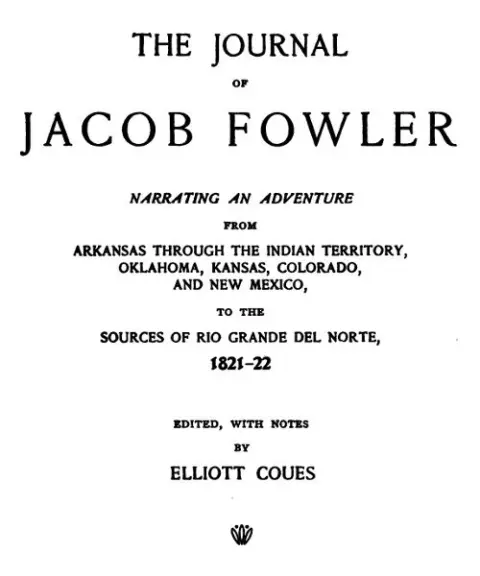
"The Journal of Jacob Fowler" by Jacob Fowler is a historical account documenting a remarkable journey through the American West during the early 19th century. The narrative covers Fowler's expedition from Fort Smith through various territories, including Arkansas, Oklahoma, Kansas, Colorado, and New Mexico, in 1821-22. The text provides a firsthand account of the challenges faced and observations made by the author and his companions as they navigate uncharted territories and encounter both natural obstacles and indigenous peoples. The opening of the journal introduces readers to the initial stages of this adventurous journey, beginning on September 6, 1821. Jacob Fowler describes crossing rivers, traversing rich lands, and encountering both wildlife and challenging terrain, often while battling harsh weather conditions. As the party progresses, they set up camps, forage for food, and contend with the perils of travel, such as losing pack animals and maintaining supplies. The narrative is characterized by Fowler's detailed descriptions and personal reflections, immersing readers in the hardships and triumphs of early American exploration.
Introduction adapted from the source catalogue; source summaries may be automatically generated.
Free to read · English · 48,766 words · No account needed
MAKE TIME FOR A GOOD BOOK
On by default. Untick to stop anonymous reading totals. Each page counts after 10 seconds in view. How this works.
Anonymous counting is on unless you have switched it off.
Vanbeber, Van Biber, Jesse, 5, 69, 82, 120, 123, 131, 132, 137
Van Buren, Ark., 1
Verdigris r., xxii, 3, 4, 6, 7, 9, 161, 164, 165
trail, xx
Vermejo cr., 146
Vermilion r., 3
Veta mts., 99
Veta pass, 100
Vie, Esther de, xi
Virdegree r., see Verdigris r.
Virginia, 47
Wagon Wheel Gap, 121, 124
Wahtoyah, 45, 105
Wakarusa cr., 169
Walnut cr., 16, 17, 162, 163
cr., another, 22, 23, 160, 161
Walters, Richard, 5, 84, 85, 86, 100, 108, 126
Ward, Eli, 5, 12, 46, 78, 88, 91, 123, 131, 147, 151, 167, 170
Warm Spring branch of Rio Conejos, 135
Wasetihoge r., 3
Washington, D. C., vii, xxiv, 157
Wassuja r., 3
Watervale, Col., 149
Wet mts., 97, 99
Wharf cr., 69
Whight r., see White r.
white bear, 41
White Bear cr., 148
White r., 16, 162
Whitewater r., xxii, 16, 162
Wichita, Kas., 13, 18
Wild Horse cr., 35
Wilkinson, J. B., xx
Williams, E., xix
Willow cr., 36, 116, 135
Willow Spring, Col., 151
Springs camp, 168
Wilson’s cr., 47
Winfield, Kas., 16
Wise, Gov., 47
Wolf cr., 119
Workman, J., xiv
Expeditions of Zebulon Montgomery Pike.
To the Headwaters of the Mississippi River, the Interior Parts of Louisiana, Mexico and Texas, in the years of 1805-6-7. Reprinted in full from the original Philadelphia edition of 1810. With copious explanatory, geographical and scientific notes to the text, a new Memoir of Pike and an Index to the whole. By Prof. Elliott Coues, Edition limited, 3 vols., 8vo.
1,000 on fine book paper $10.00 net per set. 150 on hand-made paper $20.00 net per set.
This edition of Pike’s explorations is only second in value to the annotated journals of Lewis & Clark, by the same editor. The rearrangement by Dr. Coues of the appendices and other extraneous matter adds very greatly to its value, since in the original edition even the experienced reader has found it difficult to collate complete information on many important topics. The volumes are an important contribution to geographical and historical literature.—The Nation (3 columns).
On the whole, the new Pike must prove monumental. It will forever link its author with Pike’s fame. Its map of Mississippi sources, and the arduous voyage (of the editor) into the farthest fountains, will not let us wonder that the Minnesota Park Commissioner styled a lakelet feeding Itasca, Elliot Coues, and inscribed that name upon a boulder on that utmost shore.—American Historical Review (2½ pages).
The great merit in Dr. Coues’ notes is that they preserve the history of the localities and give credit to all the local historians and archæologists. Dr. Coues seems to have read all of the local histories and records, whether contained in books, pamphlets or even newspapers, and has given the references with great painstaking. In fact, the notes are equivalent to a bibliography.—American Antiquarian and Oriental Journal.
Your reading position is saved on this browser. Take it to another device with a library code. Reading pages adapt to text, rather than matching a printed edition.
BEHIND THE BOOK
This eBook is for the use of anyone anywhere in the United States and most other parts of the world at no cost and with almost no restrictions whatsoever. You may copy it, give it away or re-use it under the terms of the Project Gutenberg License included with this eBook or online at www.gutenberg.org. If you are not located in the United States, you will have to check the laws of the country where you are located before using this eBook. Read the source licence.
The original source file, including credits and licence, is retained by this library. Request an original-format copy at no charge. Please include the book title and Project Gutenberg identifier #62018.
KEEP YOUR CURIOSITY GOING
Wilfrid Scawen Blunt
Wilfrid Scawen Blunt

E. W. (Edgar Watson) Howe
Cécile Tormay

Moritz Busch
John L. Ransom