THE CLASSIC COLLECTION✦My diaries, being a personal narrative of events 1888-1914, Part 2 (1900-1914)CLASSIC FREE BOOKS
My diaries, being a personal narrative of events 1888-1914, Part 2 (1900-1914)
Wilfrid Scawen Blunt
THE CLASSIC COLLECTION · 1898
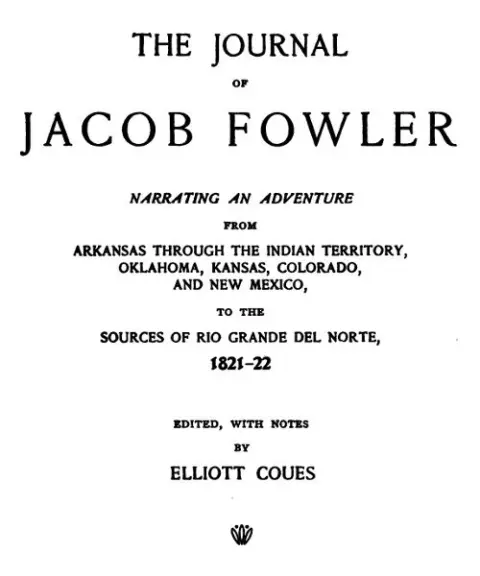
"The Journal of Jacob Fowler" by Jacob Fowler is a historical account documenting a remarkable journey through the American West during the early 19th century. The narrative covers Fowler's expedition from Fort Smith through various territories, including Arkansas, Oklahoma, Kansas, Colorado, and New Mexico, in 1821-22. The text provides a firsthand account of the challenges faced and observations made by the author and his companions as they navigate uncharted territories and encounter both natural obstacles and indigenous peoples. The opening of the journal introduces readers to the initial stages of this adventurous journey, beginning on September 6, 1821. Jacob Fowler describes crossing rivers, traversing rich lands, and encountering both wildlife and challenging terrain, often while battling harsh weather conditions. As the party progresses, they set up camps, forage for food, and contend with the perils of travel, such as losing pack animals and maintaining supplies. The narrative is characterized by Fowler's detailed descriptions and personal reflections, immersing readers in the hardships and triumphs of early American exploration.
Introduction adapted from the source catalogue; source summaries may be automatically generated.
Free to read · English · 48,766 words · No account needed
MAKE TIME FOR A GOOD BOOK
On by default. Untick to stop anonymous reading totals. Each page counts after 10 seconds in view. How this works.
Anonymous counting is on unless you have switched it off.
[44] Exactly so—passing Hartland, seat of Kearney Co., and continuing 10 m. N. 80° W. to camp near border of Kearney and Hamilton counties, nearly in the position of Kendall, in the latter county. See Pike, ed. of 1895, p. 440.
[45] Reading 4 + 6 + 6 = 16 m. to-day, and the last course W., we should bring Fowler past Syracuse, seat of Hamilton Co., to the vicinity of Coolidge, and thus near the boundary between Kansas and Colorado. This lap seems to me to stretch somewhat, but such advance as I here indicate appears to be required to adjust Fowler’s topography beyond, and bring him correctly to Purgatory river on the 13th. See Pike, ed. of 1895, p. 441. Compare also date of June 11, 1822, beyond.
[46] Apparently that now known as Two Butte creek, from the S., falling in nearly opposite Wild Horse or Little Sandy creek from the N., a mile or two above Hollys, Prowers Co., Colorado. Camp 3 m. above Two Butte creek would be about 2 m. short of the station Adana, on the A. T. and S. F. R. R. See Pike, ed. of 1895, p. 442.
[47] Past Adana, Granada, and Manville, to a point about opposite
Carlton, Prowers Co.
[48] This large dry creek, from the N., is the Big Sandy, which falls in about the distance said above the camp which was on the island opposite Carlton. See Pike, ed. of 1895, p. 443. Somewhere about the mouth of Big Sandy creek is one of the locations of the shifty Chouteau’s island mentioned on p. 32.
[49] Willow creek, on which is Lamar, seat of Prowers Co. See Pike, ed.
of 1895, p. 443.
[50] Present name the same—Mud or Muddy creek, nearly halfway between Prowers, Bent Co., and Caddoa creek. See Pike, ed. of 1895, p. 443.
[51] A statement which serves to fix camp with perfect precision. The two mounds said are both between one and two miles due W. of Caddoa, and just the distance said W. of Caddoa creek. These isolated elevations appear in due form on the U. S. Geological Survey map of Colorado, Lamar sheet, near lower left-hand corner. The railroad cuts between the river and these bluffs, but the wagon road rises over them, back of their tops. See Pike, ed. of 1895, p. 443.
[52] Two special elevations across the river, directly in line from camp, are respectively 3975 and 4200 feet high, and their summits just about 5 m. apart.
[53] Present Rule creek, quite at the distance said from the twin bluffs
at camp.
Your reading position is saved on this browser. Take it to another device with a library code. Reading pages adapt to text, rather than matching a printed edition.
BEHIND THE BOOK
This eBook is for the use of anyone anywhere in the United States and most other parts of the world at no cost and with almost no restrictions whatsoever. You may copy it, give it away or re-use it under the terms of the Project Gutenberg License included with this eBook or online at www.gutenberg.org. If you are not located in the United States, you will have to check the laws of the country where you are located before using this eBook. Read the source licence.
The original source file, including credits and licence, is retained by this library. Request an original-format copy at no charge. Please include the book title and Project Gutenberg identifier #62018.
KEEP YOUR CURIOSITY GOING
Wilfrid Scawen Blunt
Wilfrid Scawen Blunt

E. W. (Edgar Watson) Howe
Cécile Tormay

Moritz Busch
John L. Ransom