THE CLASSIC COLLECTION✦My diaries, being a personal narrative of events 1888-1914, Part 2 (1900-1914)CLASSIC FREE BOOKS
My diaries, being a personal narrative of events 1888-1914, Part 2 (1900-1914)
Wilfrid Scawen Blunt
THE CLASSIC COLLECTION · 1898
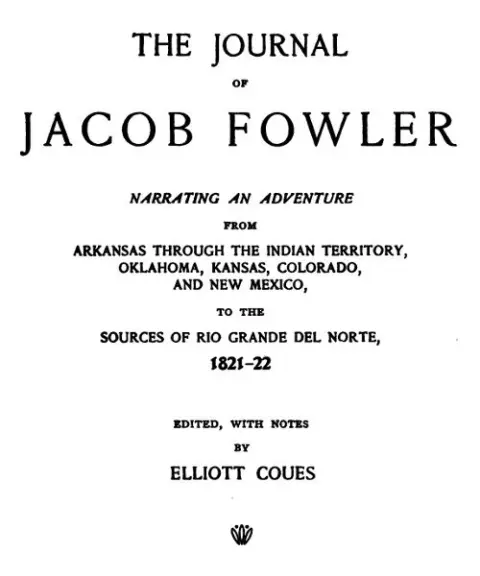
"The Journal of Jacob Fowler" by Jacob Fowler is a historical account documenting a remarkable journey through the American West during the early 19th century. The narrative covers Fowler's expedition from Fort Smith through various territories, including Arkansas, Oklahoma, Kansas, Colorado, and New Mexico, in 1821-22. The text provides a firsthand account of the challenges faced and observations made by the author and his companions as they navigate uncharted territories and encounter both natural obstacles and indigenous peoples. The opening of the journal introduces readers to the initial stages of this adventurous journey, beginning on September 6, 1821. Jacob Fowler describes crossing rivers, traversing rich lands, and encountering both wildlife and challenging terrain, often while battling harsh weather conditions. As the party progresses, they set up camps, forage for food, and contend with the perils of travel, such as losing pack animals and maintaining supplies. The narrative is characterized by Fowler's detailed descriptions and personal reflections, immersing readers in the hardships and triumphs of early American exploration.
Introduction adapted from the source catalogue; source summaries may be automatically generated.
Free to read · English · 48,766 words · No account needed
MAKE TIME FOR A GOOD BOOK
On by default. Untick to stop anonymous reading totals. Each page counts after 10 seconds in view. How this works.
Anonymous counting is on unless you have switched it off.
1. Colonel HUGH GLENN, in command.
2. Major JACOB FOWLER, the journalist, second in command.
3. ROBERT FOWLER, brother of Jacob Fowler.
4. BAPTISTE ROY, interpreter.
5. BAPTISTE PENO (French name, no doubt misspelled).
6. GEORGE DOUGLAS.
7. NATHANIEL PRYOR, ex-Sergeant of Lewis and Clark’s Expedition.
8. —— BONO (French name, no doubt misspelled, possibly Bonhomme).
9. —— BARBO (French name, no doubt misspelled, possibly Barbu).
10. LEWIS DAWSON (Fatally injured by a bear, Nov 13, 1821, died Nov 16).
11. —— TAYLOR.
12. RICHARD WALTERS.
13. ELI WARD.
14. JESSE VAN BIBER.
15. —— SLOVER.
16. —— SIMPSON.
17. DUDLEY MAXWELL.
18. —— FINDLEY.
19. BAPTISTE MORAN.
20. PAUL, a negro belonging to Jacob Fowler.
The most interesting of the above names is that of Nathaniel Pryor, of whose identity with the sergeant of Lewis and Clark I have no doubt: see L. and C., ed. of 1893, p. 254, delete the query there, and add: Nathaniel Pryor of Kentucky became an Ensign of the U. S. Army Feb 27, 1807, Second Lieutenant May 3, 1808, resigned April 1, 1810, was appointed First Lieutenant of the 44th Inf. Aug 30, 1813, promoted to be Captain Oct 1, 1814, and honorably discharged June 15, 1815. See also my article, “Letters of William Clark and Nathaniel Pryor,” in Annals of Iowa, 3d ser., Vol I, No. 8, Jan., 1895, pp. 613-620, for an account of Ensign Pryor’s disastrous attempt to convey the Mandan chief Shahaka from St. Louis, Mo., to the Mandan villages on the Missouri.
[10] Indian missionaries, several of whose establishments have been
located in this vicinity.
[11] Approximately up the Verdigris, as already indicated. The road taken is marked on several maps I have examined. For the Osage village in mention, see Pike, ed. of 1893, p. 557. This “Arkansaw band” of Osages consisted of those called “Osages of the Oaks,” in Long, ii, p. 251. Their most influential man then, as in Pike’s time, was Clermont, surnamed the “Builder of Towns,” and I suppose that the village now called Claremore, among the Blue Mounds on the Verdigris, in the Cherokee country, was named for him. In 1820 some of Long’s party were assured “that Clermont had then four wives, and thirty-seven children! a number ... which may probably be attributed to this chief by mistake,” as the narrative sagely adds. Clermont’s band are also called “Chaneers,” ibid., p. 244, on the authority of Dr. Sibley.
[12] These are the Blue Mounds mentioned in the last note. The several “cricks,” which Fowler has spoken of crossing, are inconsiderable tributaries of the Verdigris flowing southerly, as those called Big, Otter, Dog, etc.
Your reading position is saved on this browser. Take it to another device with a library code. Reading pages adapt to text, rather than matching a printed edition.
BEHIND THE BOOK
This eBook is for the use of anyone anywhere in the United States and most other parts of the world at no cost and with almost no restrictions whatsoever. You may copy it, give it away or re-use it under the terms of the Project Gutenberg License included with this eBook or online at www.gutenberg.org. If you are not located in the United States, you will have to check the laws of the country where you are located before using this eBook. Read the source licence.
The original source file, including credits and licence, is retained by this library. Request an original-format copy at no charge. Please include the book title and Project Gutenberg identifier #62018.
KEEP YOUR CURIOSITY GOING
Wilfrid Scawen Blunt
Wilfrid Scawen Blunt

E. W. (Edgar Watson) Howe
Cécile Tormay

Moritz Busch
John L. Ransom