THE CLASSIC COLLECTION✦My diaries, being a personal narrative of events 1888-1914, Part 2 (1900-1914)CLASSIC FREE BOOKS
My diaries, being a personal narrative of events 1888-1914, Part 2 (1900-1914)
Wilfrid Scawen Blunt
THE CLASSIC COLLECTION · 1898
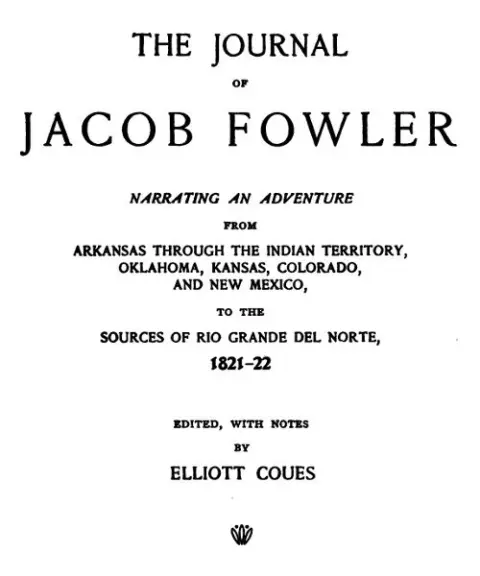
"The Journal of Jacob Fowler" by Jacob Fowler is a historical account documenting a remarkable journey through the American West during the early 19th century. The narrative covers Fowler's expedition from Fort Smith through various territories, including Arkansas, Oklahoma, Kansas, Colorado, and New Mexico, in 1821-22. The text provides a firsthand account of the challenges faced and observations made by the author and his companions as they navigate uncharted territories and encounter both natural obstacles and indigenous peoples. The opening of the journal introduces readers to the initial stages of this adventurous journey, beginning on September 6, 1821. Jacob Fowler describes crossing rivers, traversing rich lands, and encountering both wildlife and challenging terrain, often while battling harsh weather conditions. As the party progresses, they set up camps, forage for food, and contend with the perils of travel, such as losing pack animals and maintaining supplies. The narrative is characterized by Fowler's detailed descriptions and personal reflections, immersing readers in the hardships and triumphs of early American exploration.
Introduction adapted from the source catalogue; source summaries may be automatically generated.
Free to read · English · 48,766 words · No account needed
MAKE TIME FOR A GOOD BOOK
On by default. Untick to stop anonymous reading totals. Each page counts after 10 seconds in view. How this works.
Anonymous counting is on unless you have switched it off.
If we turn from the form to the substance of Fowler’s Journal, and ask to see the bill of lading, curious to know what useful or valuable information is contained in so singular a vehicle of conveyance, it may be confidently said that this “prairie schooner” is well freighted for a “voige” on the highway of Americana; for the cargo is a novel and notable contribution to our knowledge of early commercial venture and pioneering adventure in the Great West. It is simply a story of the trader and trapper, unsupported by the soldier, unimpeded by the priest, and in no danger from the politician. The scene is set in the wilderness; the time is when pack-animals are driven across the stage, before the first wheels rolled over the plains from the States to Santa Fé; and the actors have very real parts to perform.
From the respective dates of Pursley, of Lalande, and of Pike, whose several travels were among the first if not the earliest overland from the United States to the Spanish settlements, on the part of American citizens—from the opening years of the century to the 1821-22 of Fowler—various parties were on the Arkansaw in what are now Kansas and Colorado. But the records of where they went or what they did? That is the question. Ezekiel Williams, James Workman, Samuel Spencer, sole and shadowy survivors of Coyner’s “Lost Trappers,” are only uneasy spirits flitting from the Missouri to Mexico and California in an apocryphal book, never materializing out of fable-land into historical environment. Wherever other American trappers or traders may have gone on the Arkansaw or even the Rio Grande in those days, and whatever they may have done, Fowler was first to forge another sound link in the chain which already reached from Pike to Long. The latter’s justly celebrated expedition came down the Arkansaw and the Canadian in 1820. Pike ascended the main river from its great bend to its sources in 1806, the same year that his lieutenant, Wilkinson, descended this stream from the point where he parted from his captain. For the lower reaches of the river we have Thomas Nuttall’s Journal of Travels into the Arkansa Territory, during the year 1819, and various other accounts. But I know of no record, earlier in date than Fowler’s, of continuous ascent of the river from Fort Smith to the present position of Pueblo in Colorado. He meandered the whole course of the Arkansaw between the points named, except his cut-off of a small portion by the Verdigris trail. One of his men, Lewis Dawson, who was killed by a grizzly bear at the mouth of the Purgatory—and who, let us hope, left that place for happier hunting-grounds—may not have been the first white American buried in Colorado soil; but the record of a prior funeral would be far to seek. Whose was the first habitable and inhabited house on the spot where Pueblo now stands? Fowler’s, probably; for Pike’s stockade was hardly a house, and Jim Beckwourth came twenty years after Fowler. The Taos Trail from Santa Fé through the Sangre de Cristo Pass to the Arkansaw at Pueblo was well known to the Spaniards when Fowler’s party traversed it in the opposite direction; but we have no American itinerary of that passage at an earlier date than his. When Fowler ascended the Rio Grande to Hot Spring creek in the San Juan range, he followed a Spanish road; but never before had an American expedition been so near the sources of that great river Del Norte, and not till many years afterward did any such prolong Fowler’s traces upward. The greater part of Fowler’s homeward journey from Taos to Fort Osage will doubtless prove as novel to his readers as it was unexpected by his editor. South of the Arkansaw, his trail was neither by the way he had gone before, nor by either of those roads which were soon be established and become well known; for he came neither by the Cimarron nor the Raton route, but took a straighter course than either, between the two, over Chico Rico Mesa and thence along Two Butte creek to the Arkansaw on the Kansan-Coloradan border. Again, when Fowler left the Arkansaw to strike across Kansas, he did not take up the direct route which caravans were about to blaze as the Santa Fé Trail from Missouri through Council Grove to Great Bend; but went a roundabout way, looping far south to heads of the Whitewater and Verdigris rivers before he crossed the Neosho to make for the Missouri below the mouth of the Kansas.
Your reading position is saved on this browser. Take it to another device with a library code. Reading pages adapt to text, rather than matching a printed edition.
BEHIND THE BOOK
This eBook is for the use of anyone anywhere in the United States and most other parts of the world at no cost and with almost no restrictions whatsoever. You may copy it, give it away or re-use it under the terms of the Project Gutenberg License included with this eBook or online at www.gutenberg.org. If you are not located in the United States, you will have to check the laws of the country where you are located before using this eBook. Read the source licence.
The original source file, including credits and licence, is retained by this library. Request an original-format copy at no charge. Please include the book title and Project Gutenberg identifier #62018.
KEEP YOUR CURIOSITY GOING
Wilfrid Scawen Blunt
Wilfrid Scawen Blunt

E. W. (Edgar Watson) Howe
Cécile Tormay

Moritz Busch
John L. Ransom