
The Writing of News A Handbook with Chapters on Newspaper Correspondence and Copy Reading
Charles G. (Charles Griffith) Ross
THE CLASSIC COLLECTION · 1887
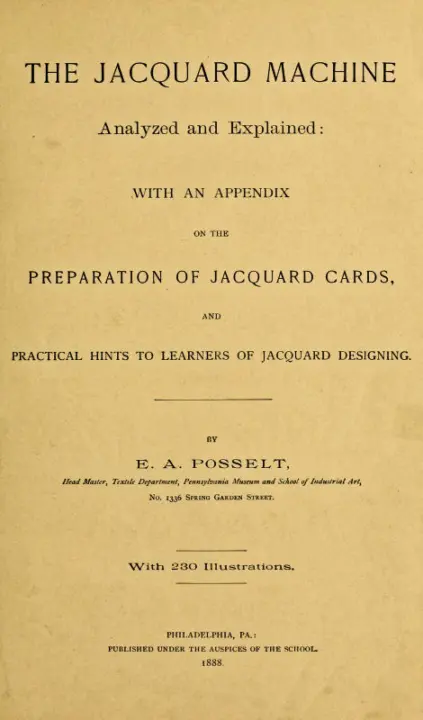
"The Jacquard Machine Analyzed and Explained" by E. A. Posselt is a scientific publication written in the late 19th century. This detailed work focuses on the Jacquard machine, a significant invention in textile manufacturing, exploring its mechanisms, applications, and operational techniques. It aims to provide practical insights into the machine's design, operation, and the preparation of Jacquard cards necessary for weaving complex fabrics. The opening portion introduces the Jacquard machine and its historical context, outlining its inventor Joseph Marie Jacquard's early life and challenges. Posselt emphasizes the machine's mechanical functions, such as the role of hooks, leashes, and needles in weaving, as well as the importance of punching cards for controlling the warp threads. The preface also mentions the lack of literature on this topic, positioning the book as a crucial resource for students and practitioners in the field of textile arts.
Introduction adapted from the source catalogue; source summaries may be automatically generated.
Free to read · English · 38,829 words · No account needed
MAKE TIME FOR A GOOD BOOK
On by default. Untick to stop anonymous reading totals. Each page counts after 10 seconds in view. How this works.
Anonymous counting is on unless you have switched it off.
=Guide-board=, used for regulating the height of the mails by tying-up a Jacquard harness, 23
=Guiding-rod.= See Jacquard Plunger.
=Hammer=, a part of the Jacquard machine, 16
=Harness cords=, the cords of each leash, 9
=Heavy Square=, its practical points of use on designing paper, 105
=Heddle and Harness-cord=, combining, 23
=Heddles=, as required for compound harness, 62 ---- For the Jacquard harness, 9, 22
=Hook=, a part of the Jacquard machine, 9, 10, 13
=Index Machines.= See Dobbies.
=Ingrain=, as applied to carpets, was originally intended for a fabric where the wool was colored before carding and spinning, but which is not true at present, as the yarn is mostly manufactured before coloring. The great variety of colors used in an ingrain carpet at the present time, the constant changing of styles, besides the saving of expense by coloring the yarn after manufacture, are the general reasons for it. Ingrain carpet in our country means the same as Scottish or Kidderminster in Europe.
=Ingrain Carpet=, two-ply, construction of the fabric, 72
---- Two-ply, designs for, 116
---- Two-ply, Jacquard Machine, 71
---- Two-ply, selection of designing paper, 106
---- Two-ply, tying-up of its Jacquard harness, 72
=Ingrain Carpet Loom=, two-ply, built with a stationary shuttle-raceway and an independent comb for beating up the filling, 82
---- Two-ply, in which the journals are lifted from above by means of a cam arrangement, 81
---- Two-ply, in which the journals are lifted from below and controlled by either a chain or cam motion, 81, 82
=Jacquard Cards=, general arrangement and application, 7, 9, 17, 18 ---- Preparing of, 85 ---- Stamping of, 85, 91
=Jacquard Designing=, practical hints, 103
=Jacquard Harness=, general arrangement and application, 20
=Jacquard, Joseph Marie=, life of, 7, 8
=Jacquard Loom=, a loom furnished with the Jacquard arrangement.
=Jacquard Plunger=, a part of the Jacquard machine; also known as Guiding-rod, 12
=Journals=, peculiarly constructed harness frames used in the manufacture of two-ply ingrain carpets, 75
=Jute= is a native plant of China and the East Indies; its long fibre, which is of a brown to silver gray color, is used largely in the manufacture of Brussels and tapestry carpets, rugs, etc., for the body--ground structure of the fabric. It is distinguished from flax by being colored yellow under the influence of sulphuric acid and iodine solution. The size of the thread when spun is indicated by the same rule as wool--Cut system--300 yards to 16 ounces.
=Keys=, as used in the Piano Card-stamping machine, 86
=Keys=, as used in the Repeating machine, 93
=Key Wire=, used in the Repeating machine, 95
=Lace-hole Press=, 96
=Lacing= of Jacquard cards, 97
=Lacing Frame=, 97
=Lacing Machines=, using two needles for lacing each series of holes, 98
---- Using one needle and one shuttle for lacing each series of holes, 100
=Lacing Needles=, 100
=Lacing Twine=, the kind to use for machine lacing, 100
Your reading position is saved on this browser. Take it to another device with a library code. Reading pages adapt to text, rather than matching a printed edition.
BEHIND THE BOOK
This eBook is for the use of anyone anywhere in the United States and most other parts of the world at no cost and with almost no restrictions whatsoever. You may copy it, give it away or re-use it under the terms of the Project Gutenberg License included with this eBook or online at www.gutenberg.org. If you are not located in the United States, you will have to check the laws of the country where you are located before using this eBook. Read the source licence.
The original source file, including credits and licence, is retained by this library. Request an original-format copy at no charge. Please include the book title and Project Gutenberg identifier #54193.
KEEP YOUR CURIOSITY GOING
Charles G. (Charles Griffith) Ross
Hannah Webster Foster

Emily Lawless
Edwin Hamlin Carr

Charles De Lano Hine
Andrew Ure