
The Writing of News A Handbook with Chapters on Newspaper Correspondence and Copy Reading
Charles G. (Charles Griffith) Ross
THE CLASSIC COLLECTION · 1887
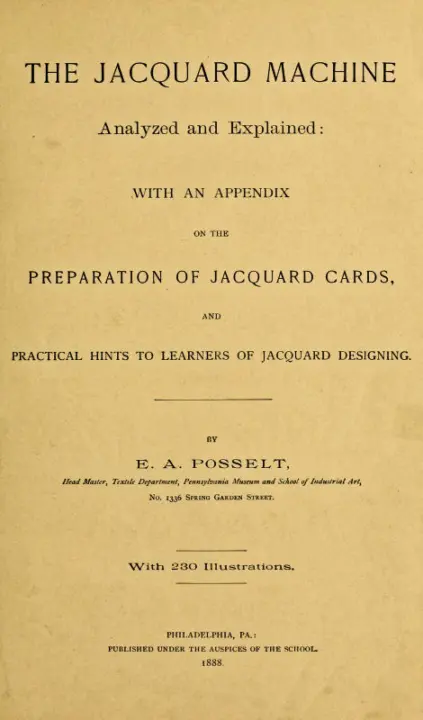
"The Jacquard Machine Analyzed and Explained" by E. A. Posselt is a scientific publication written in the late 19th century. This detailed work focuses on the Jacquard machine, a significant invention in textile manufacturing, exploring its mechanisms, applications, and operational techniques. It aims to provide practical insights into the machine's design, operation, and the preparation of Jacquard cards necessary for weaving complex fabrics. The opening portion introduces the Jacquard machine and its historical context, outlining its inventor Joseph Marie Jacquard's early life and challenges. Posselt emphasizes the machine's mechanical functions, such as the role of hooks, leashes, and needles in weaving, as well as the importance of punching cards for controlling the warp threads. The preface also mentions the lack of literature on this topic, positioning the book as a crucial resource for students and practitioners in the field of textile arts.
Introduction adapted from the source catalogue; source summaries may be automatically generated.
Free to read · English · 38,829 words · No account needed
MAKE TIME FOR A GOOD BOOK
On by default. Untick to stop anonymous reading totals. Each page counts after 10 seconds in view. How this works.
Anonymous counting is on unless you have switched it off.
[N. B.--The plain weave used for explaining the present example may be substituted by other weaves, as a [2/1] twill, [2/2] twill, or the four harness broken twill, etc., without changing the figure design.]
Designs for Figured Pile Fabrics.
Designs for figured pile fabrics (terry or velvet), Plushes, Astrakhans, etc., are also executed without introducing a weave in the design. The design is only intended for the pile-threads, which are raised when introducing the wire; the front harness operating the ground-warp. The pile-warp, when raised over the wire, is bound by means of the previous pick, as well as by the pick following by the filling to the ground cloth.
The Shading of Textile Fabrics by the Weave.
This is generally done in the “figure” part (especially in flowers, leaves, etc.), of damasks and similar textile fabrics. The shading can be applied to the satin weaves to the best advantage.
Rule for Shading with Satin Weaves.
Put the ground weave (filling for face) over the entire part of the [O] designing paper, which is required to be shaded; afterwards add one, two, three or more horizontal or vertical (connecting) spots to the one spot which forms the foundation or satin filling for face. The heaviness of the shade is regulated by the sketch or the fabric. For example: In an 8-leaf satin the difference between filling for face and warp for face may be made with three or four changes only; or with the entire seven changes.
For shading twill weaves no rule can be given.
Fig. 100 shows the shading of the 5-leaf satin, four changes, each eight threads, giving 4 × 8, or 32 threads for the effect.
Fig. 101 illustrates the 8-leaf satin applied for shading a circle, using in rotation every possible change.
Fig. 102 illustrates the shading of the 10-leaf satin from filling for face [1/9], to warp for face [8/2], and back again to filling for face.
Fig. 103 represents the [7/1] eight harness twill, shaded from the filling for face to the warp for face effect; the change occurring every eight picks.
Glossary and Index.
Technical words, names and terms given in the Index, with reference to the number of the page where explained, are a complete collection used in the work.
The Glossary, connected with the Index, contains those terms (mostly technical words) which to some extent have been mentioned in the book, or terms which, in the course of study, will appear alone. They are treated in a short but thorough and comprehensive manner in this Glossary.
=American Index=, Piano Card-stamping machines for, 86
=Analysis=, the art of resolving a machine, fabric, or substance of any kind, into its constituent parts.
Your reading position is saved on this browser. Take it to another device with a library code. Reading pages adapt to text, rather than matching a printed edition.
BEHIND THE BOOK
This eBook is for the use of anyone anywhere in the United States and most other parts of the world at no cost and with almost no restrictions whatsoever. You may copy it, give it away or re-use it under the terms of the Project Gutenberg License included with this eBook or online at www.gutenberg.org. If you are not located in the United States, you will have to check the laws of the country where you are located before using this eBook. Read the source licence.
The original source file, including credits and licence, is retained by this library. Request an original-format copy at no charge. Please include the book title and Project Gutenberg identifier #54193.
KEEP YOUR CURIOSITY GOING
Charles G. (Charles Griffith) Ross
Hannah Webster Foster

Emily Lawless
Edwin Hamlin Carr

Charles De Lano Hine
Andrew Ure