
The Writing of News A Handbook with Chapters on Newspaper Correspondence and Copy Reading
Charles G. (Charles Griffith) Ross
THE CLASSIC COLLECTION · 1887
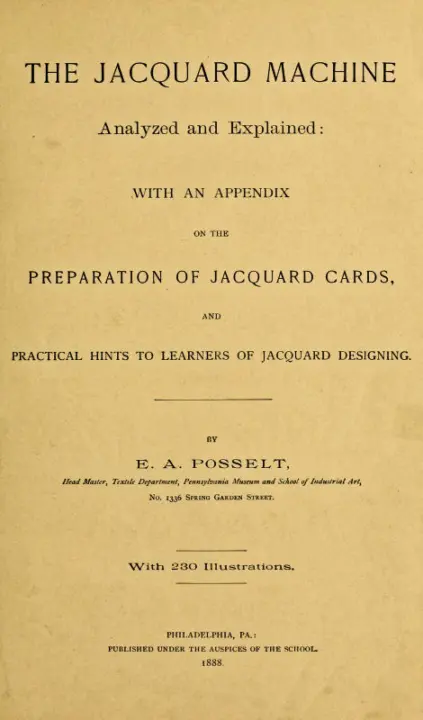
"The Jacquard Machine Analyzed and Explained" by E. A. Posselt is a scientific publication written in the late 19th century. This detailed work focuses on the Jacquard machine, a significant invention in textile manufacturing, exploring its mechanisms, applications, and operational techniques. It aims to provide practical insights into the machine's design, operation, and the preparation of Jacquard cards necessary for weaving complex fabrics. The opening portion introduces the Jacquard machine and its historical context, outlining its inventor Joseph Marie Jacquard's early life and challenges. Posselt emphasizes the machine's mechanical functions, such as the role of hooks, leashes, and needles in weaving, as well as the importance of punching cards for controlling the warp threads. The preface also mentions the lack of literature on this topic, positioning the book as a crucial resource for students and practitioners in the field of textile arts.
Introduction adapted from the source catalogue; source summaries may be automatically generated.
Free to read · English · 38,829 words · No account needed
MAKE TIME FOR A GOOD BOOK
On by default. Untick to stop anonymous reading totals. Each page counts after 10 seconds in view. How this works.
Anonymous counting is on unless you have switched it off.
The kind of designing paper needed is found by dividing 90 by 3, and multiplying by 2, thus: 90 ÷ 3 × 2 = 60, number of ends of face-warp per inch, and 132 ÷ 4 × 3 = 99, number of picks filling per inch, giving a 60 × 99 paper, or its equivalent, 6 × 10.
Face cards for these fabrics must be stamped twice, first for the face weave, and afterward for the binder. If using a 12-row machine, use punches 1, 2, 4, 5, 7, 8, 10, and 11, for face; 3, 6, 9, and 12, for the back of the fabric.
Selection of Designing Paper for Two-ply Ingrain Carpets.
Always observe the proportion existing between the number of warp and filling-threads. For instance, take a carpet having 1072 ends warp (536 ground and 536 filling) per yard, with 30 picks per inch (1 pick ground and 1 pick filling, or 15 pair). Then, 1072 ÷ 36 = 29-28/36 ends of warp per inch. The proposition is as 29-28/36: 30; or, what is practically the same, 30: 30, showing that the paper must be equally divided, and 8 × 8 may be used, as is usually done.
Again, take a carpet having 832 ends warp (416 ground, 416 figure) per yard with 20 picks per inch (1 pick ground, 1 pick figure, or 10 pair). Then 832 ÷ 36 = 23-4/36, and the proportion is as 23-1/9: 20, or as 7-19/27: 6-2/3, practically 8: 7; and 8 × 7 paper may be used.
NOTE.--It will always be advantageous for the card stamping if the designing paper be selected so that the number of warp-ends in one square equals the number of griffe-bars used in the Jacquard machine.
Selection of the Proper Brush for the Different [O] Designing Papers.
The brush used by the designer must be clipped according to the size of the rectangles of the paper. It should cover the rectangle in warp direction at one sweep of the hand; hence each size of the squared paper requires a specially prepared brush for quick, good, and perfect work.
Colors used For Painting Textile Designs.
For this purpose take common colors (in powder), and mix with water and mucilage to avoid rubbing off after application. Use no more mucilage than necessary, as too much will be followed by slow and imperfect work. Colors mixed in this manner must be kept moist by adding a few drops of water daily. The colors most generally used for painting textile designs are:
Vermilion.
Lamp Black.
White Lead.
Emerald Green.
Chrome Yellow.
Burnt Umber.
Cobalt Blue.
Carmine, etc.
A few drops of alcohol will greatly assist the mixing of vermilion, umber, and similar colors which have no affinity for water. Chloride of lime is used on colors having a vegetable basis (as carmine, etc.,) for correcting imperfections, applying weaves or changes in the colored part of a design.
If the designing paper becomes greasy, the colors will not adhere. To cure this take a moist sponge and wipe off the paper.
Preservation of Textile Designs.
Your reading position is saved on this browser. Take it to another device with a library code. Reading pages adapt to text, rather than matching a printed edition.
BEHIND THE BOOK
This eBook is for the use of anyone anywhere in the United States and most other parts of the world at no cost and with almost no restrictions whatsoever. You may copy it, give it away or re-use it under the terms of the Project Gutenberg License included with this eBook or online at www.gutenberg.org. If you are not located in the United States, you will have to check the laws of the country where you are located before using this eBook. Read the source licence.
The original source file, including credits and licence, is retained by this library. Request an original-format copy at no charge. Please include the book title and Project Gutenberg identifier #54193.
KEEP YOUR CURIOSITY GOING
Charles G. (Charles Griffith) Ross
Hannah Webster Foster

Emily Lawless
Edwin Hamlin Carr

Charles De Lano Hine
Andrew Ure