
The Writing of News A Handbook with Chapters on Newspaper Correspondence and Copy Reading
Charles G. (Charles Griffith) Ross
THE CLASSIC COLLECTION · 1887
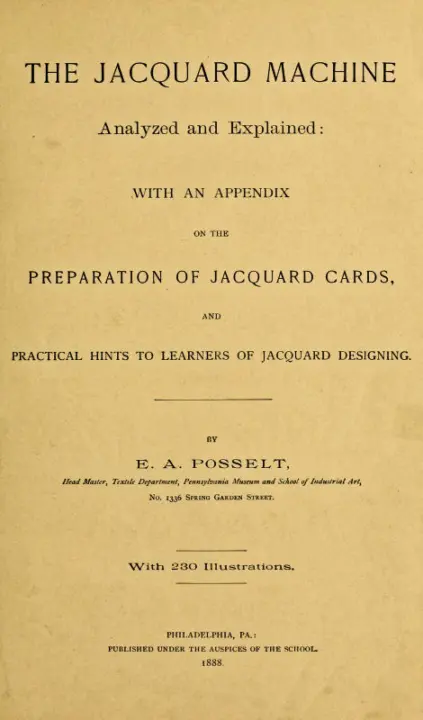
"The Jacquard Machine Analyzed and Explained" by E. A. Posselt is a scientific publication written in the late 19th century. This detailed work focuses on the Jacquard machine, a significant invention in textile manufacturing, exploring its mechanisms, applications, and operational techniques. It aims to provide practical insights into the machine's design, operation, and the preparation of Jacquard cards necessary for weaving complex fabrics. The opening portion introduces the Jacquard machine and its historical context, outlining its inventor Joseph Marie Jacquard's early life and challenges. Posselt emphasizes the machine's mechanical functions, such as the role of hooks, leashes, and needles in weaving, as well as the importance of punching cards for controlling the warp threads. The preface also mentions the lack of literature on this topic, positioning the book as a crucial resource for students and practitioners in the field of textile arts.
Introduction adapted from the source catalogue; source summaries may be automatically generated.
Free to read · English · 38,829 words · No account needed
MAKE TIME FOR A GOOD BOOK
On by default. Untick to stop anonymous reading totals. Each page counts after 10 seconds in view. How this works.
Anonymous counting is on unless you have switched it off.
This method of tying-up is illustrated in Fig. XLVI., and the fabric produced in Fig. XLVII. With this method of tying-up is usually introduced an extra margin for the purpose of separating the ornamentation of the design, so as to permit of a clearer definition. This is tied-up on 8 needles and hooks, situated between border and centre, (24 ends) shown at margin B in the design. The centre of the fabric, (two divisions only illustrated out of ten actually used), is tied-up on the straight-through method, requiring for its working, harness-cords 1 to 240. The border has the point tie-up in half sections; these half sections have a straight-through tie-up design in its centre. Harness-cords 241 to 456 are used for the straight-through section, and 457 to 600 for the point tie-up section. The margin is produced by harness-cords 601 to 608, leaving 16 needles and hooks of the machine unemployed, which may be used for selvedge or other purposes. The drawing of this tie-up and fabric illustrates only the right-hand side. The complete design requires, in addition to the borders and margins, 10 divisions or repeats in the centre. The figure shows only two of these repeats and border and margins of one side. The number of ends in the fabric is found as follows:
Centre, 10 × 240 = 2400 ends.
Border, {point, 4 × 144 = 576} = 1008 " {straight, 2 × 216 = 432}
Margin, {between border and centre, 24 × 2 = 48} = 144 " {between border and selvedge, 48 × 2 = 96}
Selvedge, not indicated in drawing of tie-up, = 48 " ---- 3620 ends in warp.
Number of harness-cords required for each leash:
Leashes 1 to 240 = 10 cords to 1 leash.
" 241 " 456 = 2 " 1 "
" 457 " 600 = 4 " 1 "
" 601 " 608 = 18 " 1 "
Selvedge leashes, if worked by 4 needles and hooks, = 12 cords to 1
leash.
Fig. XLVIII., on page 42, illustrates another fabric design to be executed on this method of tie-up.
A to D = Border { A to B = point tie-up with C to D. { B to C = straight-through part.
D to E = Centre, first repeat, division, for straight-through.
Straight-Through and Point Tie-ups Combined.
D.--For fabrics composed of the straight-through tie-up for centre; the point tie-up, half divisions, and the point tie-up, full divisions, for borders.
This method of tie-up is used to a great extent in the manufacture of damask napkins, containing in its centre the monogram of hotels, restaurants, or private names. This effect is produced by floating the filling.
In this manner, we find tie-up, Fig. XLIX., and fabric sample, Fig. L., executed, using for explanation a 400 Jacquard machine, certainly very low texture for these fabrics. In case of a higher texture being necessary, each effect must be proportionally increased. The machines most generally used for this class of fabrics are of the 900-1200 denomination.
Your reading position is saved on this browser. Take it to another device with a library code. Reading pages adapt to text, rather than matching a printed edition.
BEHIND THE BOOK
This eBook is for the use of anyone anywhere in the United States and most other parts of the world at no cost and with almost no restrictions whatsoever. You may copy it, give it away or re-use it under the terms of the Project Gutenberg License included with this eBook or online at www.gutenberg.org. If you are not located in the United States, you will have to check the laws of the country where you are located before using this eBook. Read the source licence.
The original source file, including credits and licence, is retained by this library. Request an original-format copy at no charge. Please include the book title and Project Gutenberg identifier #54193.
KEEP YOUR CURIOSITY GOING
Charles G. (Charles Griffith) Ross
Hannah Webster Foster

Emily Lawless
Edwin Hamlin Carr

Charles De Lano Hine
Andrew Ure