
The Writing of News A Handbook with Chapters on Newspaper Correspondence and Copy Reading
Charles G. (Charles Griffith) Ross
THE CLASSIC COLLECTION · 1887
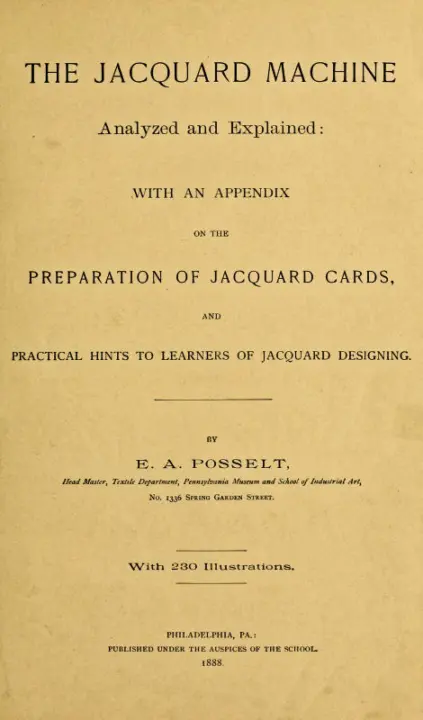
"The Jacquard Machine Analyzed and Explained" by E. A. Posselt is a scientific publication written in the late 19th century. This detailed work focuses on the Jacquard machine, a significant invention in textile manufacturing, exploring its mechanisms, applications, and operational techniques. It aims to provide practical insights into the machine's design, operation, and the preparation of Jacquard cards necessary for weaving complex fabrics. The opening portion introduces the Jacquard machine and its historical context, outlining its inventor Joseph Marie Jacquard's early life and challenges. Posselt emphasizes the machine's mechanical functions, such as the role of hooks, leashes, and needles in weaving, as well as the importance of punching cards for controlling the warp threads. The preface also mentions the lack of literature on this topic, positioning the book as a crucial resource for students and practitioners in the field of textile arts.
Introduction adapted from the source catalogue; source summaries may be automatically generated.
Free to read · English · 38,829 words · No account needed
MAKE TIME FOR A GOOD BOOK
On by default. Untick to stop anonymous reading totals. Each page counts after 10 seconds in view. How this works.
Anonymous counting is on unless you have switched it off.
Ground plan for above fabric: Letters A, C, D, B, F, correspond to same letters as used on the outside of fabric design. S, S´, S´´, S´´´, S´´´´, also correspond for centre division.
For the purpose of giving a correct comprehension of the foregoing explanation of tying-up, but under a different arrangement, Fig. XXXIX. was designed for a 600 machine, having the same arrangement of the borders, viz.: point tie-up, using one-half division for each side; the centre a straight tie-up, but employing only one repeat. The following particulars will explain the entire procedure:
200 needles and hooks are used for borders, point tie-up, once through, equals 1/2 division for each border. [See letters B and B´ on comber-board.]
400 needles and hooks are used for centre, straight tie-up, one repeat. [See letter C on comber-board.]
200 ends for each border, = 400 warp-threads.
" centre, = 400 "
----
800 warp-threads.
In the ground plan of the fabric A is the centre; B, B´, B´´, B´´´, borders; C, C´, C´´, C´´´, corners.
Fig. XL. is a fabric design executed on this principle: a to b, border; c to d, centre; b to a, repeat of the first border.
Straight-Through and Point Tie-ups Combined.
B.--For fabrics requiring for their centres a straight-through tie-up, and for their border on point tie-up one full division for each border.
This arrangement of both foundation tie-ups resembles the preceding. The only difference is found in employing the full division of the centre or point tie-up for each border instead of the half division.
Fig. XLI. illustrates this method of tying-up adjusted to a 600 Jacquard machine. The centre of the fabric requires 400 needles and hooks in 6 repeats or divisions, or 400 × 6 = 2400 warp-threads. The border calls for 204 needles and hooks, point tie-up, one full division for each side, or 204 × 2 x 2 = 816 warp-threads. The arrangement of margin and selvedge, as applied on each side, is explained separately through ground plan of comber-board by fig. XLII. The margin calls for 8 needles and 8 hooks in machine, 6 repeats of same for each side, or 96 warp-threads. The selvedge is formed by 2, 4 or 8 needles, (working plain), and has 24 heddles for each side or 48 selvedge-threads in warp. These selvedge ends may, if preferred, be drawn two ends in one heddle. By adding these different systems of threads we find:
Centre = 2400 warp-threads.
Borders = 816 " " (814 if point drawn only once.)
Margin = 96 " "
Selvedge = 48 " "
-----
3360 threads in warp.
For the centre part of the fabric, needle and hook 1 to 400 are used. " border " " " " 401 " 604 " " margin " " " " 605 " 612 "
Leaving one complete row of the reserve to use for selvedge, etc., if
required.
Your reading position is saved on this browser. Take it to another device with a library code. Reading pages adapt to text, rather than matching a printed edition.
BEHIND THE BOOK
This eBook is for the use of anyone anywhere in the United States and most other parts of the world at no cost and with almost no restrictions whatsoever. You may copy it, give it away or re-use it under the terms of the Project Gutenberg License included with this eBook or online at www.gutenberg.org. If you are not located in the United States, you will have to check the laws of the country where you are located before using this eBook. Read the source licence.
The original source file, including credits and licence, is retained by this library. Request an original-format copy at no charge. Please include the book title and Project Gutenberg identifier #54193.
KEEP YOUR CURIOSITY GOING
Charles G. (Charles Griffith) Ross
Hannah Webster Foster

Emily Lawless
Edwin Hamlin Carr

Charles De Lano Hine
Andrew Ure