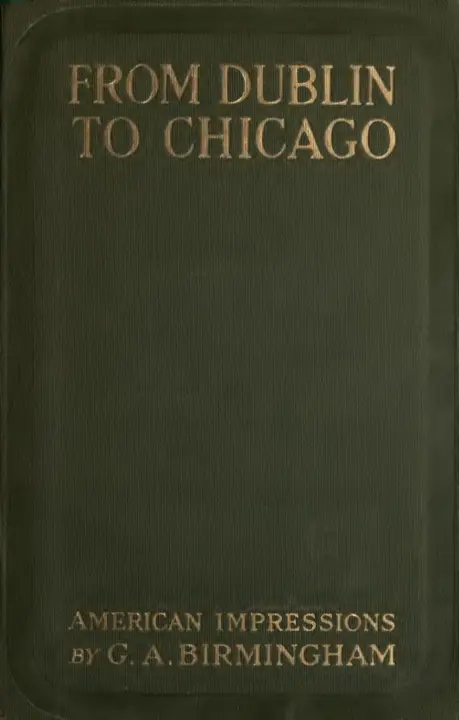
From Dublin to Chicago: Some Notes on a Tour in America
George A. Birmingham
THE CLASSIC COLLECTION · 1918
"The Island Mystery" by George A. Birmingham is a fictional novel written in the early 20th century. This story likely revolves around the intriguing and mysterious events on the fictional Mediterranean island of Salissa, particularly during the backdrop of World War I, as suggested by the references to the war and political dynamics. Central characters introduced in the opening include Sir Bartholomew Bland-Potterton and King Konrad Karl II of Megalia, both of whom are tied to the political turmoil surrounding the island. At the start of the novel, the author sets the scene by discussing the obscurity and strategic importance of Salissa, hinting at its underlying political intrigues. The narrator reveals that the island remains largely unknown to the public despite its significance during the war, and that gossip, rather than news, fuels public perception. Sir Bartholomew is noted for having a story connected to a lady associated with Salissa, and the narrative gradually introduces the notion of a mysterious American millionaire, Mr. Donovan, who has ambitions tied to the island. As the characters begin to interact, discussions about its governance and the notion of kingship arise, setting the stage for an unfolding tale rich with humor, adventure, and perhaps mischief in the narrative structure.
Introduction adapted from the source catalogue; source summaries may be automatically generated.
Free to read · English · 70,267 words · No account needed
MAKE TIME FOR A GOOD BOOK
On by default. Untick to stop anonymous reading totals. Each page counts after 10 seconds in view. How this works.
Anonymous counting is on unless you have switched it off.
Gorman collapsed then. Steinwitz' portentous solemnity was too much for him. Sticking pins into a man or an ape is a pleasant sport. They have skins of reasonable density. It is dull work pricking a rhinoceros, even with a rapier.
"About going to Salissa," he said meekly. "Can you manage to send me
there?"
"Certainly," said Steinwitz. "How soon can you start?"
"At once," said Gorman. "I'll buy a tooth-brush on my way to the steamer. I realize that I must waste no time when conducting business for the Emperor."
"That is so," said Steinwitz, "but you cannot start before to-morrow. To-morrow at 9 a.m. the Ida leaves Tilbury. She is the steamer which Mr. Donovan chartered from us. She returns to the island according to his orders. If you care to sail on her----"
Steinwitz took up the receiver of the telephone which stood on his
desk.
"Is Captain Wilson in the office?" he called. "Captain Wilson of the Ida. Oh, he's not, but Mr. Phillips is. Very well. Ask Mr. Phillips to come up and speak to me here. Mr. Phillips," he explained to Gorman, "is first officer on the Ida. I shall give him orders to be ready for you to-morrow."
There was a brisk tap at the door. Phillips walked in.
"Mr. Phillips," said Steinwitz, "Mr. Gorman will sail with you to-morrow on the Ida. You will see that a cabin is prepared for him, and tell Captain Wilson, with my compliments, that Mr. Gorman is to be made as comfortable as possible. If there are any particular directions you'd like to give, Mr. Gorman----"
"I prefer Irish to Scotch," said Gorman, "but I don't insist on it."
"Irish? Scotch?" said Steinwitz. "Ah, yes, whisky, of course. Make a note of that, if you please, Mr. Phillips."
"And I detest tinned salmon," said Gorman.
"You need not be uneasy," said Steinwitz. "On our ships no passenger is ever asked to eat tinned salmon. As the guest of the company----"
"Of the Emperor," said Gorman.
He deliberately winked at Phillips when he mentioned the Emperor. Phillips has a nice, round, sun-burned face, clear eyes and curly hair. Gorman felt that it would be easy to make friends with him. Phillips laughed and then checked himself abruptly. He saw no joke in a reference to the Emperor, but Gorman's wink appealed to him strongly. Steinwitz frowned.
"That will do, Mr. Phillips," he said.
He turned to Gorman when the young man left the room.
"You will let me hear from you," he said. "I shall expect a letter. The Ida will, no doubt, return after she is unloaded. You can give your letters to Captain Wilson."
Your reading position is saved on this browser. Take it to another device with a library code. Reading pages adapt to text, rather than matching a printed edition.
George A. Birmingham

George A. Birmingham
George A. Birmingham
George A. Birmingham
BEHIND THE BOOK
This eBook is for the use of anyone anywhere in the United States and most other parts of the world at no cost and with almost no restrictions whatsoever. You may copy it, give it away or re-use it under the terms of the Project Gutenberg License included with this eBook or online at www.gutenberg.org. If you are not located in the United States, you will have to check the laws of the country where you are located before using this eBook. Read the source licence.
The original source file, including credits and licence, is retained by this library. Request an original-format copy at no charge. Please include the book title and Project Gutenberg identifier #29644.
KEEP YOUR CURIOSITY GOING
Coulson Kernahan

Maurice Baring
Frances Wright
Cécile Tormay

Frederic Jesup Stimson

W. H. P. (William Henry Pope) Jarvis