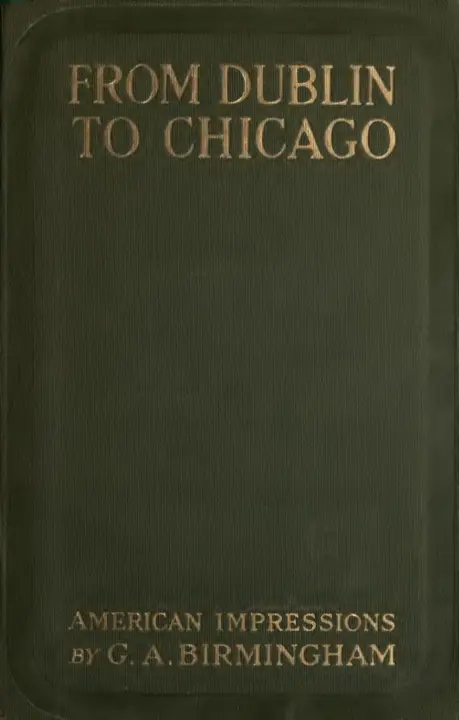
From Dublin to Chicago: Some Notes on a Tour in America
George A. Birmingham
THE CLASSIC COLLECTION · 1918
"The Island Mystery" by George A. Birmingham is a fictional novel written in the early 20th century. This story likely revolves around the intriguing and mysterious events on the fictional Mediterranean island of Salissa, particularly during the backdrop of World War I, as suggested by the references to the war and political dynamics. Central characters introduced in the opening include Sir Bartholomew Bland-Potterton and King Konrad Karl II of Megalia, both of whom are tied to the political turmoil surrounding the island. At the start of the novel, the author sets the scene by discussing the obscurity and strategic importance of Salissa, hinting at its underlying political intrigues. The narrator reveals that the island remains largely unknown to the public despite its significance during the war, and that gossip, rather than news, fuels public perception. Sir Bartholomew is noted for having a story connected to a lady associated with Salissa, and the narrative gradually introduces the notion of a mysterious American millionaire, Mr. Donovan, who has ambitions tied to the island. As the characters begin to interact, discussions about its governance and the notion of kingship arise, setting the stage for an unfolding tale rich with humor, adventure, and perhaps mischief in the narrative structure.
Introduction adapted from the source catalogue; source summaries may be automatically generated.
Free to read · English · 70,267 words · No account needed
MAKE TIME FOR A GOOD BOOK
On by default. Untick to stop anonymous reading totals. Each page counts after 10 seconds in view. How this works.
Anonymous counting is on unless you have switched it off.
Gorman led Smith to Donovan's room. The man must have known all about the Megalian admiral's threat. He probably understood, better than any one else on the island, the meaning and purpose of the ultimatum presented to Donovan. But he showed no signs of embarrassment or excitement. When Gorman summoned him--he was brushing a pair of Konrad Karl's trousers at the moment--he apologized for having put Gorman to the trouble of looking for him. When he entered the room where Donovan waited he stood quietly near the door in his usual attitude of respectful attention.
Donovan greeted him as if he had been a friend and not a servant.
"Take a chair, Smith, and sit down. I want to talk to you."
Smith refused to accept this new position.
"Beg pardon, sir," he said, "but if it's all the same to you, I'd rather stand. Seems more natural, sir."
Gorman, who had followed Smith into the room, hovered uncertainly near the door. He very much wanted to hear what Donovan had to say; but he was not quite sure whether he was meant to be present.
"Any objection to my staying?" he asked. "I'm interested in international peace movements and Hague Conferences. I'd like to hear how you mean to work this affair."
"Sit down," said Donovan, "but don't get interrupting. Now that I've taken hold I mean to handle this damned business my own way."
Gorman sat down and lit his pipe. Donovan turned to Smith.
"You're a valuable man, Smith," he said, "and I'd like to retain your
services."
"Thank you, sir," said Smith. "I've done my best to give
satisfaction."
"But if you're to stay on with me," said Donovan, "we've got to have some straight talk. I'd like it to be clearly understood that your engagement with me is to be a whole-time job for the future."
"More satisfactory, sir, certainly."
"At present," said Donovan, "you're also engaged by Mr. Steinwitz."
"Not by Mr. Steinwitz, sir, if you'll excuse my correcting you. By the
Emperor."
Gorman groaned deeply. Smith turned to him, solicitous, anxious to be
of use.
"Beg pardon, sir, can I do anything for you, sir? Anything wrong,
sir?"
"No," said Gorman, "no. The mention of the Emperor upsets me a little. That's all. Don't do it again, if you can help it, Smith. I'm sorry, Donovan. I didn't mean to interrupt."
Smith turned to Donovan again.
"Perhaps I should say, sir, the Imperial Secret Service."
"Salary?" said Donovan.
He showed no surprise, anger or disgust. Smith was equally cool. He answered the question snapped at him as if it had been the most natural in the world.
Your reading position is saved on this browser. Take it to another device with a library code. Reading pages adapt to text, rather than matching a printed edition.
George A. Birmingham

George A. Birmingham
George A. Birmingham
George A. Birmingham
BEHIND THE BOOK
This eBook is for the use of anyone anywhere in the United States and most other parts of the world at no cost and with almost no restrictions whatsoever. You may copy it, give it away or re-use it under the terms of the Project Gutenberg License included with this eBook or online at www.gutenberg.org. If you are not located in the United States, you will have to check the laws of the country where you are located before using this eBook. Read the source licence.
The original source file, including credits and licence, is retained by this library. Request an original-format copy at no charge. Please include the book title and Project Gutenberg identifier #29644.
KEEP YOUR CURIOSITY GOING
Coulson Kernahan

Maurice Baring
Frances Wright
Cécile Tormay

Frederic Jesup Stimson

W. H. P. (William Henry Pope) Jarvis