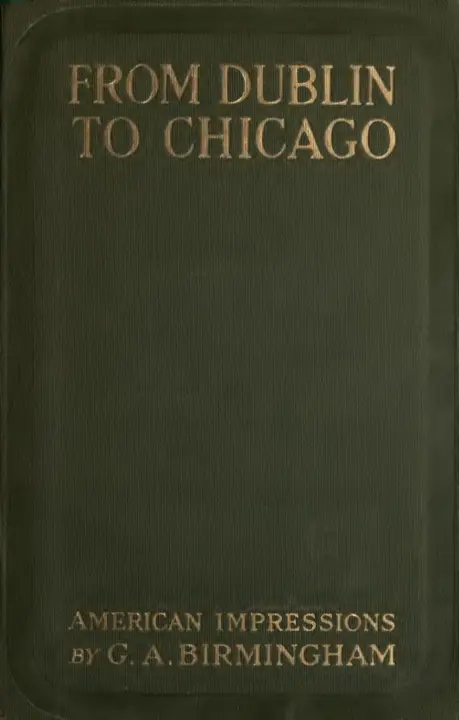
From Dublin to Chicago: Some Notes on a Tour in America
George A. Birmingham
THE CLASSIC COLLECTION · 1918
"The Island Mystery" by George A. Birmingham is a fictional novel written in the early 20th century. This story likely revolves around the intriguing and mysterious events on the fictional Mediterranean island of Salissa, particularly during the backdrop of World War I, as suggested by the references to the war and political dynamics. Central characters introduced in the opening include Sir Bartholomew Bland-Potterton and King Konrad Karl II of Megalia, both of whom are tied to the political turmoil surrounding the island. At the start of the novel, the author sets the scene by discussing the obscurity and strategic importance of Salissa, hinting at its underlying political intrigues. The narrator reveals that the island remains largely unknown to the public despite its significance during the war, and that gossip, rather than news, fuels public perception. Sir Bartholomew is noted for having a story connected to a lady associated with Salissa, and the narrative gradually introduces the notion of a mysterious American millionaire, Mr. Donovan, who has ambitions tied to the island. As the characters begin to interact, discussions about its governance and the notion of kingship arise, setting the stage for an unfolding tale rich with humor, adventure, and perhaps mischief in the narrative structure.
Introduction adapted from the source catalogue; source summaries may be automatically generated.
Free to read · English · 70,267 words · No account needed
MAKE TIME FOR A GOOD BOOK
On by default. Untick to stop anonymous reading totals. Each page counts after 10 seconds in view. How this works.
Anonymous counting is on unless you have switched it off.
"No," said the Queen. "The great thing is not to be carried away by passion. We must be cold, purely intellectual. We must be thoroughly systematic. We'll begin with the torn envelope. It happened first."
They retired to a shady corner of the balcony outside the Queen's rooms and studied the torn envelope for two hours. They were analytical, keenly and minutely observant, coldly cautious in forming conclusions. They tried every method of detection known to detective science. They held the envelope up to the light in order to discover a watermark. They examined the texture of the paper, the ink and the postage stamp, carefully through a powerful magnifying glass. They scraped one corner of the envelope with the blade of a penknife. They took four photographs, two of the front and two of the back, with the Queen's hand camera. They talked a good deal about fingerprints.
Phillips had a logical mind and a capacity for synthetic induction. The Queen was perhaps the more careful observer. She had certainly the more brilliant imagination. After two hours' work they summed up their conclusions, making careful notes with the Queen's fountain pen on the blank pages at the end of a large diary.
"A man or men----" said Phillips.
The Queen wrote down "A man or men" in the diary.
"Has," said Phillips, "or have, been present on the island of Salissa at some date between December 15, 1913, and April 30, 1914. The said man or men was or were during part of that period in occupation of the royal palace."
"Royal palace," said the Queen, writing rapidly.
"This man--or men, of course--was in correspondence with some person at present unknown, resident in the city of London."
"That's very important," said the Queen. "Anything more?"
"No," he said, "that's all I've got."
The Queen handed over the diary. It was Phillips' turn to write.
"I observed," she said, "that the envelope is of the kind used by
business men, an office envelope; also that the stamp is put on
crooked."
Phillips looked at the stamp. It was put on crooked.
"From this I infer," said the Queen, "either that the man in
London----What did you call him?"
"Person at present unknown," said Phillips.
"Either that the person at present unknown was (a) habitually careless about details, or that (b) though usually careful he was in a hurry when he despatched this letter."
"By Jove!" said Phillips, "but, I say, mightn't somebody else, an office boy or some one, have put on the stamp?"
"Not on a letter of this kind," said the Queen. "The writer wouldn't
have trusted any one else."
Your reading position is saved on this browser. Take it to another device with a library code. Reading pages adapt to text, rather than matching a printed edition.
George A. Birmingham
George A. Birmingham
George A. Birmingham
George A. Birmingham
BEHIND THE BOOK
This eBook is for the use of anyone anywhere in the United States and most other parts of the world at no cost and with almost no restrictions whatsoever. You may copy it, give it away or re-use it under the terms of the Project Gutenberg License included with this eBook or online at www.gutenberg.org. If you are not located in the United States, you will have to check the laws of the country where you are located before using this eBook. Read the source licence.
The original source file, including credits and licence, is retained by this library. Request an original-format copy at no charge. Please include the book title and Project Gutenberg identifier #29644.
KEEP YOUR CURIOSITY GOING
Coulson Kernahan

Maurice Baring
Frances Wright
Cécile Tormay

Frederic Jesup Stimson

W. H. P. (William Henry Pope) Jarvis