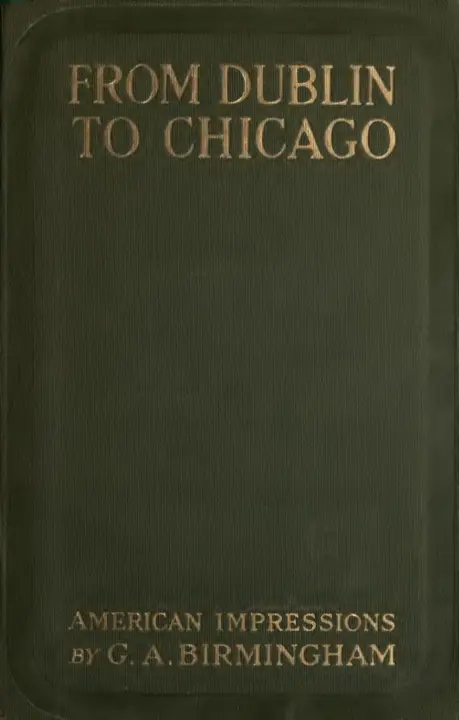
From Dublin to Chicago: Some Notes on a Tour in America
George A. Birmingham
THE CLASSIC COLLECTION · 1918
"The Island Mystery" by George A. Birmingham is a fictional novel written in the early 20th century. This story likely revolves around the intriguing and mysterious events on the fictional Mediterranean island of Salissa, particularly during the backdrop of World War I, as suggested by the references to the war and political dynamics. Central characters introduced in the opening include Sir Bartholomew Bland-Potterton and King Konrad Karl II of Megalia, both of whom are tied to the political turmoil surrounding the island. At the start of the novel, the author sets the scene by discussing the obscurity and strategic importance of Salissa, hinting at its underlying political intrigues. The narrator reveals that the island remains largely unknown to the public despite its significance during the war, and that gossip, rather than news, fuels public perception. Sir Bartholomew is noted for having a story connected to a lady associated with Salissa, and the narrative gradually introduces the notion of a mysterious American millionaire, Mr. Donovan, who has ambitions tied to the island. As the characters begin to interact, discussions about its governance and the notion of kingship arise, setting the stage for an unfolding tale rich with humor, adventure, and perhaps mischief in the narrative structure.
Introduction adapted from the source catalogue; source summaries may be automatically generated.
Free to read · English · 70,267 words · No account needed
MAKE TIME FOR A GOOD BOOK
On by default. Untick to stop anonymous reading totals. Each page counts after 10 seconds in view. How this works.
Anonymous counting is on unless you have switched it off.
The Queen, fully dressed at last, ran to her father's room. Kalliope was at her heels. Donovan was in bed and still asleep. At that hour Smith had not even brought him his cup of coffee or his shaving water. The Queen was less ruthless than Kalliope had been. She did not pull her father out of bed; but she wakened him without pity.
"Father," she said, "a steamer has arrived. She came during the night. She looks like a yacht. Do you think she can be a yacht? I wonder who's on board of her."
Donovan sat up and yawned.
"Is she going off again right now?" he asked.
"Oh no," said the Queen, "she has gone in quite close to the shore.
She has put out four anchors. She looks as if she meant to stay for
weeks."
"Then there's no darned hurry," said Donovan, "and no need for me to strain my heart by getting out of bed at this hour. Just you run away, Daisy, and take that girl of yours with you."
"But, father, don't you want to see the yacht? Don't you want to know
who's in her?"
"We'll send Smith after breakfast," said Donovan, "and ask the
proprietor to dine."
Mr. Donovan lay down again and put his head on the pillow.
"But I can't possibly wait till dinner-time," said the Queen.
"Well, luncheon," said Donovan.
His voice was a little muffled. After lying down he had taken a pull at the bedclothes and had arranged the corner of the sheet over his mouth and ear.
The Queen gave him up; but she was not willing to wait even till luncheon-time or to trust Smith to deliver the invitation. Kalliope shared her impatience.
"Go row," she said, "quick--quick--slick."
"Slick" was a word which she had recently learned from Smith. He often used it in urging on his staff of housemaids. He was forced to use an English word now and then when he could not express his meaning in the Megalian language. There is no equivalent to "slick" in Megalian.
What the Queen wanted most at the moment was to be quick and slick in getting off. She and Kalliope ran down to the steps where their boat lay moored. Smith was there, looking at the strange steamer.
"Oh, Smith," said the Queen, "is it a yacht?"
"Don't know, your Majesty," said Smith. "Never saw her before. She looks to me like a foreigner, your Majesty, not an English boat."
"Well, I'll soon find out," said the Queen. "We're going off to her."
Kalliope had already cast off the boat's mooring rope and sat ready at
the oars.
Your reading position is saved on this browser. Take it to another device with a library code. Reading pages adapt to text, rather than matching a printed edition.
George A. Birmingham

George A. Birmingham
George A. Birmingham
George A. Birmingham
BEHIND THE BOOK
This eBook is for the use of anyone anywhere in the United States and most other parts of the world at no cost and with almost no restrictions whatsoever. You may copy it, give it away or re-use it under the terms of the Project Gutenberg License included with this eBook or online at www.gutenberg.org. If you are not located in the United States, you will have to check the laws of the country where you are located before using this eBook. Read the source licence.
The original source file, including credits and licence, is retained by this library. Request an original-format copy at no charge. Please include the book title and Project Gutenberg identifier #29644.
KEEP YOUR CURIOSITY GOING
Coulson Kernahan

Maurice Baring
Frances Wright
Cécile Tormay

Frederic Jesup Stimson

W. H. P. (William Henry Pope) Jarvis