THE CLASSIC COLLECTION✦An outlaw’s diary: the CommuneCLASSIC FREE BOOKS
An outlaw’s diary: the Commune
Cécile Tormay
THE CLASSIC COLLECTION · 1915
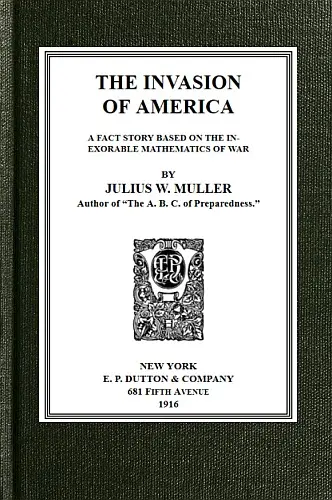
"The Invasion of America: A Fact Story Based on the Inexorable Mathematics of War" by Julius W. Muller is a historical account written in the early 20th century. The text explores a hypothetical invasion of the United States and examines the military implications of such an event, highlighting the country's unpreparedness for war. The narrative is constructed around a detailed portrayal of military maneuvers, strategies, and logistics that might occur during an invasion. The opening portion of the book sets the stage for an impending war, beginning with a joint military maneuver led by the President that reveals the vulnerabilities in America's defense. High-ranking officials discuss the strengths and weaknesses of the U.S. Army and Navy, emphasizing that the country is ill-equipped to face an invading force. As the coalition of enemy nations embarks on an assault, the narrative unfolds with a sense of urgency and dread as American cities brace for the potential landing of enemy troops. The detailed descriptions of military preparations illustrate not only the logistical challenges but also the societal panic and desire for protection that grips the nation in the face of war.
Introduction adapted from the source catalogue; source summaries may be automatically generated.
Free to read · English · 66,442 words · No account needed
MAKE TIME FOR A GOOD BOOK
On by default. Untick to stop anonymous reading totals. Each page counts after 10 seconds in view. How this works.
Anonymous counting is on unless you have switched it off.
[119] There is an immense literature on military law, and every army contains officers who have taken degrees in law, for the purpose of expounding and administering it.
[120] The legal and technical correctness of all acts is of extreme importance in the peace settlements.
[121] All authority in conquered country is only by and with the authority of the military conqueror. His power, practically, is limited only by his motives of policy or kindness.
[122] This requisition is taken almost verbatim from a requisition issued by a belligerent army in the field. It is an accepted and acknowledged principle of war that the conqueror may force the enemy to pay his expenses to as large an extent as possible. A commander may waive the right, but it is held unimpaired.
[123] This decision covered a case that arose during the Civil War, and was cited by the Law Office, Division of Insular Affairs, on several occasions to fortify United States procedure after the Spanish-American War.
[124] A literal extract from the Sedition Act (No. 292, etc.) of the Philippine Commission, except that the act provides for specific imprisonment and fine.
[125] So laid down by nearly all writers on military law who touch on
this subject.
[126] This principle was laid down in regard to territory subjected to military occupation by the United States during the war with Mexico. The United States claimed (and sparingly exercised) the right to court martial and execute as rebels certain leaders of an insurrection against the military government in New Mexico, 1847-8.
[127] “In many instances the deficiency has reached such a figure as to leave militia organizations such in name only.”--Page 206, last report, General Mills, U. S. A.
[128] Table No. 9, Report, Division of Militia Affairs, U. S. A., 1914.
[129] Range of four miles.
[130] Page 231, Report on militia field artillery, General Mills, U.
S. A., 1914.
[131] Table 9, militia cavalry statistics, Division of Militia Affairs, U. S. A. Annual Report, 1914.
[132] From statistics, gathered before the present European War, of the armament then owned by at least four of the great Powers.
[133] From statistics, gathered before the present European War, of the armament then owned by at least four of the great Powers.
[134] A literal transcript of the report of two medical officers on the conditions existing among good militia troops who were ordered out for maneuvers distinctly specified as war maneuvers to be conducted under war conditions.
[135] This figure is purposely placed below what is actually expected. During the Connecticut maneuvers, 1909, the straggling was a subject for comment among both militia and regular officers, though the troops did well considering their softness. One officer reported that the straggling amounted to 15 to 25 per cent. of some regiments.
Your reading position is saved on this browser. Take it to another device with a library code. Reading pages adapt to text, rather than matching a printed edition.
BEHIND THE BOOK
This eBook is for the use of anyone anywhere in the United States and most other parts of the world at no cost and with almost no restrictions whatsoever. You may copy it, give it away or re-use it under the terms of the Project Gutenberg License included with this eBook or online at www.gutenberg.org. If you are not located in the United States, you will have to check the laws of the country where you are located before using this eBook. Read the source licence.
The original source file, including credits and licence, is retained by this library. Request an original-format copy at no charge. Please include the book title and Project Gutenberg identifier #52038.
KEEP YOUR CURIOSITY GOING
Cécile Tormay

Moritz Busch
John L. Ransom
Frances Wright
Cécile Tormay

Mabel Potter Daggett