THE CLASSIC COLLECTION✦An outlaw’s diary: the CommuneCLASSIC FREE BOOKS
An outlaw’s diary: the Commune
Cécile Tormay
THE CLASSIC COLLECTION · 1915
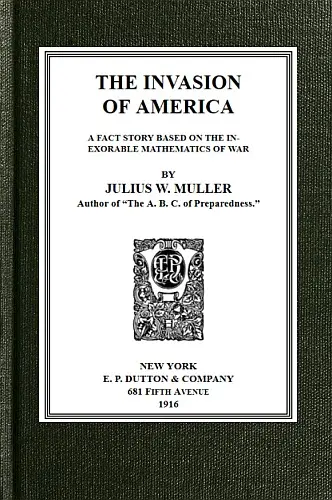
"The Invasion of America: A Fact Story Based on the Inexorable Mathematics of War" by Julius W. Muller is a historical account written in the early 20th century. The text explores a hypothetical invasion of the United States and examines the military implications of such an event, highlighting the country's unpreparedness for war. The narrative is constructed around a detailed portrayal of military maneuvers, strategies, and logistics that might occur during an invasion. The opening portion of the book sets the stage for an impending war, beginning with a joint military maneuver led by the President that reveals the vulnerabilities in America's defense. High-ranking officials discuss the strengths and weaknesses of the U.S. Army and Navy, emphasizing that the country is ill-equipped to face an invading force. As the coalition of enemy nations embarks on an assault, the narrative unfolds with a sense of urgency and dread as American cities brace for the potential landing of enemy troops. The detailed descriptions of military preparations illustrate not only the logistical challenges but also the societal panic and desire for protection that grips the nation in the face of war.
Introduction adapted from the source catalogue; source summaries may be automatically generated.
Free to read · English · 66,442 words · No account needed
MAKE TIME FOR A GOOD BOOK
On by default. Untick to stop anonymous reading totals. Each page counts after 10 seconds in view. How this works.
Anonymous counting is on unless you have switched it off.
[103] The primary harbor defense batteries (12-inch, 10-inch and 8-inch guns and 12-inch mortars) are not emplaced for anything except sea-ward fire, nor should they be. To use them against land attack would be only a matter of desperation, as in the case here described. As a matter of fact, they would be rather inefficient against smaller guns that are more mobile and durable.
[104] “Firing at speed, the shots from a dozen guns shooting at successive intervals, would not have five seconds between them.”
[105] The tremendous air-compression in fortifications during gun-action almost always tears out parts of the general installation even in mere target practice. If fire-control installation, wiring, telephone systems, etc., are efficient only to the minimum degree, and there is no adequate reserve supply of material for repairs, they are certain to break down in any attack that is pressed with vigor. An attacked harbor-work is subjected to the most terrible destructive attempts that humanity has been able to devise.
[106] Long range investment with modern artillery serves the double purpose of commanding the ultimate target, and commanding all the territory in between, thus giving the artillerist possession of many miles of area.
[107] Financial Statistics, Department of Commerce, Bureau of the
Census, 1914.
[108] In Brown versus the United States, the U. S. Supreme Court decreed that “war gives to the sovereign,” i.e. the conquering power, “full right to take the persons and confiscate the property of the enemy wherever found.--Humane mitigations may affect exercise of this right but cannot impair the right itself.”
[109] “The so-called exemption of private property from capture or seizure on land may be called almost nominal.”--Rear-Admiral Stockton, Outlines of International Law.
[110] Napoleon made Valencia pay $100,000 for the support of his army. Receipts were provided for originally when troops made requisitions, not necessarily to insure pay to the despoiled inhabitants, but merely to prevent unauthorized plundering.
[111] A universally accepted form of military rule, and distinguished
from merely martial law.
[112] U. S. Census Bureau Report, 1914; also Boston City Manual.
[113] So certified to City Clerk, Boston, by Board of Assessors, June 30, 1914, exact number 123,657.
[114] Statistics of Cities of the United States, 1914.
[115] From “Instructions for Government of Armies of the United States in the Field” (with exception of statement as to specific punishment for infraction. Punishment mentioned here, however, is such as all military authorities will claim the right to inflict.)
[116] The right of quartering troops on the inhabitants of enemy country is unquestioned and universally exercised. Equally universal is the military commanders’ right to punish treachery by death.
[117] “Complete conquest carries with it all rights of former government.”--U. S. Supreme Court.
[118] Benjamin Harris’ “Publick Occurrences,” suppressed after one
issue.
Your reading position is saved on this browser. Take it to another device with a library code. Reading pages adapt to text, rather than matching a printed edition.
BEHIND THE BOOK
This eBook is for the use of anyone anywhere in the United States and most other parts of the world at no cost and with almost no restrictions whatsoever. You may copy it, give it away or re-use it under the terms of the Project Gutenberg License included with this eBook or online at www.gutenberg.org. If you are not located in the United States, you will have to check the laws of the country where you are located before using this eBook. Read the source licence.
The original source file, including credits and licence, is retained by this library. Request an original-format copy at no charge. Please include the book title and Project Gutenberg identifier #52038.
KEEP YOUR CURIOSITY GOING
Cécile Tormay

Moritz Busch
John L. Ransom
Frances Wright
Cécile Tormay

Mabel Potter Daggett