THE CLASSIC COLLECTION✦An outlaw’s diary: the CommuneCLASSIC FREE BOOKS
An outlaw’s diary: the Commune
Cécile Tormay
THE CLASSIC COLLECTION · 1851
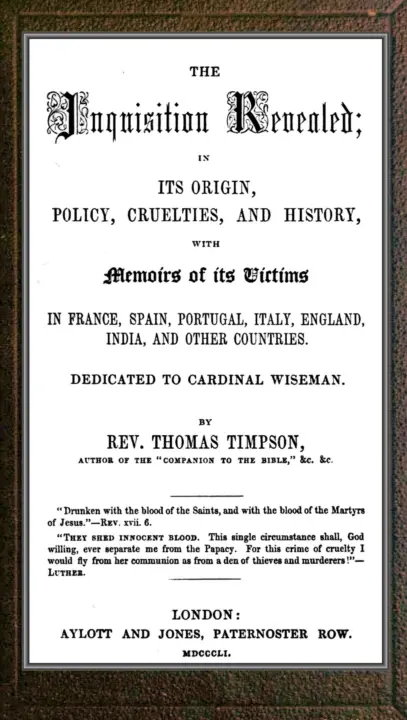
"The Inquisition Revealed" by Rev. Thomas Timpson is a historical account written in the mid-19th century. This work delves into the various aspects of the Inquisition, including its origins, policies, cruelties, and history, while also providing memoirs of its numerous victims across different countries. The narrative likely emphasizes the gruesome nature of the Inquisition as it pertains to religious persecution, particularly against those deemed heretics. At the start of the book, the author introduces the concept of the Inquisition as a cruel and oppressive force masquerading as a protector of Christianity. Timpson argues that the institution has historically been responsible for significant brutality, using religious rhetoric to justify its actions. The opening chapters outline how the Inquisition arose from a broader spirit of intolerance within the church and begins to detail its perpetrations against dissenters, with specific examples of victims and outright brutality. The author sets a foundational critique of the Roman Catholic Church's authority, suggesting that its hierarchical structure leads to moral degradation and persecution, laying the groundwork for the subsequent exploration of the Inquisition's history and its victims.
Introduction adapted from the source catalogue; source summaries may be automatically generated.
Free to read · English · 97,157 words · No account needed
MAKE TIME FOR A GOOD BOOK
On by default. Untick to stop anonymous reading totals. Each page counts after 10 seconds in view. How this works.
Anonymous counting is on unless you have switched it off.
Inquisition in Spain--Inquisitors--Vicars--Counsellors--Promoters-Fiscal--Notaries-- Treasurer--Executor--Familiars--Cross-Bearers--Visitors--Privileges-- Jurisdiction--Prohibition of books--Prison-keepers.
Spain, Portugal, and Rome have been most notorious for cruelty, by means of the dreaded court of inquisition. The “Holy Office,” in those countries, has been the most extended, and the most complete in its arrangements; its ministers, therefore, have been most numerous. The number of officers in the Spanish Inquisition has been reckoned at about three thousand, and its expense to the country about one million of pounds sterling per annum!
District courts were formed in many places, of which it is said, “In every province of Spain there ought to be two or three inquisitors, one judge of the forfeited effects, one executor, three notaries, one keeper of the prison, one messenger, one door-keeper, and one physician. Besides these, assessors, skilful counsellors, familiars and others,” were appointed for the service of this court. These require some notice, the better to understand the character of the Inquisition.
1. INQUISITORS APOSTOLIC.--These are the chief officers, delegates from the Pope, for the special service of judging heretics. Their rank is exalted in the papacy, as each has the title of “lord,” and every inquisitor is styled “most reverend.” One among those in Spain was president of the Inquisition, and was called “inquisitor-major,” or “inquisitor-general.” The Romish cardinals, also, were inquisitors-general.
2. VICARS.--These are appointed by the inquisitors, to serve as their substitutes in case of absence or sickness, and these exercise all the power of their principals, in receiving accusations, and arresting those who may be accused.
3. COUNSELLORS.--These were skilful lawyers, appointed to advise and assist the inquisitors, who were generally ignorant of legal forms. They were sworn to secrecy.
4. PROMOTER-FISCAL.--This officer also is a lawyer, whose business is to examine the depositions of witnesses, to give information against criminals, to demand their imprisonment, and to frame their indictment against them. He was a kind of counsellor for the Holy Office.
5. NOTARIES.--These officers were short-hand writers, whose duty was to attend the examinations of the prisoners, to note down everything they said, their behaviour, and even change of countenance, while questioned by the inquisitors. They are required to be skilful in different languages; as the prisoners may be French, German, or Italian, before a Spanish Inquisition.
6. TREASURER.--This officer is called, in Spain, the receiver-general of the effects and property of the prisoners: in Rome he is called, treasurer of the Holy Office. He takes charge of all the effects of the prisoners, letting or selling their lands and houses; so that immense property falls into his hands.
Your reading position is saved on this browser. Take it to another device with a library code. Reading pages adapt to text, rather than matching a printed edition.
BEHIND THE BOOK
This eBook is for the use of anyone anywhere in the United States and most other parts of the world at no cost and with almost no restrictions whatsoever. You may copy it, give it away or re-use it under the terms of the Project Gutenberg License included with this eBook or online at www.gutenberg.org. If you are not located in the United States, you will have to check the laws of the country where you are located before using this eBook. Read the source licence.
The original source file, including credits and licence, is retained by this library. Request an original-format copy at no charge. Please include the book title and Project Gutenberg identifier #71850.
KEEP YOUR CURIOSITY GOING
Cécile Tormay

Moritz Busch
John L. Ransom
Frances Wright
Cécile Tormay

Mabel Potter Daggett