THE CLASSIC COLLECTION✦An outlaw’s diary: the CommuneCLASSIC FREE BOOKS
An outlaw’s diary: the Commune
Cécile Tormay
THE CLASSIC COLLECTION · 1851
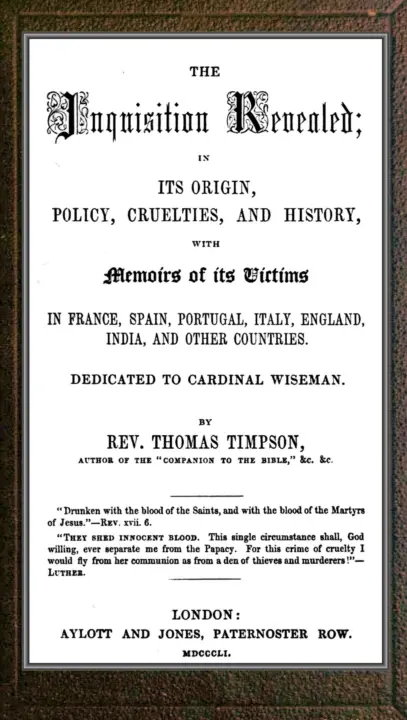
"The Inquisition Revealed" by Rev. Thomas Timpson is a historical account written in the mid-19th century. This work delves into the various aspects of the Inquisition, including its origins, policies, cruelties, and history, while also providing memoirs of its numerous victims across different countries. The narrative likely emphasizes the gruesome nature of the Inquisition as it pertains to religious persecution, particularly against those deemed heretics. At the start of the book, the author introduces the concept of the Inquisition as a cruel and oppressive force masquerading as a protector of Christianity. Timpson argues that the institution has historically been responsible for significant brutality, using religious rhetoric to justify its actions. The opening chapters outline how the Inquisition arose from a broader spirit of intolerance within the church and begins to detail its perpetrations against dissenters, with specific examples of victims and outright brutality. The author sets a foundational critique of the Roman Catholic Church's authority, suggesting that its hierarchical structure leads to moral degradation and persecution, laying the groundwork for the subsequent exploration of the Inquisition's history and its victims.
Introduction adapted from the source catalogue; source summaries may be automatically generated.
Free to read · English · 97,157 words · No account needed
MAKE TIME FOR A GOOD BOOK
On by default. Untick to stop anonymous reading totals. Each page counts after 10 seconds in view. How this works.
Anonymous counting is on unless you have switched it off.
As to the sacrifices of the Protestants in France, it is collected from authentic records that during forty years, in the middle of this century, not less than a million were the victims of the unrelenting bigotry of the Romish inquisitors!
Protestantism still survived in France; and many again took up arms in their own defence, until 1598, when Henry IV., of Navarre, succeeded to the throne. He granted the famous “Edict of Nantes,” which was called “Irrevocable!” and by which the Protestants were allowed liberty of conscience, the free exercise of their religion, and access to all places of public trust and dignity. But the Papists continued by all kinds of intrigues to annoy them. One shameful invasion of their rights succeeded another, by the enactment of inhuman laws, until the reign of Louis XIV., who was prevailed on, in 1685, by the Popish bishops and the Jesuits, contrary to the most solemn obligations which human or divine laws can frame, to revoke the “Irrevocable Edict of Nantes.”
By this means it was intended, in one grand effort, to extirpate the very remembrance of the Protestant profession in France. Reconciliation with Rome was required, or banishment from the kingdom. Fifteen days were allowed to the preachers and professors, and many of them fled. About eight hundred thousand, chiefly artisans, escaped from the dragoons, who were commissioned to destroy those who would not conform. Many of the exiles, being weavers, were well received in England, where they contributed greatly to the wealth and prosperity of the nation, by their woollen factories in Yorkshire and the west, and by their silk works in Spitalfields, London.
Those who could not escape were treated with every species of brutality. “The troopers, soldiers and dragoons,” says a French Protestant author, in 1686, “went into the Protestants’ houses, where they marred and defaced their household stuff, broke their looking-glasses, and other utensils and ornaments. Those things which they could not destroy in this manner--such as furniture of beds, linens, wearing apparel, plate, &c.,--they carried to the market-place, and sold them to the Jesuits and other Roman Catholics. They turned the dining-rooms of gentlemen into stables for their horses; and treated the owners of the houses where they were quartered with the highest indignity and cruelty, lashing them about from one to another, day and night, without intermission, not suffering them to eat or drink. In several places the soldiers applied ret-hot irons to the hands and feet of men and breasts of women. At Nantes they hung up several women and maids by their feet, and others by their arm-pits, and thus exposed them to public view, stark naked. They bound to posts mothers that gave suck, and let their sucking infants lie languishing in their sight for several days and nights, crying, mourning, and gasping for life. Some they bound before a great fire, and, being half-roasted, let them go--a punishment worse than death. Amidst a thousand hideous cries and blasphemies, they hung up men and women by the hair, and some by their feet, on hooks in chimneys, and smoked them with wisps of wet hay till they were suffocated. They tied some under the arms with ropes, and plunged them again and again into wells; they bound others like criminals, put them to the tortures, and, with a funnel, filled them with wine, till the fumes of it took away their reason, when they made them say they consented to be Catholics. They stripped them naked, and, after a thousand indignities, stuck them with pins and needles from head to foot. They cut and slashed them with knives; and sometimes with red-hot pincers took hold of them by the nose and other parts of the body, and dragged them about the rooms till they promised to be Catholics. They beat them with staves, and thus bruised, and with broken bones, dragged them to the church, where their forced presence was taken for abjuration. In some places they tied fathers and husbands to their bed-posts, and, before their eyes, ravished their wives and daughters with impunity. With these scenes of desolation and horror the popish clergy feasted their eyes, and made them only a matter of laughter and sport. Though my heart aches, I beg the reader’s patience to lay before him two other instances, which, if he hath a heart like mine, he will not be able to read without watering these sheets with tears. The first is of a young woman, who being brought before the council, upon refusing to abjure her religion, was ordered to prison. There they shaved her head, singed off the hair from other parts of her body; and having stripped her stark naked, led her through the streets of the city, where many a blow was given her, and stones flung at her; then they set her up to the neck in a tub of water for awhile; they took her out, and put on her a shift dipped in wine, which, as it dried and stuck to her sore and bruised body, they snatched off again, and then had another ready dipped in wine to clap on her. This they repeated six times, thereby making her body exceeding raw and sore. When all these cruelties could not shake her constancy, they fastened her by the feet in a kind of gibbet, and let her hang in that posture, with her head downward, till she expired!
Your reading position is saved on this browser. Take it to another device with a library code. Reading pages adapt to text, rather than matching a printed edition.
BEHIND THE BOOK
This eBook is for the use of anyone anywhere in the United States and most other parts of the world at no cost and with almost no restrictions whatsoever. You may copy it, give it away or re-use it under the terms of the Project Gutenberg License included with this eBook or online at www.gutenberg.org. If you are not located in the United States, you will have to check the laws of the country where you are located before using this eBook. Read the source licence.
The original source file, including credits and licence, is retained by this library. Request an original-format copy at no charge. Please include the book title and Project Gutenberg identifier #71850.
KEEP YOUR CURIOSITY GOING
Cécile Tormay

Moritz Busch
John L. Ransom
Frances Wright
Cécile Tormay

Mabel Potter Daggett