THE CLASSIC COLLECTION✦An outlaw’s diary: the CommuneCLASSIC FREE BOOKS
An outlaw’s diary: the Commune
Cécile Tormay
THE CLASSIC COLLECTION · 1851
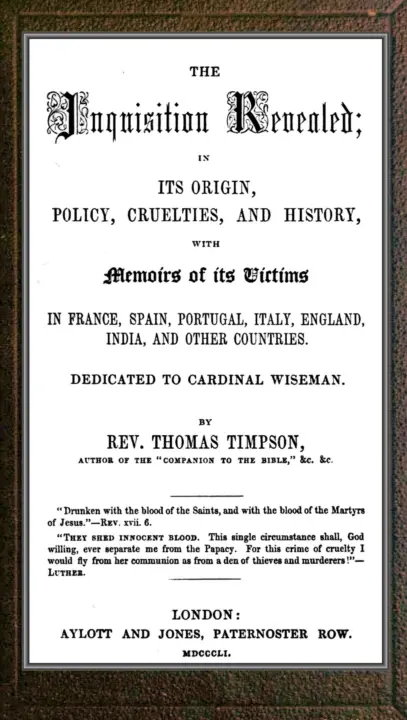
"The Inquisition Revealed" by Rev. Thomas Timpson is a historical account written in the mid-19th century. This work delves into the various aspects of the Inquisition, including its origins, policies, cruelties, and history, while also providing memoirs of its numerous victims across different countries. The narrative likely emphasizes the gruesome nature of the Inquisition as it pertains to religious persecution, particularly against those deemed heretics. At the start of the book, the author introduces the concept of the Inquisition as a cruel and oppressive force masquerading as a protector of Christianity. Timpson argues that the institution has historically been responsible for significant brutality, using religious rhetoric to justify its actions. The opening chapters outline how the Inquisition arose from a broader spirit of intolerance within the church and begins to detail its perpetrations against dissenters, with specific examples of victims and outright brutality. The author sets a foundational critique of the Roman Catholic Church's authority, suggesting that its hierarchical structure leads to moral degradation and persecution, laying the groundwork for the subsequent exploration of the Inquisition's history and its victims.
Introduction adapted from the source catalogue; source summaries may be automatically generated.
Free to read · English · 97,157 words · No account needed
MAKE TIME FOR A GOOD BOOK
On by default. Untick to stop anonymous reading totals. Each page counts after 10 seconds in view. How this works.
Anonymous counting is on unless you have switched it off.
Two ladies, at this period, exercised extraordinary influence in religion in France. Margaret, the duchess of Alençon, sister of Francis, entertained opinions far different from those of the king; and she afforded her powerful protection to the reformers, who increased in several parts of France, especially at Meaux and Lyons. Louisa of Savoy, mother of Francis, professedly a Roman Catholic, but in reality a woman of no religious principle, was made regent of the kingdom, while he carried his arms into Italy, in 1524. He was, at first, successful; but, being eager to take Pavia, he was defeated near that city by the imperial forces, and taken prisoner by Lannoy, vice-king of Naples.
Francis I. became a captive in the power of the Emperor Charles V., and was carried a prisoner into Spain. During his absence the terrors of the Inquisition were felt in France. For, no sooner had Louisa obtained possession of the reins of government, by the captivity of the king, her son, than she wrote to the Pope, as the means of conciliating his favour, asking his advice as to the best mode of dealing with the heretics that infested France. Clement VII., exasperated by the failure of every attempt to arrest the progress of the reformation in Germany and Switzerland, was delighted with the message which laid the heretics throughout the “Most Christian kingdom of France” at the mercy of the sovereign pontiff. He responded with practical effect; and, by a papal bull, established the Inquisition in France.
For the purpose of carrying out his policy, the Pope appointed Chancellor Duprat to be archbishop of Sens, and created him a cardinal. Thus the Inquisition was, at once, constituted in France, as all the influential powers,--the regent, the chancellor, and the parliament,--were leagued with the Pope and the Sorbonne, to exterminate heresy with fire and sword. A commission was appointed, consisting of four priests, to whom was entrusted absolute power to proceed against all persons suspected of being tainted with Lutheran doctrines. The highest dignitaries were held responsible to this dread tribunal; and the first victim of the inquisitors was Briconnet, count of Montbrun, bishop of Meaux. He was compelled to answer, like the humblest priest, before two of the inquisitors, and every appeal that he attempted to make to the parliament, or to the regent, was rejected. He recanted the evangelical doctrines that he had preached; and Lefevre, an aged professor in the university, “the forerunner of the reformation,” fled to Strasburgh. But neither the fall of the bishop, nor the flight of the doctor, could satisfy the inquisitors of Paris. Jean Pavanne was burned at the stake in the Place de Grève, rejoicing that he was counted worthy to suffer death for Christ. Their next victim was “the good hermit of Livry.” As he had evangelised the villagers around his dwelling, about nine miles from Paris, it was resolved to make him a public example. A vast pile was raised in the open area in front of the cathedral of Notre Dame, in which this servant of Christ was sacrificed, in the presence of the whole of the clergy, and a multitude of the people, who had been called together by the great bell of the cathedral. To such humble victims others were added of higher rank, and by other means than the prison and the stake. Michael D’Arande, chaplain to the Princess Margaret, was threatened with death, and Anthony Papillon, chief master of requests to the Dauphin, was carried off by poison. The inquisitors, in a few months, had committed to the flames, or driven from France, nearly every individual who had been the object of their envy or suspicion. At length, after a year’s captivity in Spain, Francis obtained his freedom, on most humiliating conditions, to the performance of which he was bound by a solemn oath. From this oath to the emperor the Pope gave him absolution, and thereby bound him more closely to himself by such faithless bonds of perjury and deceit. But this favour rendered it the more difficult for him to change the policy which, under the regency of his mother, had delivered up the heretics of France to the inquisitors of Rome.
Your reading position is saved on this browser. Take it to another device with a library code. Reading pages adapt to text, rather than matching a printed edition.
BEHIND THE BOOK
This eBook is for the use of anyone anywhere in the United States and most other parts of the world at no cost and with almost no restrictions whatsoever. You may copy it, give it away or re-use it under the terms of the Project Gutenberg License included with this eBook or online at www.gutenberg.org. If you are not located in the United States, you will have to check the laws of the country where you are located before using this eBook. Read the source licence.
The original source file, including credits and licence, is retained by this library. Request an original-format copy at no charge. Please include the book title and Project Gutenberg identifier #71850.
KEEP YOUR CURIOSITY GOING
Cécile Tormay

Moritz Busch
John L. Ransom
Frances Wright
Cécile Tormay

Mabel Potter Daggett