THE CLASSIC COLLECTION✦An outlaw’s diary: the CommuneCLASSIC FREE BOOKS
An outlaw’s diary: the Commune
Cécile Tormay
THE CLASSIC COLLECTION · 1851
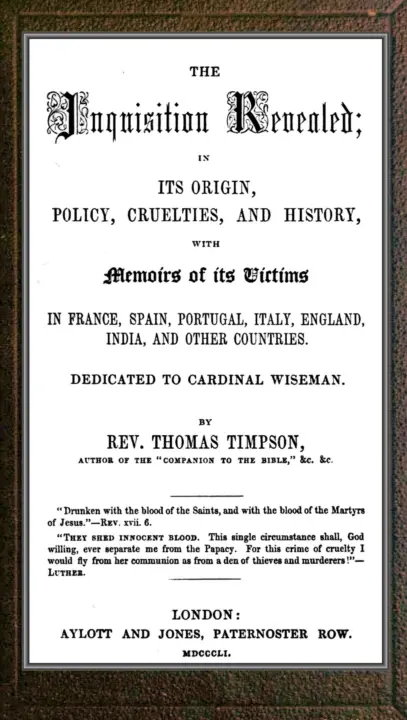
"The Inquisition Revealed" by Rev. Thomas Timpson is a historical account written in the mid-19th century. This work delves into the various aspects of the Inquisition, including its origins, policies, cruelties, and history, while also providing memoirs of its numerous victims across different countries. The narrative likely emphasizes the gruesome nature of the Inquisition as it pertains to religious persecution, particularly against those deemed heretics. At the start of the book, the author introduces the concept of the Inquisition as a cruel and oppressive force masquerading as a protector of Christianity. Timpson argues that the institution has historically been responsible for significant brutality, using religious rhetoric to justify its actions. The opening chapters outline how the Inquisition arose from a broader spirit of intolerance within the church and begins to detail its perpetrations against dissenters, with specific examples of victims and outright brutality. The author sets a foundational critique of the Roman Catholic Church's authority, suggesting that its hierarchical structure leads to moral degradation and persecution, laying the groundwork for the subsequent exploration of the Inquisition's history and its victims.
Introduction adapted from the source catalogue; source summaries may be automatically generated.
Free to read · English · 97,157 words · No account needed
MAKE TIME FOR A GOOD BOOK
On by default. Untick to stop anonymous reading totals. Each page counts after 10 seconds in view. How this works.
Anonymous counting is on unless you have switched it off.
“This auto was celebrated on the 8th of October, 1559. In order to greater decorum and solemnity, this most pious monarch thought it opportune to assist, with all his court, in those horrors, and recreate himself in the frightful destruction of many of his subjects, illustrious for their birth, their virtue, and their learning.
“Don Diego de Simancas, then secretary of the holy office, says, ‘The auto of those heretics was most solemnly celebrated in the Great Square, upon a stage made upon a new plan, so contrived, that from all parts the culprits might be seen. Upon other stages were assembled the council and principal persons; and so great was the concourse of people, who came from all the country round, that it was believed the number of persons assembled, including those of the city, could not be less than 200,000! In this fashion the most pious king, the clergy, the nobility, and the people, with tumultuous haste, had recourse to a method of amusement worthy of cannibals, or the ancient Mexicans.’”
In the month of October, 1560, twenty-eight persons, many of them members of the noblest families in Spain, were tied to the stakes and publicly burnt, as Lutheran heretics, in the presence of the king at Valladolid.
Philip was not satisfied, however, with the sacrifice of his citizens; he extended the Inquisition to the navy, appointing an inquisitor to his fleet in the year 1571; so that, among the seamen of Spain, many were sacrificed in a public act of faith, in the city of Messina. He established this court at Lima, in 1571, and in Mexico; and in the year 1574, a public act of faith was held in the market-place of that city. In this, there were eighty penitents; two of them, an Englishman and a Frenchman, were released; some others, for judaising and sorcery, were reconciled; but many of them were burnt to death, in the presence of the viceroy, the senate, the priests, and a large concourse of the Mexicans.
Philip II. died in September, 1598, after having reigned forty-two years. His name was abhorred in his own dominions on account of his sanguinary bigotry, and his pernicious policy in government. Historians represent him as worthy to be classed with those monsters of cruelty, Nero and Domitian, deserving the execration of mankind.
The number of the victims of the Inquisition during the reign of Philip II. was estimated at not less than 40,664; of whom, 6,300 were burnt; 3,124 were burnt in effigy; and 31,240 were subjected to various humiliating penances. This was, therefore, the reign of terror in Spain.
Your reading position is saved on this browser. Take it to another device with a library code. Reading pages adapt to text, rather than matching a printed edition.
BEHIND THE BOOK
This eBook is for the use of anyone anywhere in the United States and most other parts of the world at no cost and with almost no restrictions whatsoever. You may copy it, give it away or re-use it under the terms of the Project Gutenberg License included with this eBook or online at www.gutenberg.org. If you are not located in the United States, you will have to check the laws of the country where you are located before using this eBook. Read the source licence.
The original source file, including credits and licence, is retained by this library. Request an original-format copy at no charge. Please include the book title and Project Gutenberg identifier #71850.
KEEP YOUR CURIOSITY GOING
Cécile Tormay

Moritz Busch
John L. Ransom
Frances Wright
Cécile Tormay

Mabel Potter Daggett