THE CLASSIC COLLECTION✦An outlaw’s diary: the CommuneCLASSIC FREE BOOKS
An outlaw’s diary: the Commune
Cécile Tormay
THE CLASSIC COLLECTION · 1851
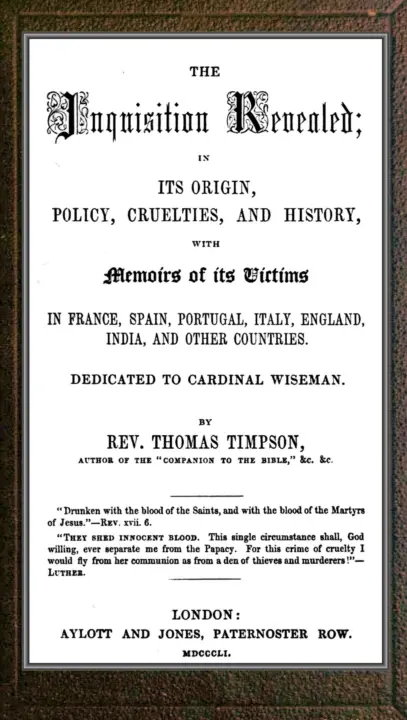
"The Inquisition Revealed" by Rev. Thomas Timpson is a historical account written in the mid-19th century. This work delves into the various aspects of the Inquisition, including its origins, policies, cruelties, and history, while also providing memoirs of its numerous victims across different countries. The narrative likely emphasizes the gruesome nature of the Inquisition as it pertains to religious persecution, particularly against those deemed heretics. At the start of the book, the author introduces the concept of the Inquisition as a cruel and oppressive force masquerading as a protector of Christianity. Timpson argues that the institution has historically been responsible for significant brutality, using religious rhetoric to justify its actions. The opening chapters outline how the Inquisition arose from a broader spirit of intolerance within the church and begins to detail its perpetrations against dissenters, with specific examples of victims and outright brutality. The author sets a foundational critique of the Roman Catholic Church's authority, suggesting that its hierarchical structure leads to moral degradation and persecution, laying the groundwork for the subsequent exploration of the Inquisition's history and its victims.
Introduction adapted from the source catalogue; source summaries may be automatically generated.
Free to read · English · 97,157 words · No account needed
MAKE TIME FOR A GOOD BOOK
On by default. Untick to stop anonymous reading totals. Each page counts after 10 seconds in view. How this works.
Anonymous counting is on unless you have switched it off.
“The great amazement that I was in took away all my senses, or the free exercise of them; for I had not liberty to think of my parents, nor of my grief, nor of the danger that was so near me. So, in this suspension of thought, the waiting-maid came, and locked the chamber-door after her, and told me, ‘Madam, let us go to bed, and only tell me at what time in the morning will you have the chocolate ready?’ ‘Mary! for heaven’s sake,’ said I, as she had told me her name, ‘tell me whether I am to die or not.’ ‘I told you, madam, that you come,’ said she, ‘to live as one of the happiest creatures in the world.’ And as I observed her reservedness, I did not ask her any more questions; so recommending myself to God Almighty, and to our Lady of the Pillar, and preparing myself to die, I went to bed, but could not sleep. I was up with the day, but Mary slept till six of the clock. She left me half an hour alone, and came back with a silver plate, with two cups of chocolate and some biscuits. I drank one cup and desired her to drink the other. ‘Well, Mary,’ said I, ‘can you give me any account of the reason of my being here?’ ‘Not yet, madam,’ said she, ‘but only have patience for a little while.’ With this answer she left me, and an hour after came again with two baskets, with a fine Holland shift, a Holland under-petticoat, with fine lace round about it; two silk petticoats, and a little Spanish waistcoat with a gold fringe all over it; with combs and ribbons, and everything suitable to a lady of higher quality than I. But my greatest surprise was to see a gold snuff-box, with the picture of Don Francisco Torrejon on it. Then I soon understood the meaning of my confinement. So I considered with myself that to refuse the present would be the occasion of my immediate death, and to accept of it was to give him, even on the first day, too great encouragement against my honour. But I found, as I thought then, a medium in the case; so I said, ‘Mary, pray give my service to Don Francisco Torrejon, and tell him that, as I could not bring my clothes with me last night, honesty permits me to accept of these clothes, which are necessary to keep me decent; but, since I take no snuff, I beg his lordship to excuse me if I do not accept this box.’ Mary went to him with this answer, and came again with a picture nicely set in gold, with four diamonds at the four corners of it, and told me that his lordship was mistaken, and that he desired me to accept that picture, which would be a great favour to him; and while I was thinking with myself what to do, Mary said to me, ‘Pray, madam, take my poor advice; accept the picture, and everything that he sends to you; for consider, that if you do not consent and comply with everything he has a mind for, you will soon be put to death, and nobody will defend you; but if you are obliging and kind to him, he is a very complaisant and agreeable gentleman, and will be a charming lover; and you will be here like a queen, and he will give you another apartment with a fine garden, and many young ladies shall come to visit you. So I advise you to send a civil answer to him, and desire a visit from him, or else you will soon begin to repent yourself.’ ‘O dear me!’ said I, ‘must I abandon my honour without any remedy? If I oppose his desire, he will obtain it by force;’ and, full of confusion, I bid Mary to give him what answer she thought fit. She was very glad of my humble submission, and went to give Don Francisco my answer. She came back, in a few minutes after, all overjoyed to tell me that his lordship would honour me with his company at supper, and that he could not come sooner on account of business that called him abroad; but, in the meantime, he desired me to divert myself, and to give Mary my measure for a suit of new clothes, and order her to bring me everything that I could wish for. Mary added to this, ‘Madam, I may now call you my mistress; and must tell you, that I have been in the Holy Office these fourteen years, and I know the customs of it very well; but because silence is imposed upon me under pain of death, I cannot tell you anything but what concerns your person. So, in the first place, do not oppose the holy father’s will and pleasure; secondly, if you see some young ladies here, never ask them the occasion of their being here, nor anything of their business; neither will they ask you anything of this nature; and take care not to tell them anything of your being here. You may come and divert yourself with them, at such hours as are appointed; you shall have music and all sorts of recreations. Three days hence you shall dine with them; they are all ladies of quality, young and merry, and this is the best of lives. You will not long for going abroad, you will be so well diverted at home; and when your time is expired, then the holy fathers will marry you to some nobleman. Never mention the name of Don Francisco, nor your name, to any one. If you see here some young ladies of your acquaintance in the city, they will never take notice of your formerly knowing each other, though they will talk with you of indifferent matters; so take care not to speak anything of your family.’
Your reading position is saved on this browser. Take it to another device with a library code. Reading pages adapt to text, rather than matching a printed edition.
BEHIND THE BOOK
This eBook is for the use of anyone anywhere in the United States and most other parts of the world at no cost and with almost no restrictions whatsoever. You may copy it, give it away or re-use it under the terms of the Project Gutenberg License included with this eBook or online at www.gutenberg.org. If you are not located in the United States, you will have to check the laws of the country where you are located before using this eBook. Read the source licence.
The original source file, including credits and licence, is retained by this library. Request an original-format copy at no charge. Please include the book title and Project Gutenberg identifier #71850.
KEEP YOUR CURIOSITY GOING
Cécile Tormay

Moritz Busch
John L. Ransom
Frances Wright
Cécile Tormay

Mabel Potter Daggett