THE CLASSIC COLLECTION✦An outlaw’s diary: the CommuneCLASSIC FREE BOOKS
An outlaw’s diary: the Commune
Cécile Tormay
THE CLASSIC COLLECTION · 1851
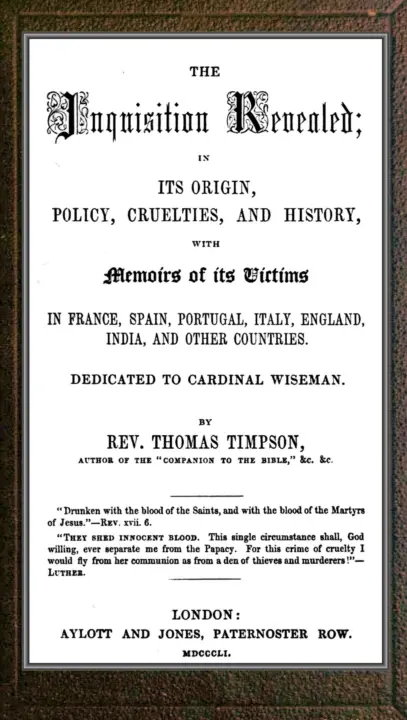
"The Inquisition Revealed" by Rev. Thomas Timpson is a historical account written in the mid-19th century. This work delves into the various aspects of the Inquisition, including its origins, policies, cruelties, and history, while also providing memoirs of its numerous victims across different countries. The narrative likely emphasizes the gruesome nature of the Inquisition as it pertains to religious persecution, particularly against those deemed heretics. At the start of the book, the author introduces the concept of the Inquisition as a cruel and oppressive force masquerading as a protector of Christianity. Timpson argues that the institution has historically been responsible for significant brutality, using religious rhetoric to justify its actions. The opening chapters outline how the Inquisition arose from a broader spirit of intolerance within the church and begins to detail its perpetrations against dissenters, with specific examples of victims and outright brutality. The author sets a foundational critique of the Roman Catholic Church's authority, suggesting that its hierarchical structure leads to moral degradation and persecution, laying the groundwork for the subsequent exploration of the Inquisition's history and its victims.
Introduction adapted from the source catalogue; source summaries may be automatically generated.
Free to read · English · 97,157 words · No account needed
MAKE TIME FOR A GOOD BOOK
On by default. Untick to stop anonymous reading totals. Each page counts after 10 seconds in view. How this works.
Anonymous counting is on unless you have switched it off.
From the enormous hypocrisy and unparalleled cruelty that we have seen recorded of the inquisitors, every one will be prepared to believe that they must have been guilty of the most atrocious personal immoralities. Many of them were priests; and the celibacy of the clergy, as enjoined by the Romish religion, was the occasion of the most shocking violations of the laws of God. These crimes are testified by papal historians of the highest character, and proved by laws of the popes made against them; but the records of the lives of the priests exhibit the most disgusting and dreadful crimes.
Elevation in office generally rendered the inquisitors above all law; and the peculiarity of their stations shielded them from accusation, rendering it dangerous in the extreme for any one to breathe a whisper against them. They, therefore, commonly rolled in luxury, and indulged in licentiousness that would appear incredible, were it not for their other enormities and abominations recorded on the faithful pages of history.
The translator of Limborch’s history remarks, therefore:--“The licentious character so largely applied to the Romish clergy has not been wanting in those deputed to the office of inquisitors. Whilst by the very constitution of their authority they are placed in a great degree above the laws, they possess, in addition to their ecclesiastical revenues, opportunities of amassing enormous wealth from the wreck of those whom they condemn; and, besides, such unbounded power as to command any object of desire, or to gratify any purpose of revenge. With such temptations, therefore, it is no wonder if the inquisitor should become voluptuous, and that, possessing the authority, he should assume the vices of the oriental monarchs.” M. Lavallée, in his “Histoire des Inquisitions Religieuses,” relates the following circumstance:--
“A gentleman, who was then (1809) residing at Paris, having business in Lisbon some years before the French revolution, and being about to go thither, took with him, from a nobleman at Versailles, a letter to the chief-inquisitor at Madrid, through which he passed. On his arrival in that city, being fatigued, and at the same time unwilling to impede his journey, he fulfilled the ceremony of delivering the letter to the inquisitor by the hands of his servant, excusing himself, on those grounds, from doing himself the honour of a personal attendance. The grand-inquisitor, however, came himself to his hotel, and, with great politeness, prevailed on him to spend the evening at his residence. The gentleman repaired to his apartment, and was lost in astonishment at the splendour of the saloons, furniture, and attendants. After some noblemen who were present had withdrawn, the inquisitor offered his guest a sight of his bed-chamber; this surpassed anything that he had ever seen for sumptuous elegance. The walls were hung with most exquisite paintings, from the heathen mythology; the floor of the finest marble, and so constructed as to admit the growth of orange trees, and a crystal stream, which, imparting a delicious coolness, rolled off through basons of porphyry, in subterranean channels, whilst the bed was adorned with such tasteful drapery as to give to the whole the air of royalty. As soon as the visitor had inspected with admiration the various embellishments of this splendid retreat, which he was the more surprised to find where he had rather expected to have seen the rigid tokens of inquisitorial devotion, he prepared to withdraw. But the inquisitor prevented him, expressing surprise that he should so soon appear fatigued; then making a signal, a Dominican appeared (his confidential minister), who conducted the traveller into a splendid saloon, lighted by a profusion of wax candles; here a magnificent supper was prepared, to which sat down the grand-inquisitor, his visitor, six ladies of great beauty and accomplishments, and some monks, who were peculiar favourites. The evening was spent with the greatest gaiety, whilst music, poetry, singing, and agreeable conversation protracted the stay of the company until sunrise. At length the traveller took his leave, greatly pleased with the courtesy of his highness, and admiring the method of relaxation he had chosen, after the studies and fatigue devolving on him from the Holy Office!”
Your reading position is saved on this browser. Take it to another device with a library code. Reading pages adapt to text, rather than matching a printed edition.
BEHIND THE BOOK
This eBook is for the use of anyone anywhere in the United States and most other parts of the world at no cost and with almost no restrictions whatsoever. You may copy it, give it away or re-use it under the terms of the Project Gutenberg License included with this eBook or online at www.gutenberg.org. If you are not located in the United States, you will have to check the laws of the country where you are located before using this eBook. Read the source licence.
The original source file, including credits and licence, is retained by this library. Request an original-format copy at no charge. Please include the book title and Project Gutenberg identifier #71850.
KEEP YOUR CURIOSITY GOING
Cécile Tormay

Moritz Busch
John L. Ransom
Frances Wright
Cécile Tormay

Mabel Potter Daggett