THE CLASSIC COLLECTION✦An outlaw’s diary: the CommuneCLASSIC FREE BOOKS
An outlaw’s diary: the Commune
Cécile Tormay
THE CLASSIC COLLECTION · 1851
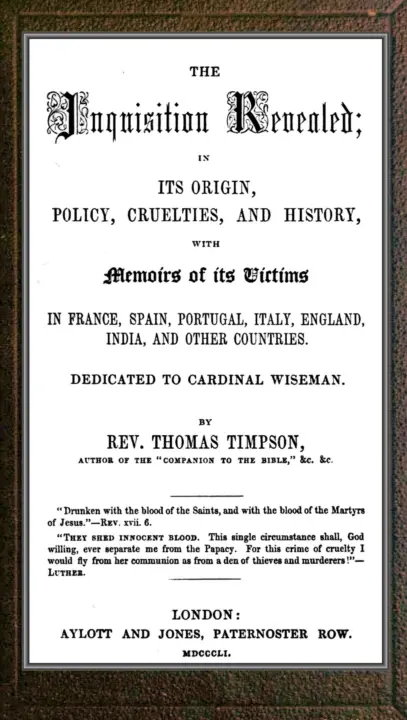
"The Inquisition Revealed" by Rev. Thomas Timpson is a historical account written in the mid-19th century. This work delves into the various aspects of the Inquisition, including its origins, policies, cruelties, and history, while also providing memoirs of its numerous victims across different countries. The narrative likely emphasizes the gruesome nature of the Inquisition as it pertains to religious persecution, particularly against those deemed heretics. At the start of the book, the author introduces the concept of the Inquisition as a cruel and oppressive force masquerading as a protector of Christianity. Timpson argues that the institution has historically been responsible for significant brutality, using religious rhetoric to justify its actions. The opening chapters outline how the Inquisition arose from a broader spirit of intolerance within the church and begins to detail its perpetrations against dissenters, with specific examples of victims and outright brutality. The author sets a foundational critique of the Roman Catholic Church's authority, suggesting that its hierarchical structure leads to moral degradation and persecution, laying the groundwork for the subsequent exploration of the Inquisition's history and its victims.
Introduction adapted from the source catalogue; source summaries may be automatically generated.
Free to read · English · 97,157 words · No account needed
MAKE TIME FOR A GOOD BOOK
On by default. Untick to stop anonymous reading totals. Each page counts after 10 seconds in view. How this works.
Anonymous counting is on unless you have switched it off.
“This morning, the 28th, after breakfast, my host went to dress for the Holy Office, and soon returned in his inquisitorial robes. He said he would go half an hour before the usual time, for the purpose of showing me the Inquisition. I fancied that his countenance was more severe than usual; and that his attendants were not so civil as before. The truth was, the midnight scene was still on my mind. The Inquisition is about a quarter of a mile distant from the convent, and on our arrival at the place the inquisitor said to me, as we were ascending the steps of the outer stair, that he hoped I should be satisfied with a transient view of the Inquisition, and that I would retire whenever he should desire it. I took this as a good omen, and followed my conductor with tolerable confidence.
“He led me first to the great hall of the Inquisition. We were met at the door by a number of well-dressed persons, who, I afterwards understood, were the familiars and attendants of the Holy Office. They bowed very low to the inquisitor, and looked with surprise at me. The great hall is the place in which the prisoners are marshalled for the procession of the auto da fé. At the procession described by Dellon, in which he himself walked bare-foot, clothed with the painted garment, there were upwards of one hundred and fifty prisoners. I traversed this hall for some time with a slow step, reflecting on its former scenes; the inquisitor walked by my side in silence. I thought of the fate of the multitude of my fellow-creatures who had passed through this place, condemned by a tribunal of their fellow-sinners--their bodies devoted to the flames, and their souls to perdition; and I could not help saying to him, ‘Would not the holy church wish, in her mercy, to have those souls back again, that she might allow them a little further probation?’ The inquisitor answered nothing, but beckoned me to go with him to a door at one end of the hall. By this door he conducted me to some small rooms, and thence to the spacious apartments of the chief-inquisitor. Having surveyed these, he brought me back again to the great hall, and I thought he seemed now desirous that I should depart. ‘Now, father,’ said I, ‘lead me to the dungeons below; I want to see the captives.’ ‘No,’ said he, ‘that cannot be.’ I now began to suspect that it had been in the mind of the inquisitor, from the beginning, to show me only a certain part of the Inquisition, in the hope of satisfying my inquiries in a general way. I urged him with earnestness, but he steadily resisted, and seemed to be offended, or rather agitated, by my importunity. I intimated to him plainly, that the only way to do justice to his own assertions and arguments, regarding the present state of the Inquisition, was to show me the prisons and the captives. I should then describe only what I saw; but now the subject was left in awful obscurity. ‘Lead me down,’ said I, ‘to the inner building, and let me pass through the two hundred dungeons, ten feet square, described by your former captives. Let me count the number of your present captives, and converse with them. I want to see if there be any subjects of the British government to whom we owe protection. I want to ask how long they have been here--how long it is since they beheld the light of the sun, and whether they ever expect to see it again. Show me the chamber of torture; and declare what modes of execution or of punishment are now practised within the walls of the Inquisition, in lieu of the public auto da fé. If, after all that has passed, father, you resist this reasonable request, I shall be justified in believing that you are afraid of exposing the real state of the Inquisition in India’. To these observations the inquisitor made no reply, but seemed impatient that I should withdraw. ‘My good father,’ said I, ‘I am about to take my leave of you, and to thank you for your hospitable attentions, (it had been before understood that I should take my final leave at the door of the Inquisition,) and I wish always to preserve on my mind a favourable sentiment of your kindness and candour. You cannot, you say, show me the captives and the dungeons; be pleased, then, merely to answer this question, for I shall believe your word:--‘How many prisoners are there now below, in the cells of the Inquisition?’ The inquisitor replied, ‘That is a question which I cannot answer.’
Your reading position is saved on this browser. Take it to another device with a library code. Reading pages adapt to text, rather than matching a printed edition.
BEHIND THE BOOK
This eBook is for the use of anyone anywhere in the United States and most other parts of the world at no cost and with almost no restrictions whatsoever. You may copy it, give it away or re-use it under the terms of the Project Gutenberg License included with this eBook or online at www.gutenberg.org. If you are not located in the United States, you will have to check the laws of the country where you are located before using this eBook. Read the source licence.
The original source file, including credits and licence, is retained by this library. Request an original-format copy at no charge. Please include the book title and Project Gutenberg identifier #71850.
KEEP YOUR CURIOSITY GOING
Cécile Tormay

Moritz Busch
John L. Ransom
Frances Wright
Cécile Tormay

Mabel Potter Daggett