THE CLASSIC COLLECTION✦An outlaw’s diary: the CommuneCLASSIC FREE BOOKS
An outlaw’s diary: the Commune
Cécile Tormay
THE CLASSIC COLLECTION · 1851
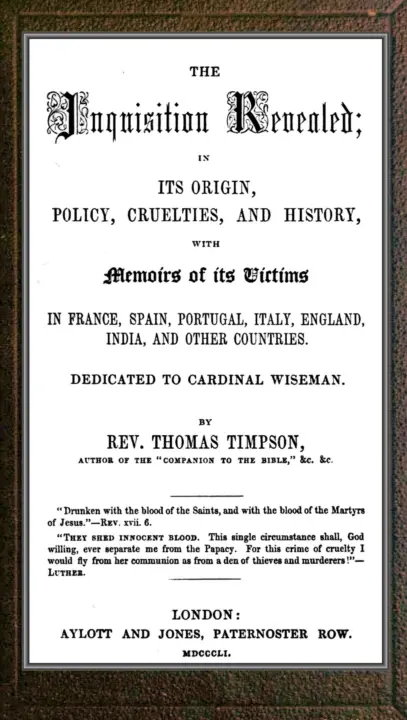
"The Inquisition Revealed" by Rev. Thomas Timpson is a historical account written in the mid-19th century. This work delves into the various aspects of the Inquisition, including its origins, policies, cruelties, and history, while also providing memoirs of its numerous victims across different countries. The narrative likely emphasizes the gruesome nature of the Inquisition as it pertains to religious persecution, particularly against those deemed heretics. At the start of the book, the author introduces the concept of the Inquisition as a cruel and oppressive force masquerading as a protector of Christianity. Timpson argues that the institution has historically been responsible for significant brutality, using religious rhetoric to justify its actions. The opening chapters outline how the Inquisition arose from a broader spirit of intolerance within the church and begins to detail its perpetrations against dissenters, with specific examples of victims and outright brutality. The author sets a foundational critique of the Roman Catholic Church's authority, suggesting that its hierarchical structure leads to moral degradation and persecution, laying the groundwork for the subsequent exploration of the Inquisition's history and its victims.
Introduction adapted from the source catalogue; source summaries may be automatically generated.
Free to read · English · 97,157 words · No account needed
MAKE TIME FOR A GOOD BOOK
On by default. Untick to stop anonymous reading totals. Each page counts after 10 seconds in view. How this works.
Anonymous counting is on unless you have switched it off.
Mass being finished, the grand-inquisitor, clothed in his pontifical vestments, pronounced a solemn absolution on all those who would repent; and then, the king being withdrawn, the criminals who had been condemned to be burnt, were delivered over to the civil power, and, being mounted upon asses, were carried in this manner through the gate called Foncural. About three hundred paces from it they were chained to stakes, and executed a little after midnight. Those who persisted in their errors were burnt alive; but such as repented, were first strangled before the fire was lighted. Those condemned to lesser punishments were remanded to prison, and the inquisitors returned home to their palace!
To us, in our enlightened times, it must appear very astonishing, that proceedings so inhuman and shocking could be witnessed and sanctioned by a great monarch and his mighty nobles. Yet these outrages continued, but not without complaints against the Inquisition from some of the nobility and statesmen, so that no less than 9,216 victims of that court are reckoned in the reign of Charles II., from A.D. 1666 to A.D. 1700: of these, 1,728 were burnt to death; 576 were burnt in effigy; and 6,912 were subjected to severe penances, in Spain.
Dr. Michael Geddes, an eminent English divine, and chaplain to the factory at Lisbon for several years, until he was apprehended by the Inquisition in 1686, when he was interdicted from officiating in his ministerial capacity, and returned to England, witnessed an auto da fé, in 1682, and he describes it as follows:--
“In the morning of the day, the prisoners are all brought into a great hall, where they have the habits put on they are to wear in the procession, which begins to come out of the Inquisition about nine of the clock in the morning. The first in the procession are the Dominican friars, who carry the standard of the Inquisition, which on the one side hath their founder Dominic’s picture, and on the other side, a cross between an olive leaf and a sword, with this motto, Justitia et Misericordia. Next after the Dominicans come the penitents, some with benitos, some without, according to the nature of their crimes; they are all in black coats without sleeves, and bare-footed, with a wax candle in their hand. Next come the penitents who have narrowly escaped being burnt, who, over their black coat, have flames painted, with their points turned downwards, to signify their having been saved, but so as by fire: this habit is called by the Portuguese fuego revolto, or flames turned upside down. Next come the negative and relapsed, that are to be burnt, with flames upon their habit, pointing upward; and next come those who profess doctrines contrary to the faith of the Roman church, and who, besides flames on their habit, pointing upward, have their picture, which is drawn two or three days before, upon their breasts, with dogs, serpents, and devils, all with open mouths, painted upon it. Pequa, a famous Spanish inquisitor, calls this procession, Horrendum ac tremendum spectaculem; and so it is in truth, there being some things in the looks of all the prisoners, besides those that are to be burnt, that is ghastly and disconsolate, beyond what can be imagined; and in the eyes and countenance of those that are to be burnt, there is something that looks fierce and eager.
Your reading position is saved on this browser. Take it to another device with a library code. Reading pages adapt to text, rather than matching a printed edition.
BEHIND THE BOOK
This eBook is for the use of anyone anywhere in the United States and most other parts of the world at no cost and with almost no restrictions whatsoever. You may copy it, give it away or re-use it under the terms of the Project Gutenberg License included with this eBook or online at www.gutenberg.org. If you are not located in the United States, you will have to check the laws of the country where you are located before using this eBook. Read the source licence.
The original source file, including credits and licence, is retained by this library. Request an original-format copy at no charge. Please include the book title and Project Gutenberg identifier #71850.
KEEP YOUR CURIOSITY GOING
Cécile Tormay

Moritz Busch
John L. Ransom
Frances Wright
Cécile Tormay

Mabel Potter Daggett