THE CLASSIC COLLECTION✦An outlaw’s diary: the CommuneCLASSIC FREE BOOKS
An outlaw’s diary: the Commune
Cécile Tormay
THE CLASSIC COLLECTION · 1851
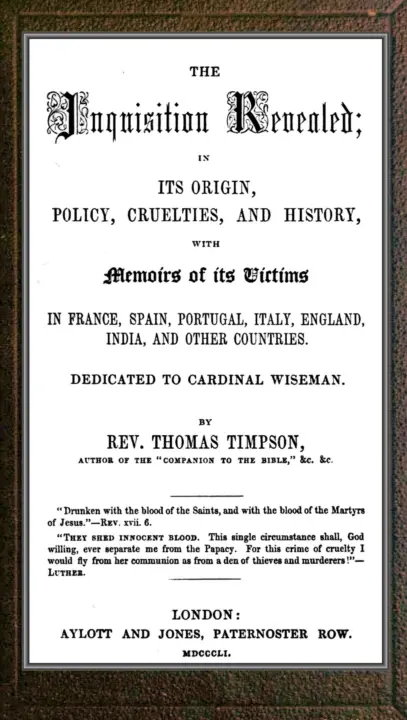
"The Inquisition Revealed" by Rev. Thomas Timpson is a historical account written in the mid-19th century. This work delves into the various aspects of the Inquisition, including its origins, policies, cruelties, and history, while also providing memoirs of its numerous victims across different countries. The narrative likely emphasizes the gruesome nature of the Inquisition as it pertains to religious persecution, particularly against those deemed heretics. At the start of the book, the author introduces the concept of the Inquisition as a cruel and oppressive force masquerading as a protector of Christianity. Timpson argues that the institution has historically been responsible for significant brutality, using religious rhetoric to justify its actions. The opening chapters outline how the Inquisition arose from a broader spirit of intolerance within the church and begins to detail its perpetrations against dissenters, with specific examples of victims and outright brutality. The author sets a foundational critique of the Roman Catholic Church's authority, suggesting that its hierarchical structure leads to moral degradation and persecution, laying the groundwork for the subsequent exploration of the Inquisition's history and its victims.
Introduction adapted from the source catalogue; source summaries may be automatically generated.
Free to read · English · 97,157 words · No account needed
MAKE TIME FOR A GOOD BOOK
On by default. Untick to stop anonymous reading totals. Each page counts after 10 seconds in view. How this works.
Anonymous counting is on unless you have switched it off.
“At the stake, Don Juan Ponce de Leon, who had abjured the Lutheran doctrines, exhorted Donna Maria to follow his example. The weakness of this apostate for a moment overcame her, and she silenced him by language rather of contempt than of pity. Recollecting herself, however, she told him that the time for controversy was past, and that their wisest plan would be, to occupy the few minutes which remained to them, in meditating on the death of their Redeemer, in order to confirm that faith by which alone they could be justified. All that poor Juan Ponce de Leon gained by his apostacy was, that he was not burnt alive, but first strangled, and then burnt. On this occasion, the attendant priest, moved by the youth and talents of Donna Maria, offered her this milder death, if she would merely repeat the Creed. With this offer she readily complied; but having finished it, she began immediately to explain its articles, according to the sense of the reformers. This confession of faith was immediately interrupted. Donna Maria was strangled by the executioner, and her body was afterwards reduced to ashes!”
4. MELCHIOR HERNANDEZ.--This victim was a merchant of Toledo, whence he removed to settle, A.D. 1564, in Murcia, where he was arrested by the officers of the Inquisition, charged with Judaism. Witnesses, known to be his enemies, appeared against him, but their evidence was contradictory; yet he was detained in prison. Being dangerously ill, he demanded an audience of the inquisitors, to whom he said that he had been present at a meeting, a year before, where the subject of conversation was the law of Moses. Some days after, at his re-examination, he declared that what was said at the meeting was in jest, and he did not recollect the particulars of the conversation. Having said to the visitor of the tribunal that the things which he had declared, he had been induced to utter before his judges by the fear of death, he was put to the torture, to compel him to confess what he knew respecting certain persons; but he bore the cruel infliction without uttering a word. On the 18th of October, 1565, he was declared, as a Jewish heretic, to be guilty of concealment in his confession, and condemned to be burnt. His execution was fixed for the 9th of December; and on the 7th he was exhorted to a full confession. He replied, that he had confessed all he knew; and the next day, being desired to prepare for death, he declared that he had seen the persons whom he had mentioned, and some others at the meeting; that they conversed respecting the law of Moses, but that he regarded their communications as mere pastime. Between this and the commencement of the auto da fé, next day, he made several communications, in hope of escaping death, giving the names of various parties as his accomplices. This disclosure being unavailing to induce the inquisitor to suspend his execution, Melchior stated that he had really believed, for a year, what had been preached in the synagogue, though he had not confessed the fact, because he thought there was no proof of heresy in the depositions of the witnesses. His execution was suspended, and he was subjected to new examinations, at which he made extraordinary and contradictory statements, perplexing to his judges; three of whom voted for his punishment and two for his reconciliation. The council decreed that Melchior should be burnt on the 8th of June, 1567; and on each of the three preceding days he was called up, and exhorted to declare his accomplices. The habit of a prisoner to be burnt was put upon him, when he declared that he could name other accomplices, and an inquisitor went to receive his confession. He gave another synagogue, and seven other places, with the names of fourteen persons who frequented them. This not being deemed satisfactory, he was led, with others, to the place of execution, where he mentioned two more houses, and twelve heretics; in a second audience, he gave seven more persons; and in a third audience, two more houses, and six persons. He was again remanded, as he hoped; but on the 23rd of June, despairing of success, he appealed to his judges, “What more could I do than accuse myself falsely? Know that I have never been summoned to any assembly; that I never attended any but for the purposes of commerce.” After many audiences, he was for the third time sentenced for execution, and he again succeeded in escaping the fire. In five subsequent audiences he denounced various persons; but he was declared “still guilty of concealment, in not mentioning several persons not less distinguished and well known than those already denounced, and that he could not be supposed to have forgotten them.”
Your reading position is saved on this browser. Take it to another device with a library code. Reading pages adapt to text, rather than matching a printed edition.
BEHIND THE BOOK
This eBook is for the use of anyone anywhere in the United States and most other parts of the world at no cost and with almost no restrictions whatsoever. You may copy it, give it away or re-use it under the terms of the Project Gutenberg License included with this eBook or online at www.gutenberg.org. If you are not located in the United States, you will have to check the laws of the country where you are located before using this eBook. Read the source licence.
The original source file, including credits and licence, is retained by this library. Request an original-format copy at no charge. Please include the book title and Project Gutenberg identifier #71850.
KEEP YOUR CURIOSITY GOING
Cécile Tormay

Moritz Busch
John L. Ransom
Frances Wright
Cécile Tormay

Mabel Potter Daggett