THE CLASSIC COLLECTION✦An outlaw’s diary: the CommuneCLASSIC FREE BOOKS
An outlaw’s diary: the Commune
Cécile Tormay
THE CLASSIC COLLECTION · 1851
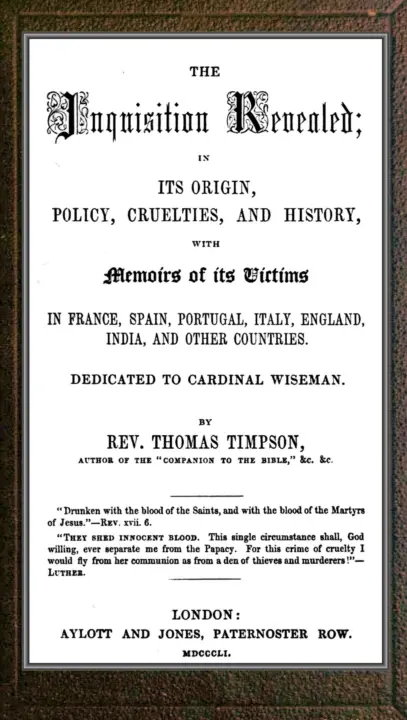
"The Inquisition Revealed" by Rev. Thomas Timpson is a historical account written in the mid-19th century. This work delves into the various aspects of the Inquisition, including its origins, policies, cruelties, and history, while also providing memoirs of its numerous victims across different countries. The narrative likely emphasizes the gruesome nature of the Inquisition as it pertains to religious persecution, particularly against those deemed heretics. At the start of the book, the author introduces the concept of the Inquisition as a cruel and oppressive force masquerading as a protector of Christianity. Timpson argues that the institution has historically been responsible for significant brutality, using religious rhetoric to justify its actions. The opening chapters outline how the Inquisition arose from a broader spirit of intolerance within the church and begins to detail its perpetrations against dissenters, with specific examples of victims and outright brutality. The author sets a foundational critique of the Roman Catholic Church's authority, suggesting that its hierarchical structure leads to moral degradation and persecution, laying the groundwork for the subsequent exploration of the Inquisition's history and its victims.
Introduction adapted from the source catalogue; source summaries may be automatically generated.
Free to read · English · 97,157 words · No account needed
MAKE TIME FOR A GOOD BOOK
On by default. Untick to stop anonymous reading totals. Each page counts after 10 seconds in view. How this works.
Anonymous counting is on unless you have switched it off.
Juan de Salas was condemned, notwithstanding his denial; and Llorente makes the following remarks on the whole case of shocking injustice and cruelty:--
“We may form an idea of the humanity of the Inquisition at Valladolid from the definitive sentence pronounced by the licentiate Moriz and his colleague, Dr. Alvarado, without any other formality, after they had taken (if we may believe them) the advice of persons noted for their learning and virtue, but without the adjournment which ought to have preceded it, and without the concurrence of the diocesan in ordinary. They declared that the fiscal had not entirely approved the accusation, and that the prisoner had succeeded in destroying some of the charges; but that, on account of the suspicion arising from the trial, Juan de Salas was condemned to the punishment of the public auto da fé, in his shirt, without a cloak, his head uncovered, and with a torch in his hand; that he should abjure heresy publicly; and that he should pay ten ducats of gold to the Inquisition, and fulfil his penance in the church assigned. It is seen, by a certificate afterwards given in, that Juan de Salas performed his auto da fé on the 24th of June, 1528, and that his father paid the fine. The trial offers no other peculiarity. This affair, and several others of a similar nature, caused the supreme council to publish a decree, in 1558, commanding that the torture should not be administered without an order from the council.”
2. DONNA JOHANNA BOHORQUES.--Limborch, from Gonsalvius, gives the following account of this noble young lady, who was really murdered by the inquisitors in their tortures of her, about A.D. 1569.
“At the same time almost, they apprehended, in the Inquisition at Seville, a noble lady, Johanna Bohorques, the wife of Don Francis de Vargos, a very eminent man, and Lord of Heguera, and daughter of Peter Garsia Xeresius, a wealthy citizen of Seville. The occasion of her imprisonment was, her sister, Maria Bohorques, a young lady of eminent piety, who was afterwards burnt for her pious confession, had declared, in her torture, that she had several times conversed with her sister concerning her doctrine. When she was first imprisoned she was about six months gone with child, upon which account she was not so straitly confined, nor used with that cruelty which the other prisoners were treated with, out of regard to the infant she carried. Eight days after her delivery they took the child from her, and on the fifteenth shut her up close, and made her undergo the fate of the other prisoners, and began to manage her cause with their usual arts and rigour. In so dreadful a calamity she had only this comfort, that a certain pious young woman, who was afterwards burnt for her religion by the inquisitors, was allowed her for her companion. This young creature was, on a certain day, carried out to her torture; and being returned from it into her gaol, she was so shaken, and had her limbs so miserably disjointed, that when she was laid upon her bed of rushes, it rather increased her misery than gave her rest, so that she could not turn herself without the most excessive pain. In this condition, as Bohorques had it not in her power to show her any, or but very little outward kindness, she endeavoured to comfort her mind with great tenderness. The girl had scarcely begun to recover from her torture, when Bohorques was carried out to the same exercise, and was tortured with such diabolical cruelty upon the rack, that the rope pierced and cut into the very bones in several places; and in this manner she was brought back to prison, just ready to expire, the blood running out of her mouth in great plenty. Undoubtedly they had burst her bowels, insomuch that the eighth day after her torture she died. And when, after all, they could not procure sufficient evidence to condemn her, though sought after and procured by all their inquisitorial arts--yet as the accused person was born in that place, where they were obliged to give some account of the affair to the people, and, indeed, could not, by any means, dissemble it--in the first act of triumph appointed after her death, they commanded her sentence to be pronounced in these words:--‘Because this lady died in prison (without doubt suppressing the cause of it), and was found to be innocent upon inspecting and diligently examining her cause, therefore the holy tribunal pronounces her free from all charges brought against her by the fiscal, and absolving her from any further process, doth restore her, both as to her innocence and reputation, and commands all her effects, which had been confiscated, to be restored to those to whom they of right belonged.’ And thus, after they had murdered her, by torture, with savage cruelty, they pronounced her innocent!”
Your reading position is saved on this browser. Take it to another device with a library code. Reading pages adapt to text, rather than matching a printed edition.
BEHIND THE BOOK
This eBook is for the use of anyone anywhere in the United States and most other parts of the world at no cost and with almost no restrictions whatsoever. You may copy it, give it away or re-use it under the terms of the Project Gutenberg License included with this eBook or online at www.gutenberg.org. If you are not located in the United States, you will have to check the laws of the country where you are located before using this eBook. Read the source licence.
The original source file, including credits and licence, is retained by this library. Request an original-format copy at no charge. Please include the book title and Project Gutenberg identifier #71850.
KEEP YOUR CURIOSITY GOING
Cécile Tormay

Moritz Busch
John L. Ransom
Frances Wright
Cécile Tormay

Mabel Potter Daggett