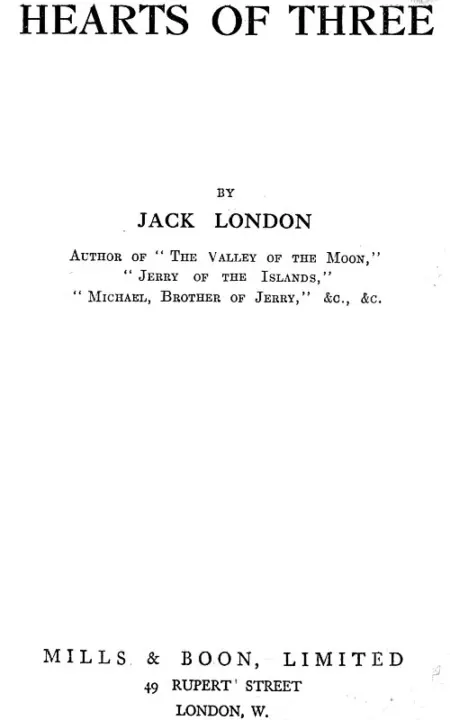
Hearts of three
Jack London
THE CLASSIC COLLECTION · 1917
"The Human Drift" by Jack London is a philosophical treatise that reflects on human migration and survival, likely written in the early 20th century. The work explores the historical patterns of human movement driven by the primal need for sustenance, touching on themes of civilization's rise and fall while critiquing the destructive nature of humanity. The opening of the book establishes a narrative framework that examines the instinctual drives behind human migration, comparing these movements to that of animals in search of food. London emphasizes that migration has been a defining characteristic of human evolution and societal development, resulting in the conquest and displacement of weaker groups. He outlines various historical migrations, illustrating that the quest for food and survival underlies much of humanity's violent history. The passage vividly portrays the struggle for existence and suggests that such patterns persist in modern society, hinting at the recurring cycles of population growth and societal conflict that define human history.
Introduction adapted from the source catalogue; source summaries may be automatically generated.
Free to read · English · 31,395 words · No account needed
MAKE TIME FOR A GOOD BOOK
On by default. Untick to stop anonymous reading totals. Each page counts after 10 seconds in view. How this works.
Anonymous counting is on unless you have switched it off.
LORETTA. [Brokenly.] I must think. I'll write to you. [Faintly.] The train? Your hat's in the hall.
BILLY. [Looks at watch, hastily tries to kiss her, succeeds only in shaking hand, starts across stage toward left.] All right. You write to me. Write to-morrow. [Stops for a moment in doorway and speaks very solemnly.] Remember, Loretta, there must be no scandal.
[Billy goes out.]
[LORETTA sits in chair quietly weeping. Slowly dries eyes, rises from chair, and stands, undecided as to what she will do next.]
[NED enters from right, peeping. Discovers that LORETTA is alone, and comes quietly across stage to her. When NED comes up to her she begins weeping again and tries to turn her head away. NED catches both her hands in his and compels her to look at him. She weeps harder.]
NED. [Putting one arm protectingly around her shoulder and drawing her toward him.] There, there, little one, don't cry.
LORETTA. [Turning her face to his shoulder like a tired child, sobbing.] Oh, Ned, if you only knew how wicked I am.
NED. [Smiling indulgently.] What is the matter, little one? Has your dearly beloved sister failed to write to you? [LORETTA shakes head.] Has Hemingway been bullying you? [LORETTA shakes head.] Then it must have been that caller of yours? [Long pause, during which LORETTA's weeping grows more violent.] Tell me what's the matter, and we'll see what I can do. [He lightly kisses her hair--so lightly that she does not know.]
LORETTA. [Sobbing.] I can't. You will despise me. Oh, Ned, I am so
ashamed.
NED. [Laughing incredulously.] Let us forget all about it. I want to tell you something that may make me very happy. My fondest hope is that it will make you happy, too. Loretta, I love you--
LORETTA. [Uttering a sharp cry of delight, then moaning.] Too late!
NED. [Surprised.] Too late?
LORETTA. [Still moaning.] Oh, why did I? [NED somewhat stiffens.] I was so young. I did not know the world then.
NED. What is it all about anyway?
LORETTA. Oh, I . . . he . . . Billy . . . I am a wicked woman, Ned. I know you will never speak to me again.
NED. This . . . er . . . this Billy--what has he been doing?
LORETTA. I . . . he . . . I didn't know. I was so young. I could not help it. Oh, I shall go mad, I shall go mad!
[NED's encircling arm goes limp. He gently disengages her and deposits
her in big chair.]
[LORETTA buries her face and sobs afresh.]
NED. [Twisting moustache fiercely, regarding her dubiously, hesitating a moment, then drawing up chair and sitting down.] I . . . I do not understand.
LORETTA. [Wailing.] I am so unhappy!
NED. [Inquisitorially.] Why unhappy?
Your reading position is saved on this browser. Take it to another device with a library code. Reading pages adapt to text, rather than matching a printed edition.
Jack London
Jack London
Jack London
Jack London
BEHIND THE BOOK
This eBook is for the use of anyone anywhere in the United States and most other parts of the world at no cost and with almost no restrictions whatsoever. You may copy it, give it away or re-use it under the terms of the Project Gutenberg License included with this eBook or online at www.gutenberg.org. If you are not located in the United States, you will have to check the laws of the country where you are located before using this eBook. Read the source licence.
The original source file, including credits and licence, is retained by this library. Request an original-format copy at no charge. Please include the book title and Project Gutenberg identifier #1669.
KEEP YOUR CURIOSITY GOING

David Patterson (Spirit) Hatch

David Patterson (Spirit) Hatch

David Patterson (Spirit) Hatch
Cécile Tormay

Moritz Busch
Coulson Kernahan