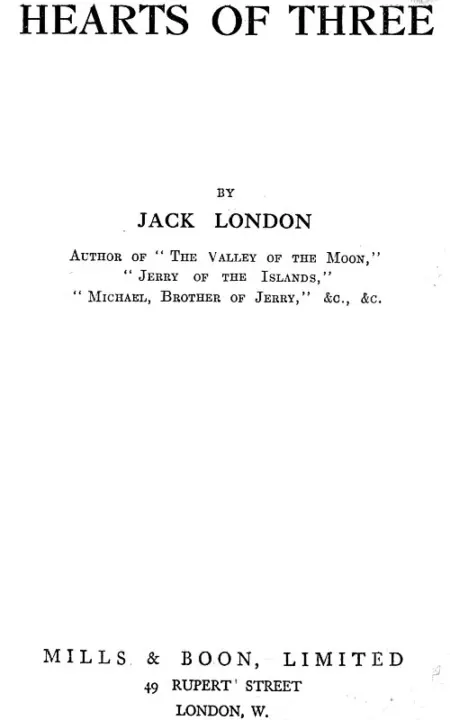
Hearts of three
Jack London
THE CLASSIC COLLECTION · 1917
"The Human Drift" by Jack London is a philosophical treatise that reflects on human migration and survival, likely written in the early 20th century. The work explores the historical patterns of human movement driven by the primal need for sustenance, touching on themes of civilization's rise and fall while critiquing the destructive nature of humanity. The opening of the book establishes a narrative framework that examines the instinctual drives behind human migration, comparing these movements to that of animals in search of food. London emphasizes that migration has been a defining characteristic of human evolution and societal development, resulting in the conquest and displacement of weaker groups. He outlines various historical migrations, illustrating that the quest for food and survival underlies much of humanity's violent history. The passage vividly portrays the struggle for existence and suggests that such patterns persist in modern society, hinting at the recurring cycles of population growth and societal conflict that define human history.
Introduction adapted from the source catalogue; source summaries may be automatically generated.
Free to read · English · 31,395 words · No account needed
MAKE TIME FOR A GOOD BOOK
On by default. Untick to stop anonymous reading totals. Each page counts after 10 seconds in view. How this works.
Anonymous counting is on unless you have switched it off.
BILLY. [Ignoring the appeal and pressing home the point.] The thing is, do you want to marry me? [He looks at his watch.] Just answer that.
LORETTA. Aren't you afraid you'll miss that train?
BILLY. Darn the train!
LORETTA. [Reprovingly.] Oh, Billy!
BILLY. [Most irascibly.] Darn isn't swearing. [Plaintively.] That's the way you always put me off. I didn't come all the way here for a train. I came for you. Now just answer me one thing. Do you want to marry me?
LORETTA. [Firmly.] No, I don't want to marry you.
BILLY. [With assurance.] But you've got to, just the same.
LORETTA. [With defiance.] Got to?
BILLY. [With unshaken assurance.] That's what I said--got to. And I'll
see that you do.
LORETTA. [Blazing with anger.] I am no longer a child. You can't bully
me, Billy Marsh!
BILLY. [Coolly.] I'm not trying to bully you. I'm trying to save your
reputation.
LORETTA. [Faintly.] Reputation?
BILLY. [Nodding.] Yes, reputation. [He pauses for a moment, then speaks very solemnly.] Loretta, when a woman kisses a man, she's got to marry him.
LORETTA. [Appalled, faintly.] Got to?
BILLY. [Dogmatically.] It is the custom.
LORETTA. [Brokenly.] And when . . . a . . . a woman kisses a man and doesn't . . . marry him . . . ?
BILLY. Then there is a scandal. That's where all the scandals you see
in the papers come from.
[BILLY looks at watch.]
[LORETTA in silent despair.]
LORETTA. [In abasement.] You are a good man, Billy. [Billy shows that he believes it.] And I am a very wicked woman.
BILLY. No, you're not, Loretta. You just didn't know.
LORETTA. [With a gleam of hope.] But you kissed me first.
BILLY. It doesn't matter. You let me kiss you.
LORETTA. [Hope dying down.] But not at first.
BILLY. But you did afterward and that's what counts. You let me you in the grape-arbour. You let me--
LORETTA. [With anguish] Don't! Don't!
BILLY. [Relentlessly.]--kiss you when you were playing the piano. You let me kiss you that day of the picnic. And I can't remember all the times you let me kiss you good night.
LORETTA. [Beginning to weep.] Not more than five.
BILLY. [With conviction.] Eight at least.
LORETTA. [Reproachfully, still weeping.] You told me it was all right.
BILLY. [Emphatically.] So it was all right--until you said you wouldn't marry me after all. Then it was a scandal--only no one knows it yet. If you marry me no one ever will know it. [Looks at watch.] I've got to go. [Stands up.] Where's my hat?
LORETTA. [Sobbing.] This is awful.
BILLY. [Approvingly.] You bet it's awful. And there's only one way out. [Looks anxiously about for hat.] What do you say?
Your reading position is saved on this browser. Take it to another device with a library code. Reading pages adapt to text, rather than matching a printed edition.
Jack London
Jack London
Jack London
Jack London
BEHIND THE BOOK
This eBook is for the use of anyone anywhere in the United States and most other parts of the world at no cost and with almost no restrictions whatsoever. You may copy it, give it away or re-use it under the terms of the Project Gutenberg License included with this eBook or online at www.gutenberg.org. If you are not located in the United States, you will have to check the laws of the country where you are located before using this eBook. Read the source licence.
The original source file, including credits and licence, is retained by this library. Request an original-format copy at no charge. Please include the book title and Project Gutenberg identifier #1669.
KEEP YOUR CURIOSITY GOING

David Patterson (Spirit) Hatch

David Patterson (Spirit) Hatch

David Patterson (Spirit) Hatch
Cécile Tormay

Moritz Busch
Coulson Kernahan